Physics engine / Instruments and loads
Instruments and loads
A pipette, a plate or a bead is not a boundary condition. It is glass with mass and stiffness, meshed into nodes, edges and faces, in the same water and under the same operator as the cell. Suction is a pressure region inside the Stokes box, and anything else the outside does to nodes sits in one world-level table of loads.
Checked against theory in a code testLaws
Micropipette as a Stokes problem
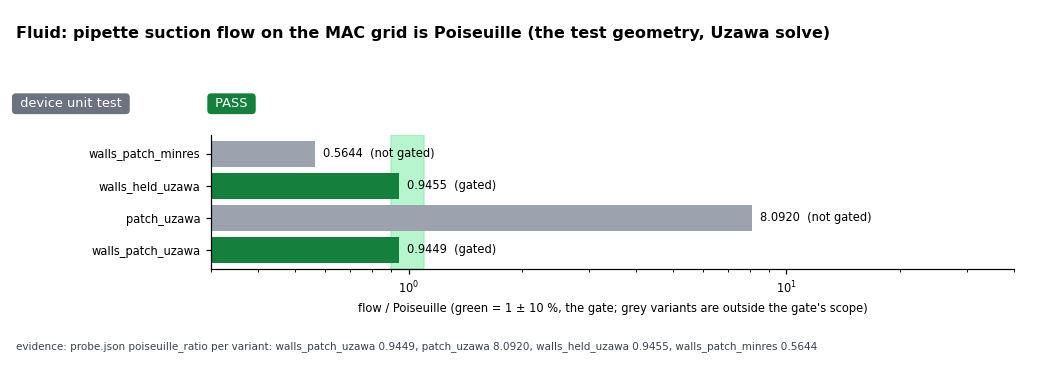
Checked against theory in a code testsuction is a pressure boundary, not a force
\[Q=\frac{\pi R^4\,\Delta p}{8\eta L}\]
- Built as
- A pressure patch on the grid at the pipette mouth.
- Inputs
- suction rows EXAMPLE
- Evidence
- Device probe 2026-09-25 (bdb14d334): flow / Poiseuille = 0.9449, inside ±10 %.
A development branch; not the cell's default fluid path.
Where it lives in the code
aleph/cell/build/instrument.pyaleph/physics/loads.pyaleph/physics/pressure_patch.pyaleph/physics/cut.py
Inputs
| Input | Value | Tag | Source |
|---|---|---|---|
instrument.bead.rigid | 0 1 | swept | W-FURIG 2026-10-15: requested AFM six-DOF constraint arm on the existing surface population |
instrument.tether_bead.rigid | 0 1 | swept | W-FURIG 2026-10-15: requested tether six-DOF constraint arm on the existing surface population |
instrument.glass.density | 2.2 pg/um^3 | example | borosilicate glass 2.2 g/cm^3 = 2.2 pg/um^3 |
instrument.glass.E | 64000000000.0 pN/um^2 | example | borosilicate Young's modulus ~64 GPa = 6.4e10 Pa = 6.4e10 pN/um^2 (1 Pa = 1 pN/um^2). CORRECTED 2026-09-21 18:24 on the PI's word: the row stored… more6.4e7 = 64 MPa, 1000x too soft against its own annotation (found by the Codex sourcing pass, SOURCING-2026-09-21 §4). Every device record through B1f / P1f ran the soft value; a towed body's drag does not read E, but the shell's stiffness-to-drag ratio, and so the solve's conditioning, is 1000x worse at the real value (a rigid body emerges from stiffness, not from immobility — directive 4) |
instrument.glass.poisson | 0.2 1 | example | borosilicate Poisson ratio ~0.2; enters the shell model mu_2d = E h / (2 (1 + nu)), D = E h^3 / (12 (1 - nu^2)) |
instrument.pipette.radius | 2.5 um | swept | R_p typically 1.5-4 um for a 15 um cell; Hochmuth 2000 J Biomech 33:15 (PMID 10609514) — R_p/R_c is the Laplace lever |
instrument.pipette.wall | 0.5 um | example | fire-polished pipette wall thickness; sets areal_density = density x wall |
instrument.pipette.length | 5.0 um | example | tube length inside the fluid box; the sink face ring sits at the far end. A STUB of about 2R (PI 2026-09-24 22:2x, #134 Q-P2;… moreDESIGN-2026-09-24-c5-pipette-suction §2): a sealed pipette carries no flow, so the pressure at its mouth does not depend on the bore's length, and while flow does pass the bore's Poiseuille resistance 8 eta L/(pi R^4) is 1-3 % of the plug's at L = 5-12 um; about 2R lets the flow at the mouth develop. The former 12 um grew the box to 816^3 cells at native (a cube) or 576 x 336 x 336 (fluid.box_per_axis = 1) |
instrument.pipette.mesh | 0.05 um | example | same 50 nm floor as the membrane mesh so the immersed boundary does not leak (directive 6) |
instrument.pipette.suction_rate | 100.0 pN/um^2/s | swept | 100 Pa/s ramp. Real MPA ramps are ~1-10 Pa/s over tens of seconds; the rate is a SWEPT protocol axis (PLAN §2 rule 2) |
instrument.pipette.suction_max | 500.0 pN/um^2 | example | 500 Pa ceiling; for T = 270 pN/um, R_p 2.5, R_c 7.5 the Laplace critical pressure is 2T(1/R_p-1/R_c) = 144 Pa |
instrument.pipette.seal | 0 1 | example | 0/1 switch, not a material value (PREREG-2026-09-25-c5-mpa-mini amendment 9; Lead Fable 00:1x). 1 puts the mouth ON the membrane: at the membrane's… morelargest x under the rim annulus [R_p, R_p + wall] plus the clearance membrane.half_thickness + 1.5 contact.d_hat (outside the barrier's activation range: a force-free start), leaving the cap's apex inside the bore by its sagitta; the build is refused if a membrane point comes within the contact half-thickness of a glass face (exact point-triangle distance) or a body node sits in the glass annulus past the mouth. 0 = the mouth instrument.gap clear of the body (today). |
instrument.pipette.holder_stiffness | 7100000.0 pN/um | example | the micromanipulator holding the glass: a zero-velocity well over every pipette node, this TOTAL spread as k/n (dev/experiments/qs_active_native; the… moreplate_base precedent, directive 4: a holder, not a frozen node). 10 x the floor dP_max*pi*R_p^2/(0.1*dx) = 500 Pa * pi * (1.5 um)^2 / 0.005 um = 7.1e5 pN/um, which keeps the glass within 0.1 dx at the peak aspiration force; a micromanipulator holds the glass effectively fixed. PI 2026-09-25 17:2x (via the Lead, ffn-cellsim-c7) |
instrument.pipette.rim_face | 0 1 | example | 0/1 switch, not a material value (PREREG-lite-2026-09-26-c5-press-v2 (3); PI 13:00). 1 adds the rim's annular face to the pipette's sheet: an outer… morering at R_p + wall in the mouth plane, triangulated to the mouth ring, so the barrier meets the rim as it meets the bore (membrane_vs_pipette, half-thickness 0; the fluid's walls unchanged); the outer ring's nodes follow the tube's rings, so pipette_far and the mouth ring keep their indices. 0 = today's one sheet at the bore (PRESS v1 found a membrane node in the annulus with no contact there) |
instrument.pipette.enabled | 0 1 | example | 0/1 — build the pipette population |
instrument.pipette.suction | 0.0 pN/um^2 | example | current sink-face pressure; the MPA protocol ramps it LIVE between steps (plan §6 f) |
instrument.plate.half_width | 10.0 um | example | tipless cantilever wedge wider than the cell (Stewart 2011 Nature 469:226, PMID 21196934) |
instrument.plate.thickness | 1.0 um | example | silicon nitride lever thickness; areal_density = 3.2 pg/um^3 x thickness |
instrument.plate.mesh | 0.05 um | example | as pipette.mesh |
instrument.plate.enabled | 0 1 | example | 0/1 — build the plate population |
instrument.plate.density | 3.2 pg/um^3 | example | silicon nitride 3.2 g/cm^3 — the number instrument.plate.thickness's source line already names |
instrument.cantilever.stiffness | 10000.0 pN/um | swept | 0.01 N/m = 1e4 pN/um; Fischer-Friedrich 2014 Sci Rep 4:6213 (PMID 25169063) used ~0.01-0.1 N/m levers. It is the harmonic well stiffness of the load… moretable (PLAN §4) |
instrument.cantilever.speed | 1.0 um/s | swept | piezo approach speed; 1 um/s is the common AFM compression rate — a SWEPT protocol axis |
instrument.cantilever.travel | 2.0 um | example | compression depth (plate) or indentation target (bead) before the hold phase |
instrument.cantilever.hold | 0.5 s | example | force-relaxation hold; the stage-0 tau observable is read here (PLAN §3) |
instrument.bead.radius | 2.5 um | swept | colloidal probe radius; Cartagena-Rivera 2016 Biophys J 110:2528 (PMID 27276270) — the shell model's lever is R_b/R_c |
instrument.bead.density | 2.0 pg/um^3 | example | silica 2.0 g/cm^3 |
instrument.bead.mesh | 0.05 um | example | as pipette.mesh |
instrument.bead.enabled | 0 1 | example | 0/1 — build the colloidal bead population |
instrument.ablation.length | 3.0 um | swept | cut length along the cortex; Mayer 2010 Nature 467:617 (PMID 20852613) cut ~ a few um |
instrument.ablation.width | 0.3 um | example | extent of the cut box ACROSS the cut line and the probe axis; the laser focal width. A relation is cut iff its segment intersects the box, so this is… morea region size, not an end test |
instrument.ablation.depth | 0.3 um | example | extent of the cut box along the probe axis (inward): how deep under the surface relations are released. Equal to the focal width here; a real… moretwo-photon focal volume is longer along the beam than across it, so this is an EXAMPLE for the PI to source or sweep |
instrument.ablation.settle | 0.5 s | example | time with the motor ON before the cut; recoil is read from the cut onward |
instrument.trap.stiffness | 100.0 pN/um | swept | optical trap 0.02-0.5 pN/nm = 20-500 pN/um; Diz-Munoz 2010 PLoS Biol 8:e1000544 (PMID 21151339) |
instrument.trap.speed | 1.0 um/s | swept | pull speed; tether force has a viscous (speed-dependent) part the closed form ignores — a SWEPT protocol axis |
instrument.trap.travel | 3.0 um | example | tether length at which the steady force is read |
instrument.trap.approach | 0.6 um | example | how far the trap anchor carries the bead TOWARD the cell before the wait. Must exceed instrument.gap (0.5 um) so the coat comes within… moretether_adhesion.reach; the excess (0.1 um) is the indentation that presses the two surfaces together, as the real experiment does |
instrument.trap.adhesion_wait | 0.5 s | swept | bead held stationary against the membrane while the adhesion patch fills. ~5 tau at k_on 10/s, k_off0 0.01/s (tau ~ 0.1 s). SWEPT because the patch… moresize at the start of the pull is what sets whether the bead peels or the membrane does |
instrument.trap.hold | 0.5 s | example | trap anchor stationary at full extension; the steady tether force f_t is read HERE, not during the pull, so the viscous (speed-dependent) part is not… morein the number the closed form 2 pi sqrt(2 kappa sigma_app) is applied to |
instrument.trap.release | 0.5 s | example | well_k -> 0. The retraction after release separates a real tube (retracts on the membrane's own tension) from a stretched patch of mesh (recoils… moreelastically) — the control the mesh-capability note DESIGN-2026-09-20-tether-mesh-capability asks for |
instrument.tether_bead.radius | 1.0 um | example | 2 um polystyrene bead |
instrument.tether_bead.density | 1.05 pg/um^3 | example | polystyrene 1.05 g/cm^3 |
instrument.tether_bead.enabled | 0 1 | example | 0/1 — build the tether bead population and its adhesion bond kind |
instrument.flicker.window | 0.5 s | example | record window for P(q); needs frames every step-cadence small enough for the q-range (observe/fluctuation.py) |
instrument.gap | 0.5 um | example | clearance between the cell radius and the instrument's nearest face at build; must stay below cantilever.travel and trap.travel |
instrument.face.enabled | 0 1 | example | 0/1 — PI 2026-09-21 17:49 ('누르는 면 한개로도 충분'): 1 builds each PRESSING instrument (plate, plate_base, bead) as ONE node carrying its whole mass plus a… moreone-sided face relation (physics.loads set_face), instead of a glass-shell node population. No squeeze film and no piston: the face has no fluid coupling beyond the carrier's drag |
instrument.face.stiffness | 1000.0 pN/um | example | penalty stiffness per pressed node of the pressing face — a numerical input, not a material: the face is rigid up to q = f/k per node. Sweep it and… moreshow the read force does not move |
instrument.alone | 0 1 | example | 0/1 — build ONLY the enabled instruments, no cell: the empty-instrument calibration run (beam, Stokes drag, Poiseuille, trap lag) |
instrument.probe_contact.enabled | 0 1 | example | switch, not a value: 1 = a mesh probe (bead, tether bead; instrument.face.enabled = 0) meets the membrane through its own scopes membrane_vs_<probe>… more/ <probe>_vs_membrane (cell/contact_core.BARRIER_SCOPES, DESIGN-2026-09-26-probe-as-mesh-body); record 402 ran with 1. 0 = the probes stay EXEMPT (bonds and fluid only) |
Experiments
None yet.