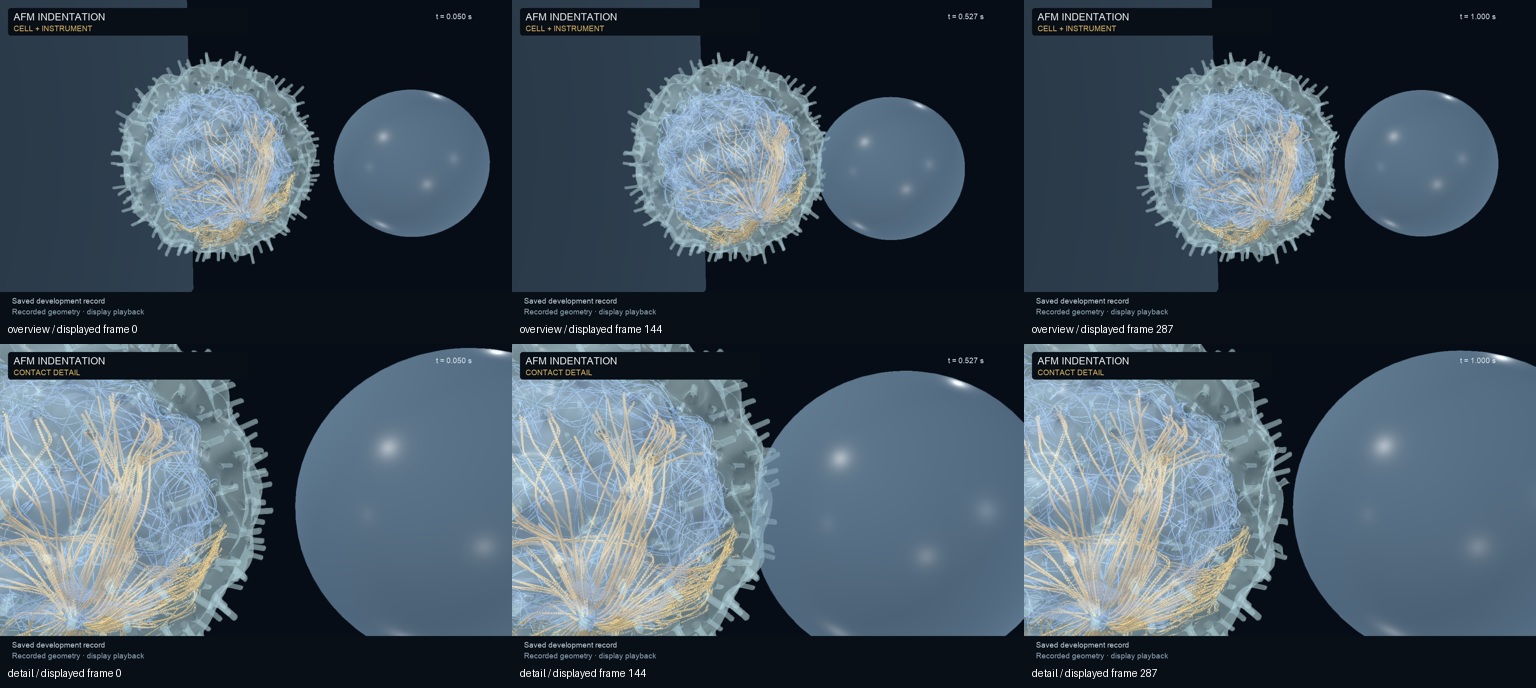
The spherical probe presses into the membrane. The close-up follows the same recorded contact.
Measurements, source and conditions
Maximum inward motion relative to bulk: patch median 0.2290 µm; local p05 0.4212 µm. These are different summaries, not whole-cell indentation.
AFM colour shows total distance from the first saved frame (step 5), including translation. The scale stays at 0–0.6 µm. It is not force, stress or strain.
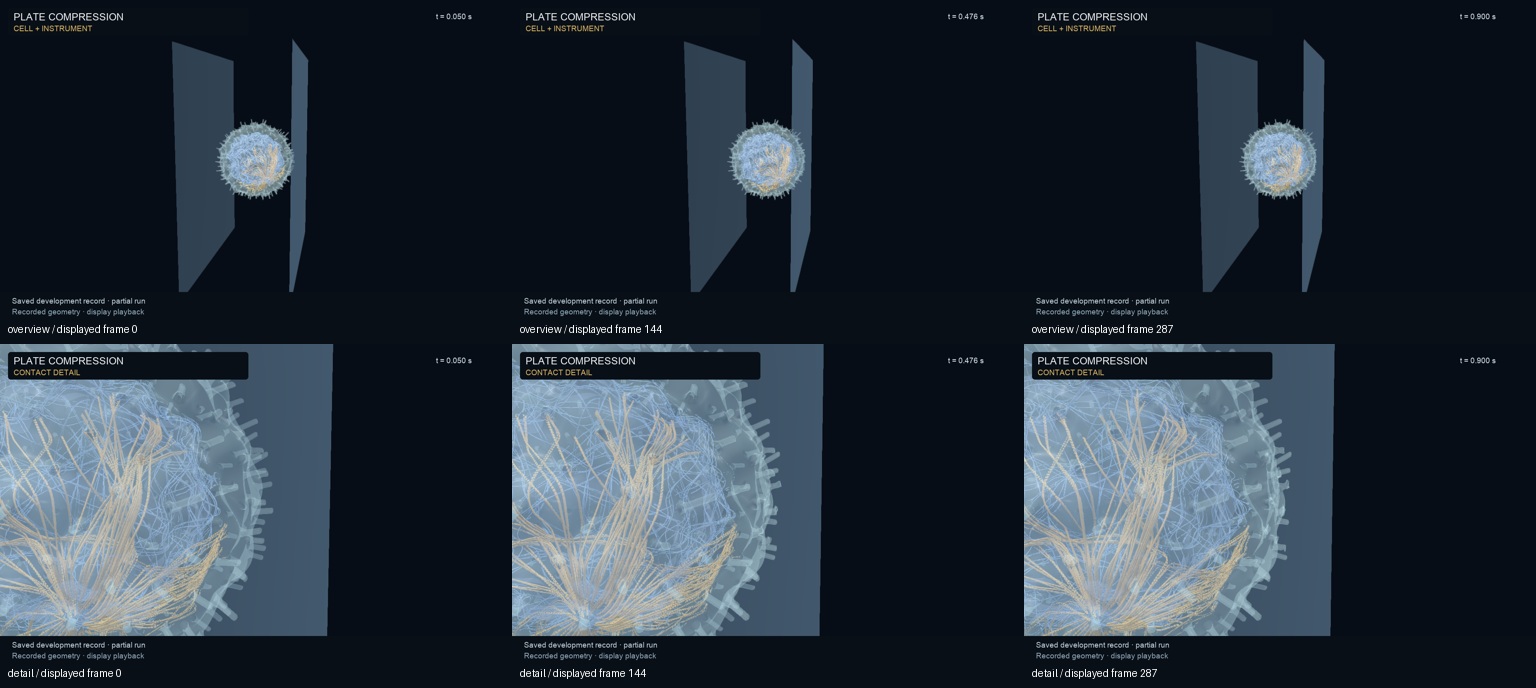
Two plates apply distributed loading. The whole view establishes their position before the contact close-up.
Measurements, source and conditions
Compression, hold and release were recorded; the final hold is incomplete. Maximum inward motion relative to bulk: patch median 0.0094 µm; local p05 0.2006 µm.
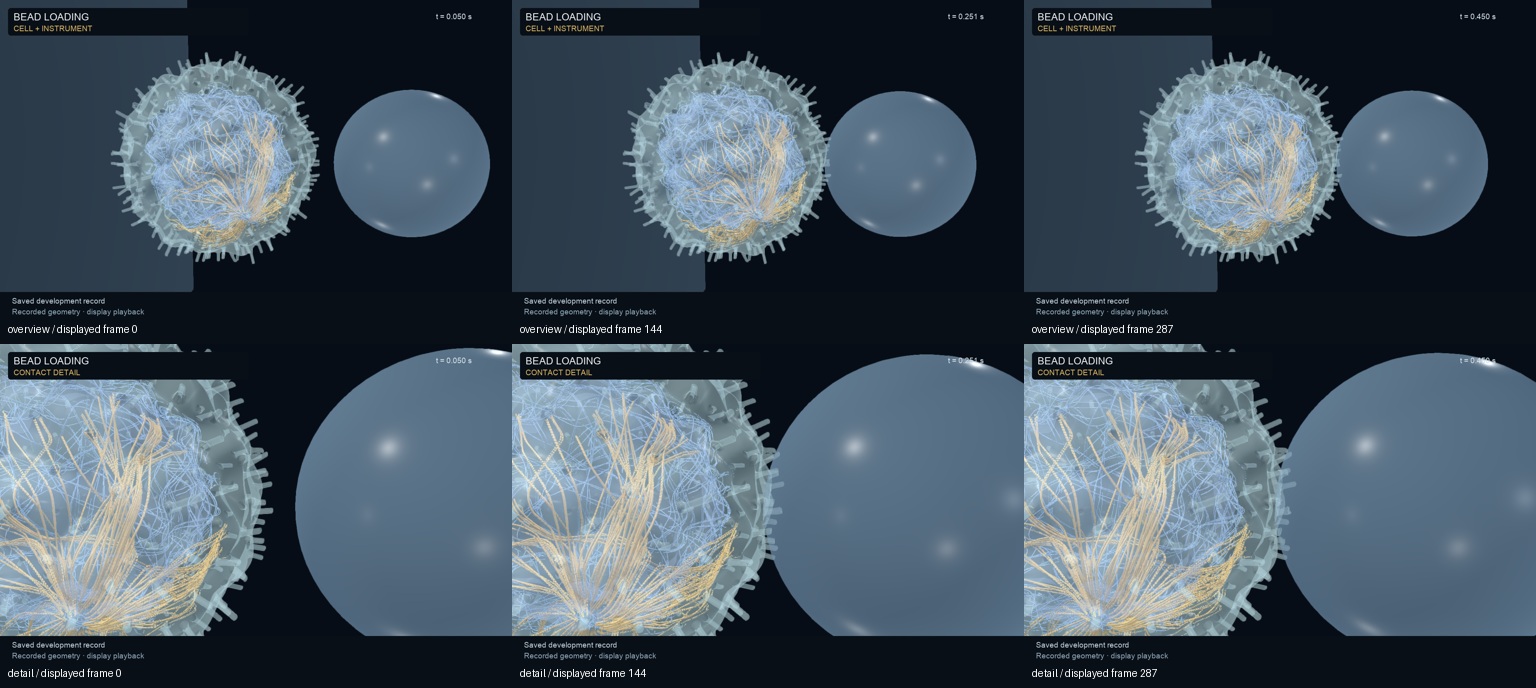
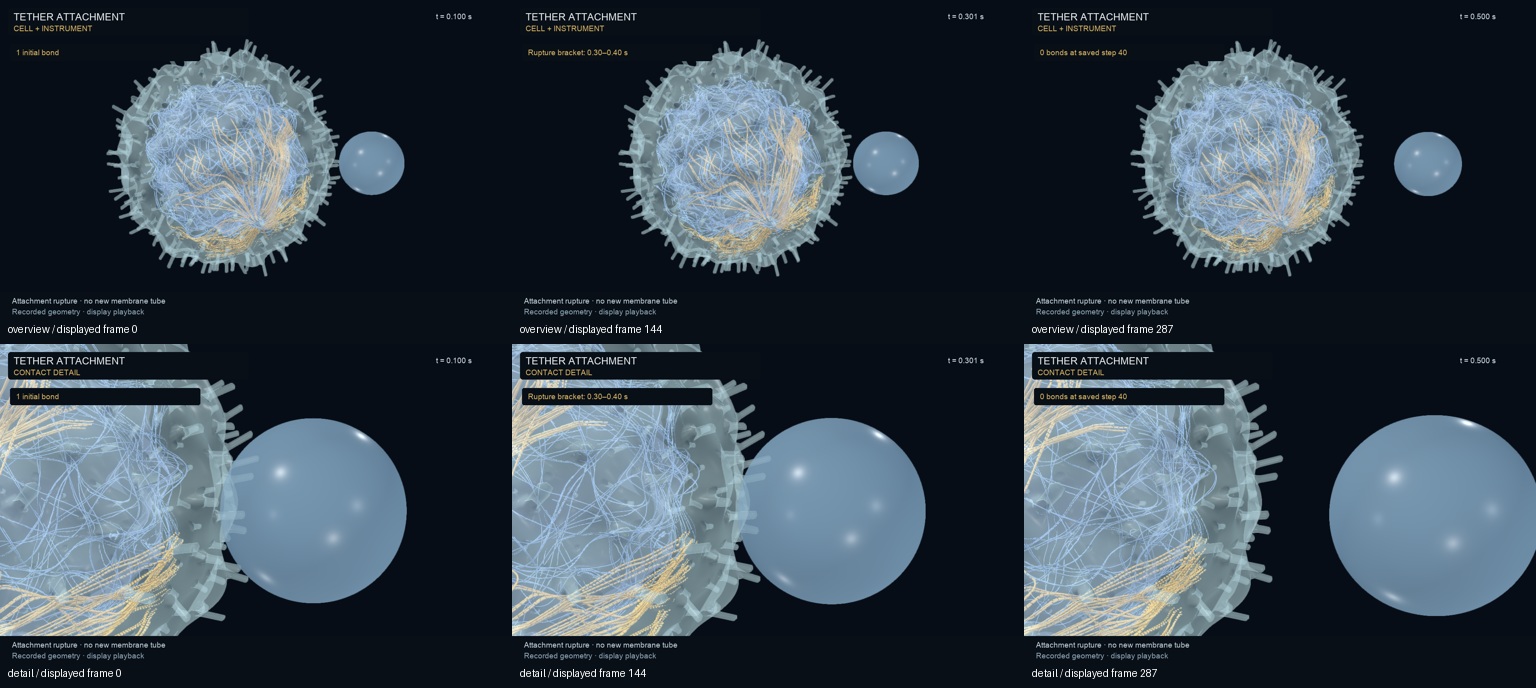
The bead starts with one declared bond. As it pulls away, the attachment breaks; no new membrane tube forms.
Measurements, source and conditions
One bond remains at saved step 30; none remain at steps 40 and 50. The exact rupture time lies between samples. Existing protrusions are not newly formed tethers.
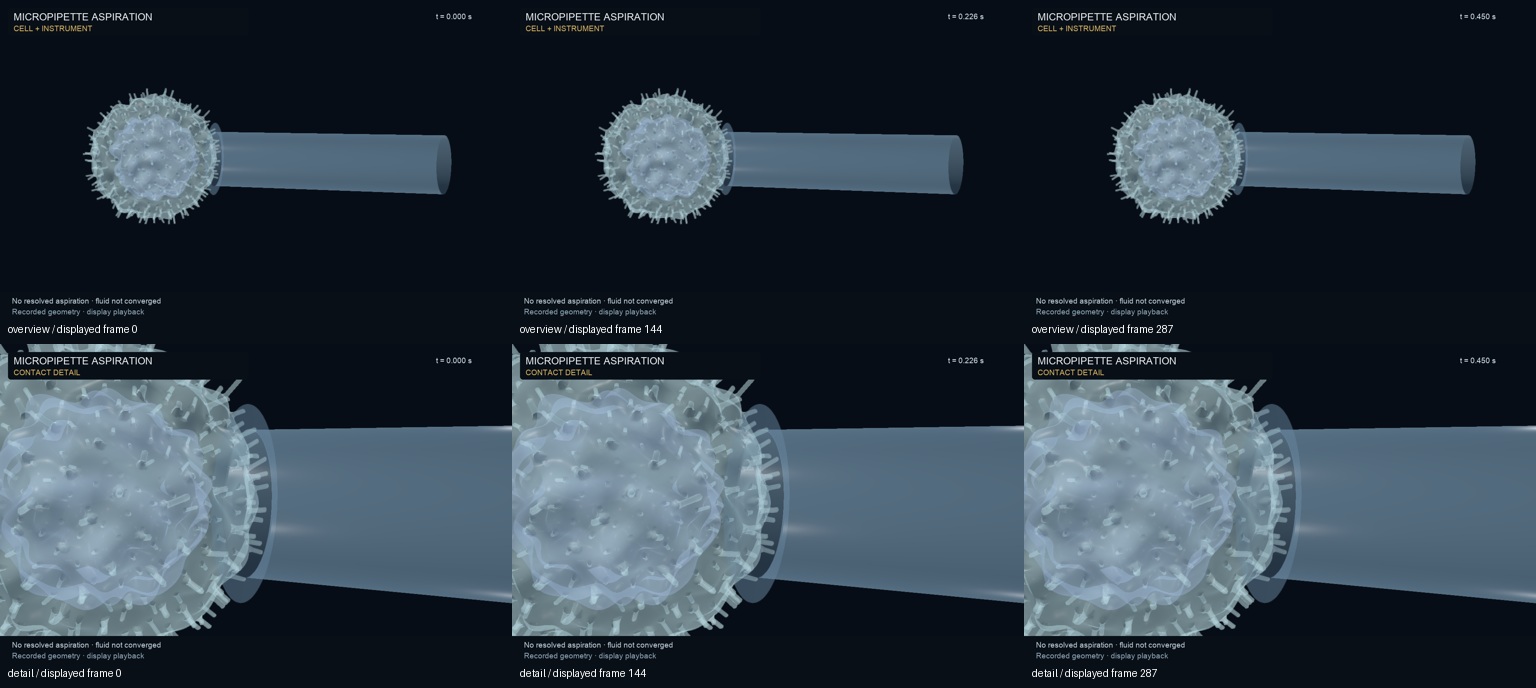
The pipette applies suction, but this record does not show the cell body being drawn into the tube.
Measurements, source and conditions
The run stopped at 45 of 60 steps and 450 Pa to preserve recording space. Maximum additional tip entry is 0.002991 µm; final entry is 0.000726 µm. The initial protrusion is excluded. Final free-fluid divergence RMS is about 11,536/s.
Watch the plate and probe move through their recorded protocols, then inspect the measured force.
Run conditions and comparison with earlier builds
The same virtual instruments, re-run on 2026-09-30 on the merged build de2d9af12 (branch lead/0930-t0show-merge: the integration build with UNIFY and the new Arp2/3 branch law, plus the four experiment lines), with no thermal kick (T = 0) and 3 Newton iterations per step, on the smaller test cell. Each card sets beside its reading the same number from the earlier build, labelled as such: the build, T and the solver budget all changed at once, so a difference is not yet explained by any one of them.
Build de2d9af12, branch lead/0930-t0show-merge. The records stamp no commit of their own; the commit is the one in each run directory's name, from the run queue's SHA-verified host tree, as each data pack says.
Every run: T = 0 (no thermal kick on the nodes; the kinetics' rate draws unchanged) and a cap of 3 Newton iterations a step; every other setting and every protocol step as in the original run's list. The arms and their stop rules were written down before the runs (PREREG-lite, 2026-09-30): a non-finite value, or one step taking more than 900 s, stops the run. A showcase: unscored, smaller test cell, no physics conclusion about the cell.
The plate, AFM and tether figures are drawn here from each record's data pack and nothing else; the pipette figures are the run's own readout and a view of its stored flow field. The 3-D close-ups play every saved step of the record. How far cell nodes sit inside a probe is measured here from the saved frames: the probe node's recorded position and its declared surface against every node.
Every input is a placeholder (EXAMPLE) value.
Parallel plates
30 September · preview
1 µm
Fixed camera; motion follows the saved positions, interpolated between recorded frames for display. Render source and settings.
The contact up close: membrane (faces), microvilli and the formin cortex within 1.6 µm, every saved step (one in five), positions interpolated between them for display; the plate drawn as its declared plane face at its node's recorded position. The plate is a penalty face (k 1000 pN/µm) on the membrane's nodes: membrane nodes sit up to 88 nm past it (step 15), and are drawn as they are.
What the instrument recorded
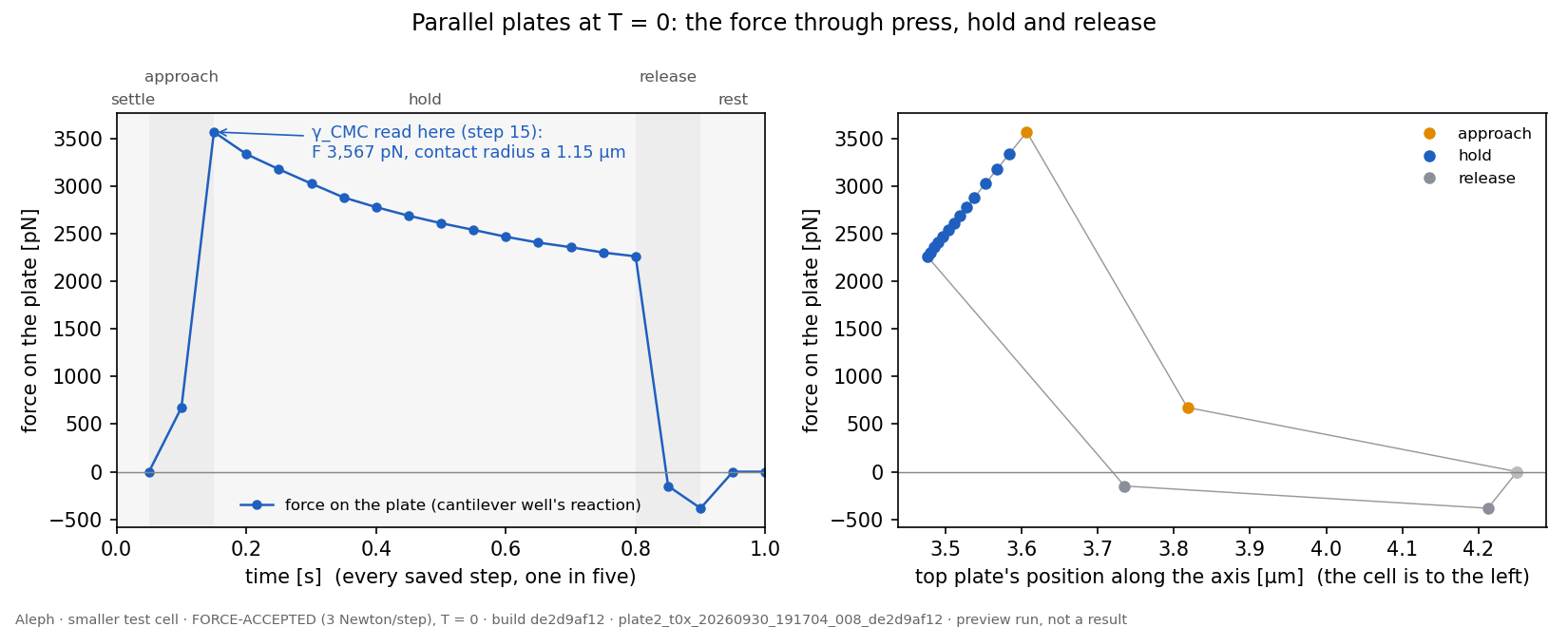
The plate was driven 1.0 µm in at 10 µm/s (steps 5–15), held (to step 80) and released (steps 80–90). The force on it peaked at 3,567 pN at the end of the approach and relaxed to 2,261 pN over the hold.
Apparent tension · 1,630 pN/µm
Inferred with the instrument’s formula. This is a model preview, not a physical result.
Interpretation, source and run conditions
The plate's formula (Laplace's law for a drop, in the form of Fischer-Friedrich et al. 2014) turns that force and the contact size (contact radius 1.15 µm, cell radius 4.12 µm) into an apparent tension of 1,630 pN/µm. The cortex's own forces read 41.8 pN/µm under load (step 25) and 12.7 pN/µm at step 100, after the release: a 39–128× gap.
The same virtual cell: the instrument's formula and the cortex disagree 39- to 128-fold on this build. Earlier build, with the kick: 1,640 against 53.8 pN/µm (31–33×).
Evidence, from the pack: FORCE-ACCEPTED RUN, 3 Newton/step (median); residual median 3.52e3 pN (step-end net force, 20 saved steps); contact share 0.99; worst step 11 (net force 9,607 pN, up from 6,869 pN).
γ_CMC = F (b² − a²) / (2π b a²) with F 3,567 pN, a 1.15 µm, b 4.12 µm (step 15): the band-selected contact radius and the largest lateral membrane radius, not a fitted shape. Cortex tension: global estimator over the full shell (cortex, Arp2/3 cortex, myosin II), 41.8 / 17.1 / 12.7 pN/µm at steps 25 / 50 / 100.
Penalty depth: the pack's caveat reads nodes up to 71 nm inside at its raw frames (step 25); over every saved frame, membrane nodes reach 88 nm past the plate's face at step 15. Not contact-protected.
Record
plate2_t0x_20260930_191704_008_de2d9af12
Build
de2d9af12
Run class
FORCE-ACCEPTED RUN, 3 Newton/step (median), T = 0; smaller test cell; a showcase, unscored
Measurements · recorded force and response
Force on the plate (its cantilever well's recorded reaction) at every saved step, against time through the protocol's phases (left) and against the top plate's position (right). The pack reads the retract as the probe's own unconverged balance, not a force.
AFM sphere (R 2.5 µm)
30 September · preview
1 µm
Fixed camera; motion follows the saved positions, interpolated between recorded frames for display. Render source and settings.
The contact up close: membrane (faces), microvilli and the formin cortex within 1.5 µm, every saved step (one in five), positions interpolated between them for display; the sphere drawn as its declared surface, r 2.5 µm, at its node's recorded position. Where cell nodes sit inside it, they are drawn as they are.
What the instrument recorded
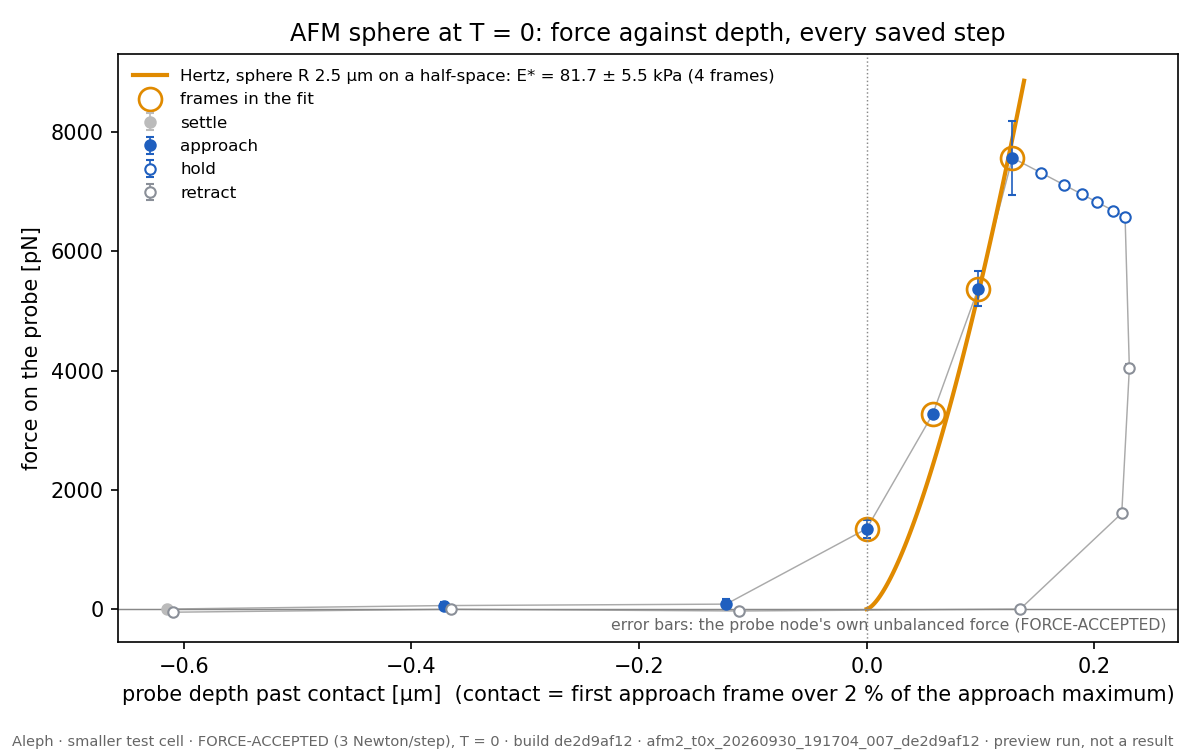
The sphere was driven in at 5 µm/s (steps 10–40), held (to step 70) and pulled back. The force reached 7,568 pN at 0.128 µm past contact at the end of the approach; the sphere crept to 0.23 µm while held.
Apparent modulus E* · 81.7 kPa
Inferred with the instrument’s formula. This is a model preview, not a physical result.
Interpretation, source and run conditions
Hertz's law for a sphere on a half-space, fitted to the approach frames the pack declares (four frames, from contact to the end of the approach), reads an apparent modulus E* = 81.7 ± 5.5 kPa (E = 61.3 ± 4.1 kPa with ν = 0.5 assumed). That is about 16× the earlier build's 5.0 kPa. The build changed the cell (in this smaller cell, cytoplasmic actin went from 87,494 to 185,935 nodes and myosin II from 20,828 to 30,988, and the new branch law holds every Arp2/3 junction at the full bending stiffness), and T and the Newton budget changed too, so the cause is not isolated.
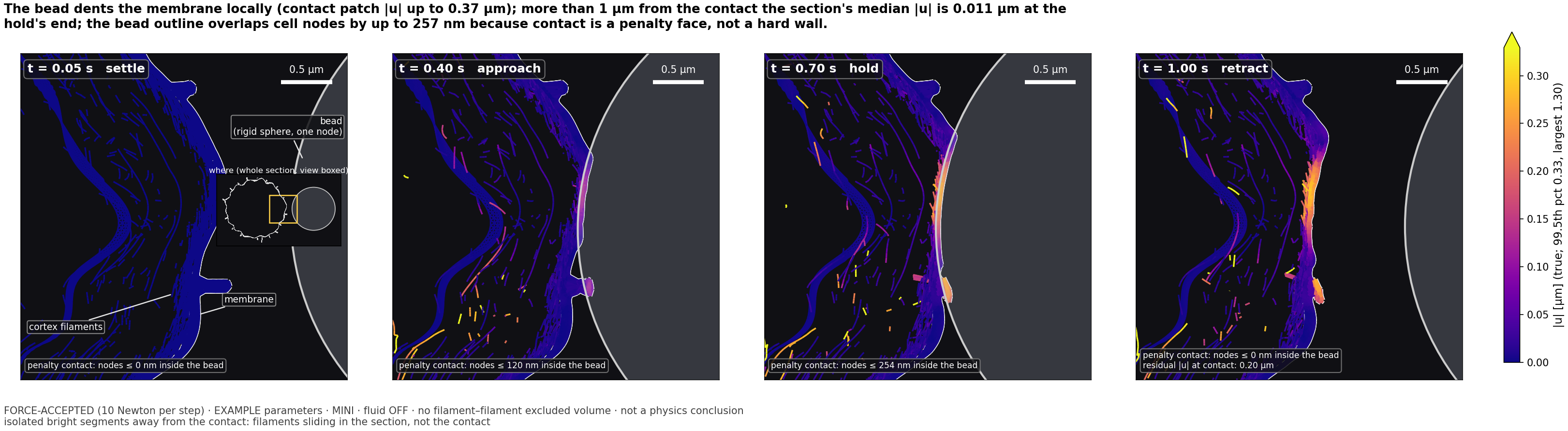
The probe is a penalty face (k 1000 pN/µm) on the membrane's nodes only, not contact-protected: membrane nodes sit up to 91 nm inside the sphere (step 40), and cortex nodes, which it does not press, up to 180 nm (step 75).
Evidence, from the pack: FORCE-ACCEPTED RUN, 3 Newton/step (median); residual median 3.26e3 pN (20 saved steps); contact share 0.99; worst step 6 (net force 7,371 pN, up from 3,570 pN); frame audit VALID (containment and exact membrane parity at steps 0, 40, 70 and 100).
Missing physics, as the pack lists it: no excluded volume between filaments (the cortex's steric resistance is absent from the force); fluid off (node drag only).
Earlier build, with the kick: E* 4,992 ± 859 Pa (record bead_deep_ka_v2_mini_20260928_001_4fc2981d4). What differs between the two records: the node counts above (the Arp2/3 cortex is 773,859 nodes in both), the bending triples on the Arp2/3 network (515,906 → 773,859), and 25 rows of the parameter file (among them crosslinker and filamin binding rates that were zero).
Record
afm2_t0x_20260930_191704_007_de2d9af12
Build
de2d9af12
Run class
FORCE-ACCEPTED RUN, 3 Newton/step (median), T = 0; smaller test cell; a showcase, unscored
Measurements · recorded force and response
Force on the probe against its depth past contact, every saved step, with the Hertz curve the pack's E* draws; the ringed frames are the fit's. Error bars are the probe node's own unbalanced force.
When an instrument gave no reading
Recorded outcomes
These runs diagnose a missing seal, a released bond or a stopped solve. Open a question to inspect the available data.
Tether pullNo instrument reading
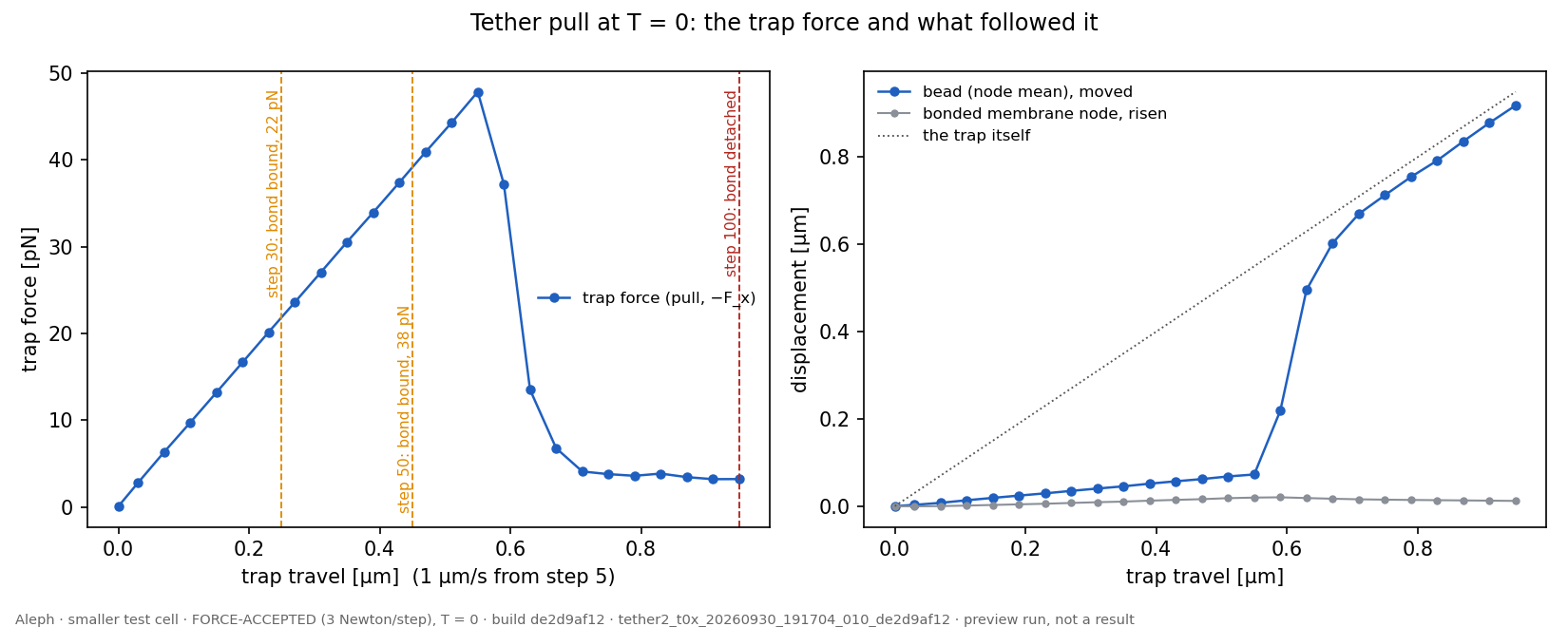
No tension reading: the bead–membrane bond let go mid-pull, so the readout withholds σ (after the release the force is not a tether force).
Trap force against the trap's travel with the declared bond's state at the raw frames (left), and how far the bead and the bonded membrane node moved (right).
Interpretation, source and run conditions
The trap moved at 1 µm/s. While the declared bond held (bound at step 50, 38 pN on it) the force rose linearly to 47.8 pN at 0.55 µm (step 60), the bead moved only 0.07 µm and the bonded membrane node rose 0.02 µm. Between steps 60 and 68 the bond let go (detached at step 100); the force fell to 3–4 pN and the bead caught up with the trap: over the whole pull it travelled 0.92 of the trap's 0.95 µm (0.97).
Earlier build, with the kick: also let go, between steps 80 and 84 (the trap force fell from 63 pN).
Evidence, from the pack: FORCE-ACCEPTED RUN, 3 Newton/step (median); residual median 2.55e3 pN (25 saved steps); contact share 0.98.
Caveat, from the pack: the bead is bound at a microvillus tip (tube 154's top ring), so the early pull extends the microvillus; connectivity is fixed (no lipid flow).
The earlier build's pull is record tether_mv_ka_rc_sparse_mini_20260928_006_ffd87692f; its trap force is read here from the saved frames' load reaction.
Record
tether2_t0x_20260930_191704_010_de2d9af12
Build
de2d9af12
Run class
FORCE-ACCEPTED RUN, 3 Newton/step (median), T = 0; smaller test cell; a showcase, unscored
Micropipette aspirationNo instrument reading
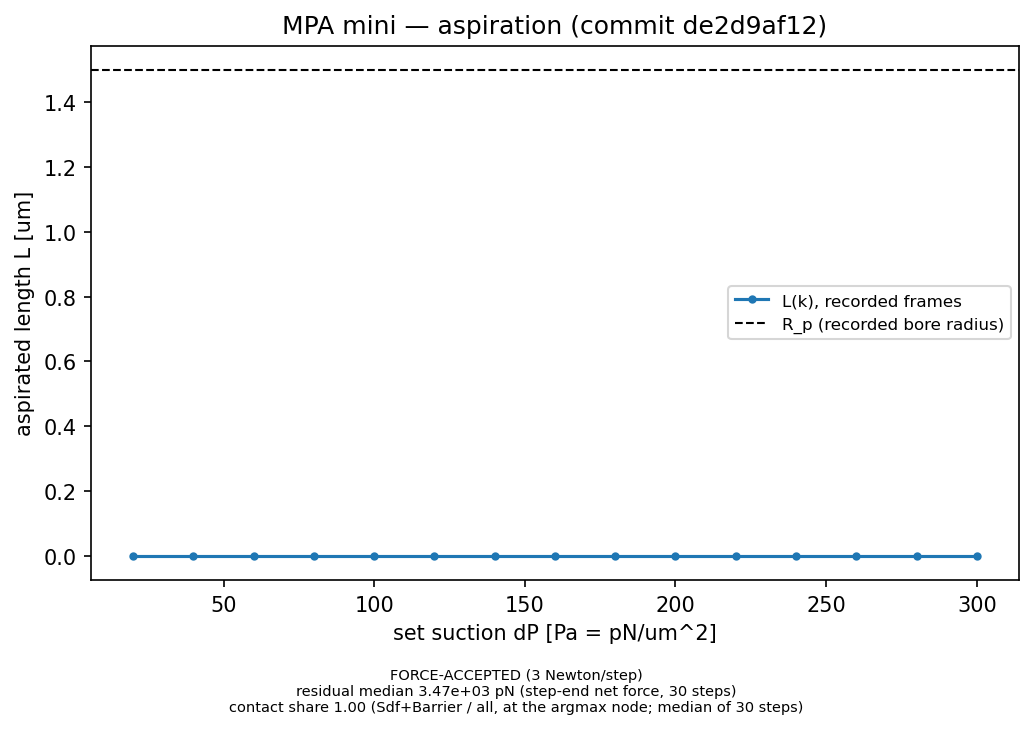
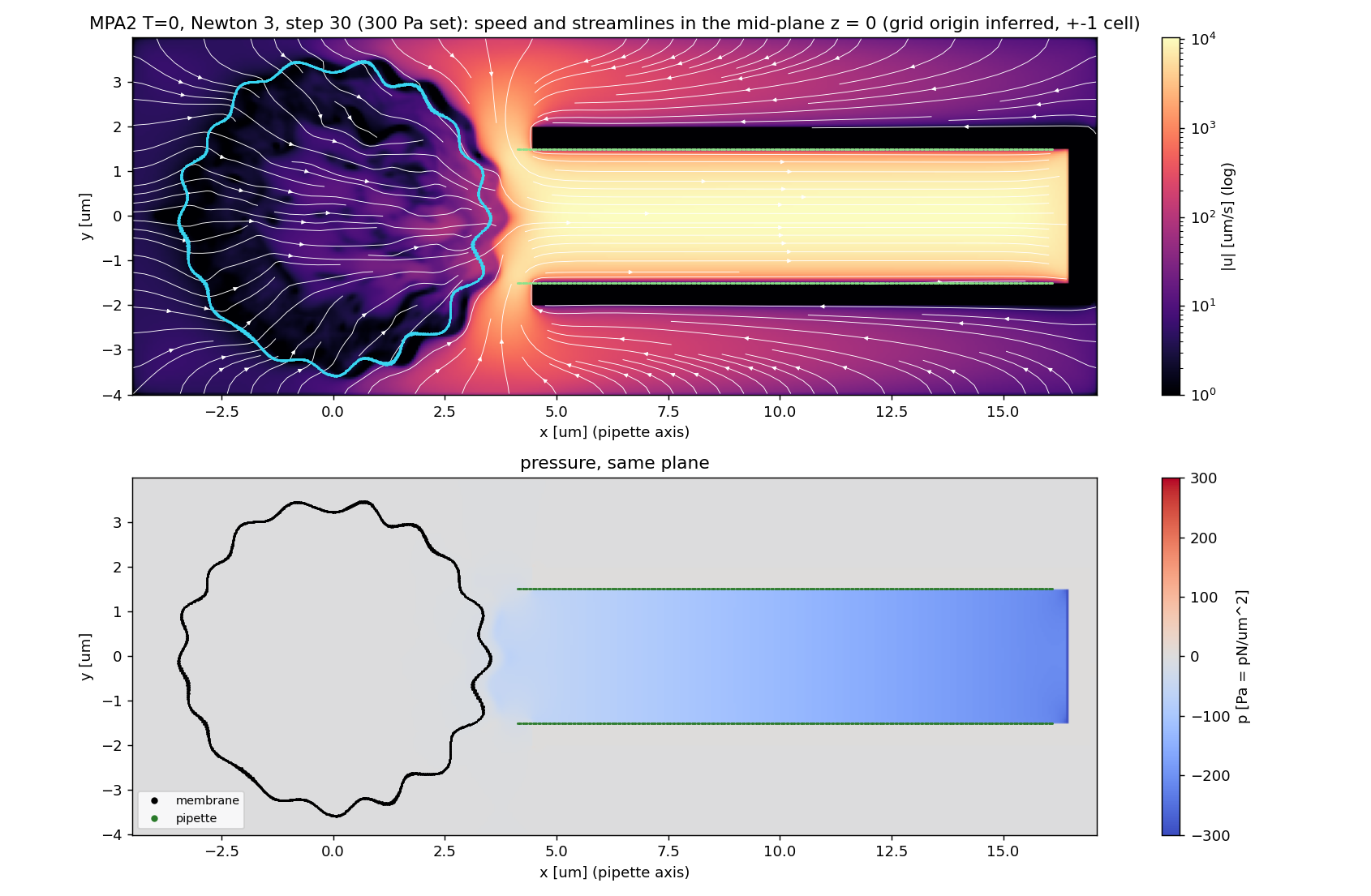
Nothing was drawn in: the aspirated length is 0 at every recorded step of the ramp, from 20 to 300 Pa.
The run's own readout: aspirated length against the set suction, with the pipette's recorded bore radius.The stored flow at step 30 (300 Pa set): speed and streamlines (top) and pressure (bottom) in the mid-plane; the grid origin is inferred, to within one cell.
Interpretation, source and run conditions
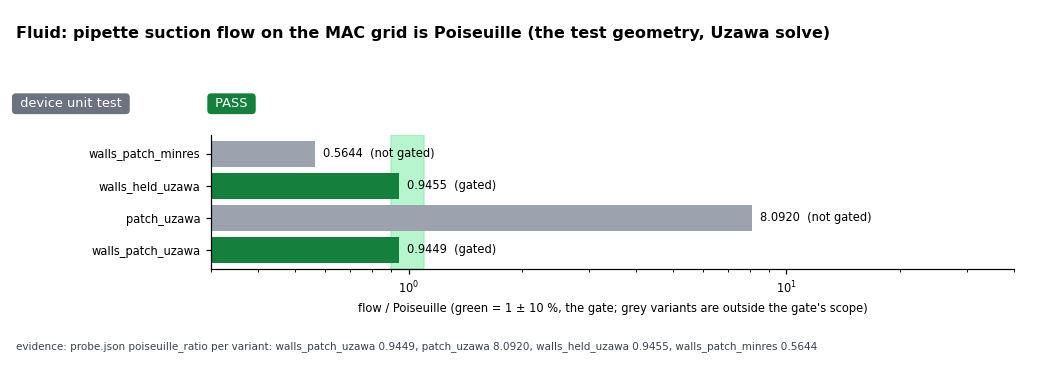
The stored flow shows why. The cell sits 0.51 µm short of the pipette's mouth at every recorded step, so the pipette pumps bath fluid: up to 1.05 × 10⁴ µm/s in the bore, a Reynolds number of about 0.045, so the flow is laminar as it must be. Only 74 of the 300 Pa acts at the mouth; the rest of the pressure drop is spent along the bore. Streamlines cross the membrane: the continuity share is 0.052 against the 0.002 bar. The protocol has no seal step.
Earlier build, with the kick: also nothing drawn in.
Evidence, from the score file: FORCE-ACCEPTED (3 Newton/step); residual median 3.47e3 pN (30 steps); contact share 1.00. The pre-registered check M1 reads: falsified, L < R_p at every recorded step up to the ramp's top.
Peak speed 1.045 × 10⁴ µm/s is the largest face velocity of the stored grid at step 30; the Reynolds number uses the bore diameter (3 µm), the fluid density row (1 pg/µm³) and η 0.692 mPa·s. The gap to the mouth is the largest membrane-node position along the pipette axis, measured from the saved frames; the continuity share is the score file's (above the bar at all 15 recorded steps).
Record
qs_t0x_mpa2fix_20260930_191704_004_de2d9af12
Build
de2d9af12
Run class
FORCE-ACCEPTED RUN, 3 Newton/step (median), T = 0; smaller test cell; a showcase, unscored
PRESS v2 (a force-controlled press of the pipette rim)No instrument reading
No reading: stopped by its pre-registered stop rule. Step 7 ran past 900 s after the largest net force (3.36 × 10⁴ pN) moved onto the pipette rim at step 6; steps 1–6 are kept.
Interpretation, source and run conditions
Earlier build, with the kick: step 6 alone took 4,538 s, and the run was stopped there.
Steps 1–5 took 16–20 s each and step 6 took 113 s (the run's log); step 7 began at 19:43 KST and had not finished when the next run in its queue began at 20:24. The score file: every kept step FORCE-ACCEPTED at 3 Newton iterations; the worst, step 6, ends at 33,640 pN on a pipette-rim node.
Record
qs_t0x_pressv2_20260930_191704_001_de2d9af12
Build
de2d9af12
Run class
FORCE-ACCEPTED RUN, 3 Newton/step (median), T = 0; smaller test cell; a showcase, unscored
Recorded colour views
Where did the cell move?
Colour shows displacement over the stated reference window. Each movie keeps one colour scale throughout; colours are not force or tension.
Choose a dated run. The 30 September views show a contact patch from its saved positions; the earlier movies retain their original regions and reference windows.
Plate · 30 September
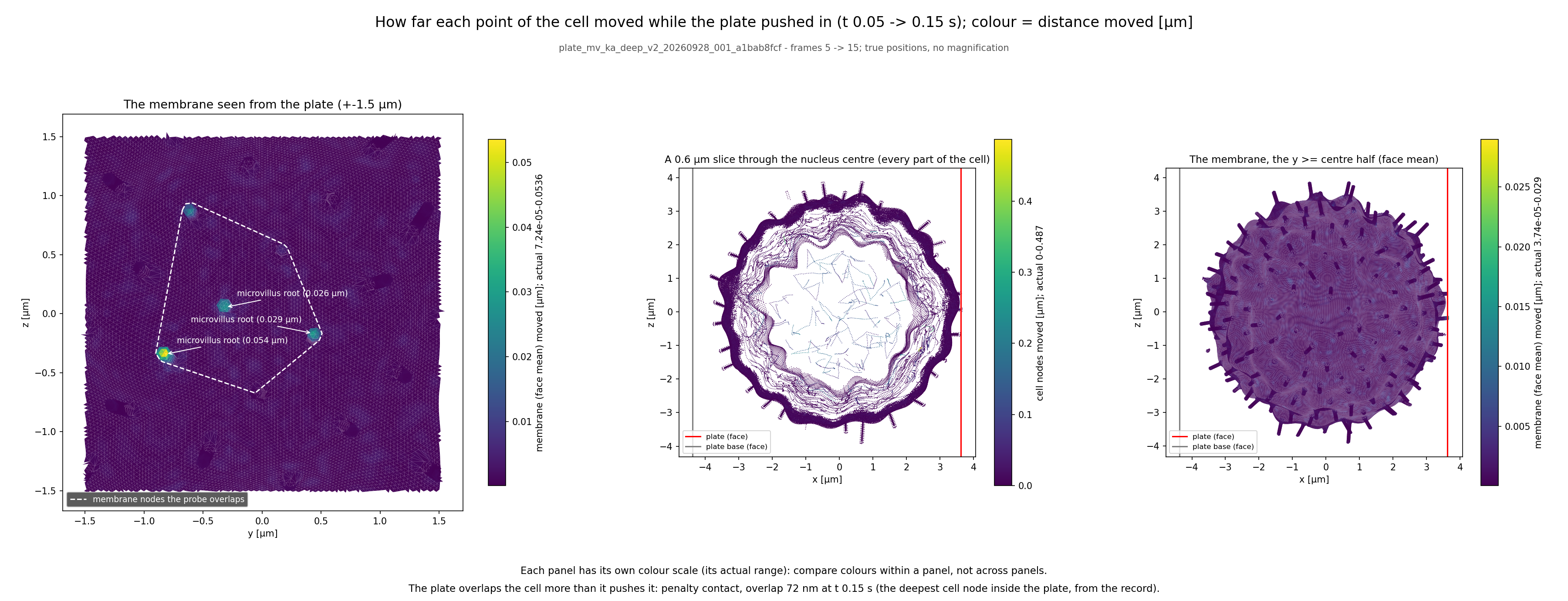
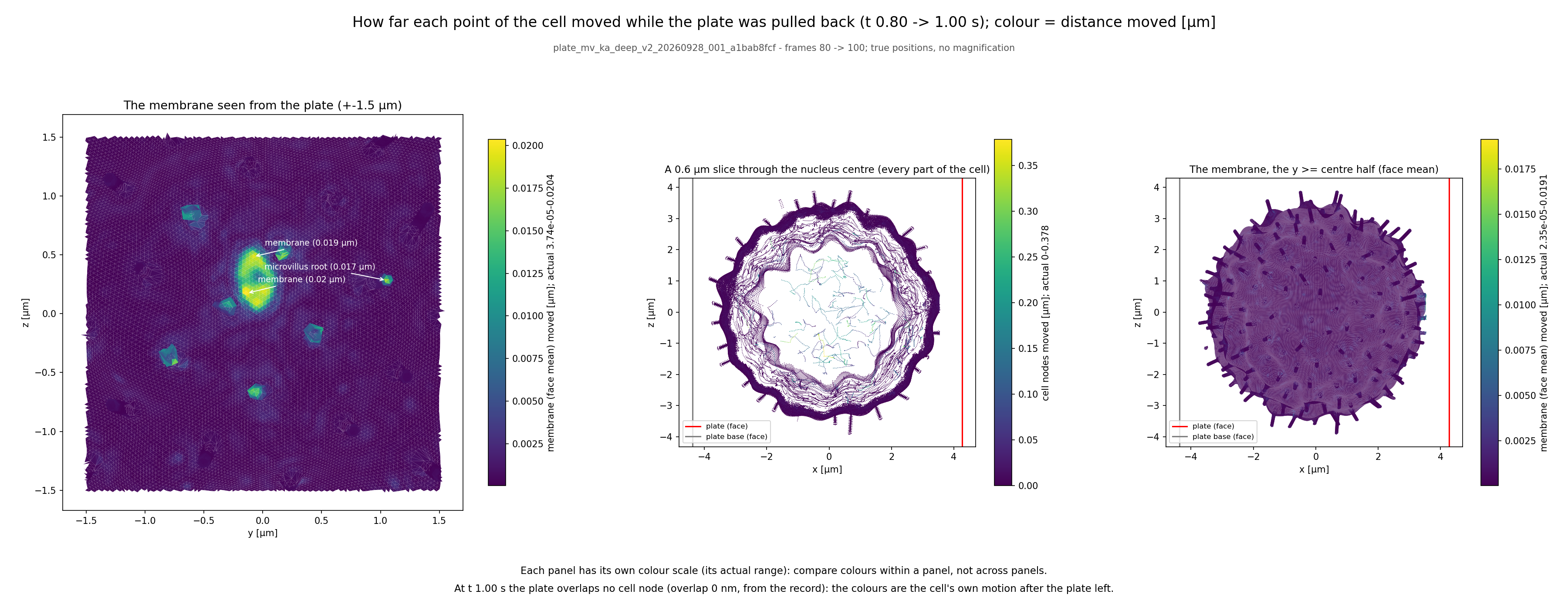
Recorded contact patch, steps 5–100. Membrane and filaments are coloured by distance from step 5, in µm. The probe keeps its material colour.
One scale throughout: 0–0.152 µm; the highest 1% of saved displacements share the top colour. Includes translation of the patch.
records / plate2_t0x_20260930_191704_008_de2d9af12
Plate compression deep v2 (1.0 µm at 10 µm/s, hold, release; 100 steps)
plate_mv_ka_deep_v2_20260928_001_a1bab8fcf
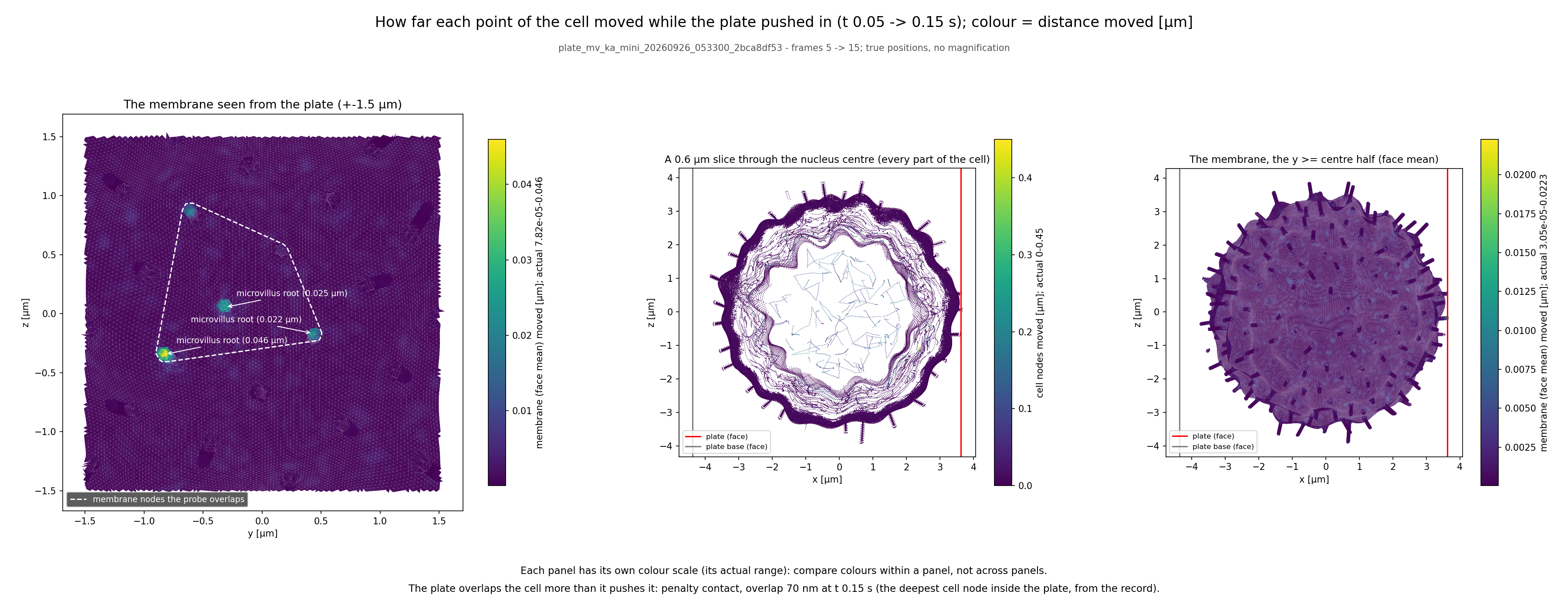
How far each point of the cell moved while the plate pushed in (t 0.05 -> 0.15 s); colour = distance moved [µm]. Every saved frame, steps 5 to 100, one colour scale for the whole movie.Open displacement still · steps 5–15How far each point of the cell moved while the plate pushed in (t 0.05 -> 0.15 s); colour = distance moved [µm] (steps 5 to 15).How far each point of the cell moved while the plate was pulled back (t 0.80 -> 1.00 s); colour = distance moved [µm]. Every saved frame, steps 80 to 100, one colour scale for the whole movie.Open displacement still · steps 80–100How far each point of the cell moved while the plate was pulled back (t 0.80 -> 1.00 s); colour = distance moved [µm] (steps 80 to 100).
Contact close-up (C3, afm_deep_movie bb1408891): a 0.2 µm section through the bead contact; colour = true |u| from the first frame, one scale for the loop. Every saved frame, steps 5 to 100, one colour scale for the whole movie.Open displacement still · steps 5–100Contact close-up (C3, afm_deep_movie bb1408891): a 0.2 µm section through the bead contact; colour = true |u| from the first frame, one scale for the loop (steps 5 to 100).
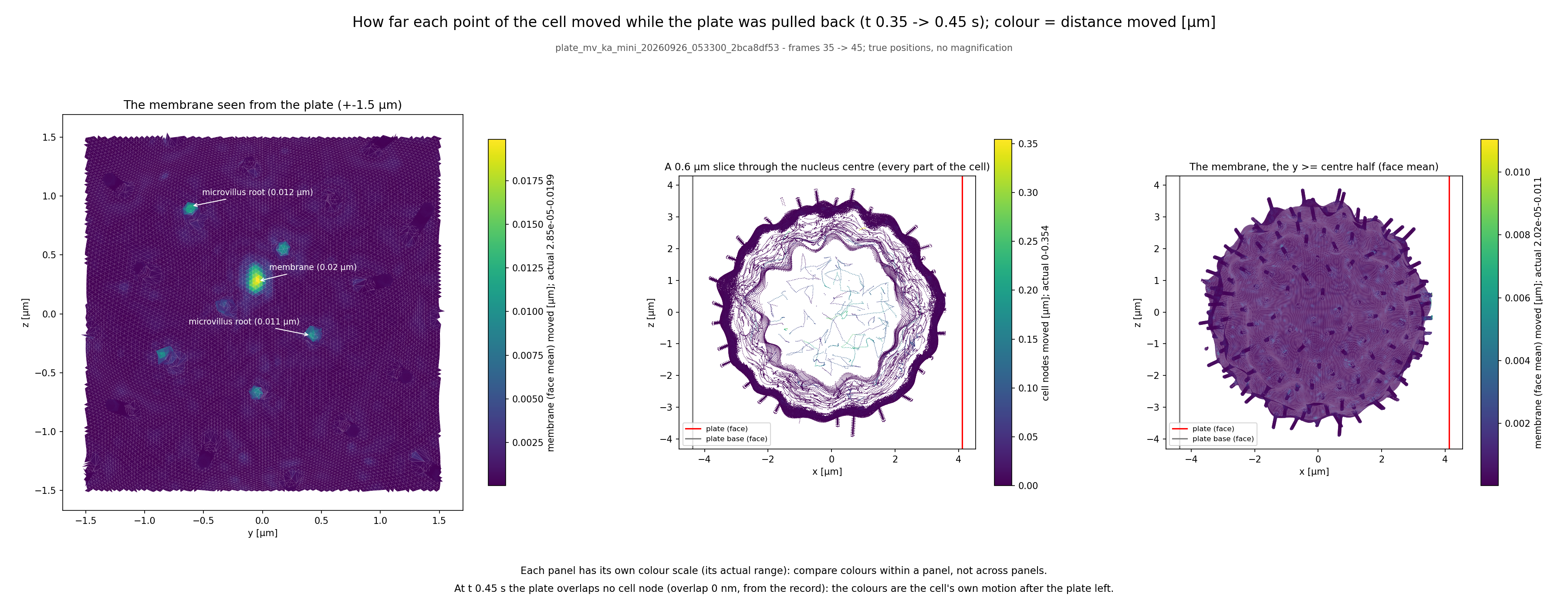
How far each point of the cell moved while the plate pushed in (t 0.05 -> 0.15 s); colour = distance moved [µm]. Every saved frame, steps 5 to 45, one colour scale for the whole movie.Open displacement still · steps 5–15How far each point of the cell moved while the plate pushed in (t 0.05 -> 0.15 s); colour = distance moved [µm] (steps 5 to 15).Open displacement still · steps 35–45How far each point of the cell moved while the plate was pulled back (t 0.35 -> 0.45 s); colour = distance moved [µm] (steps 35 to 45).
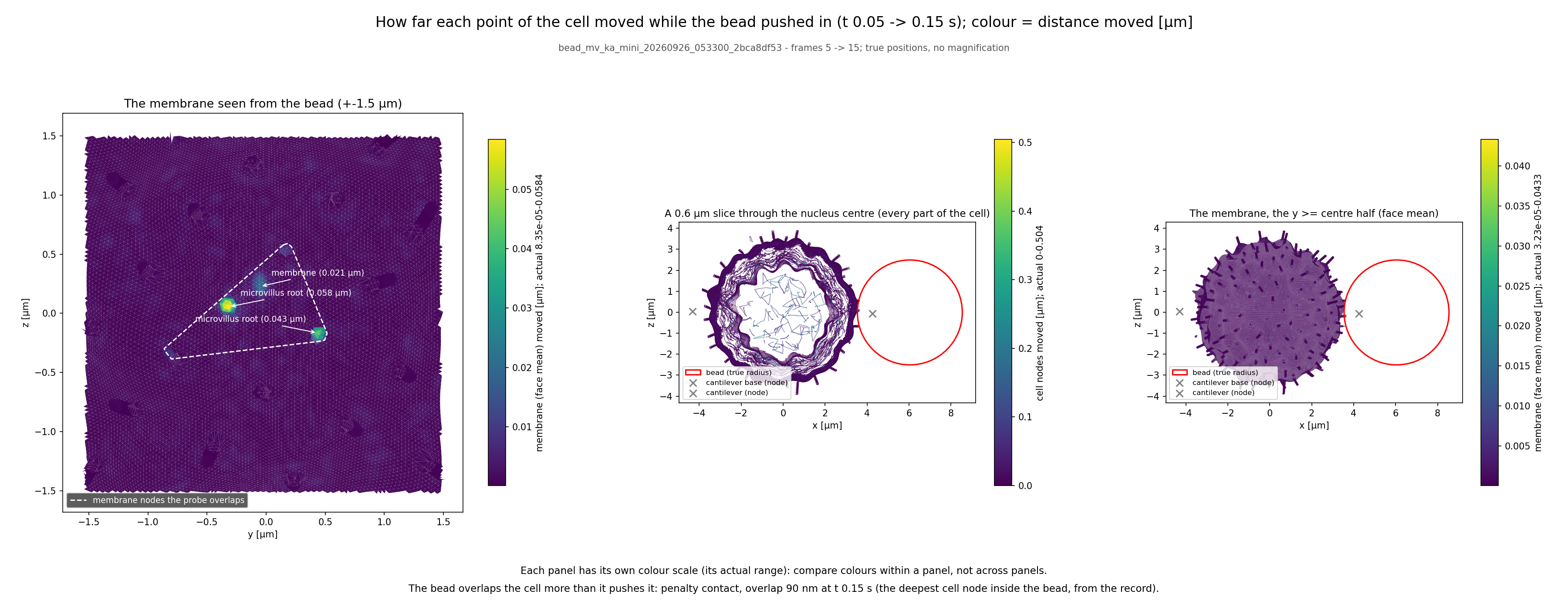
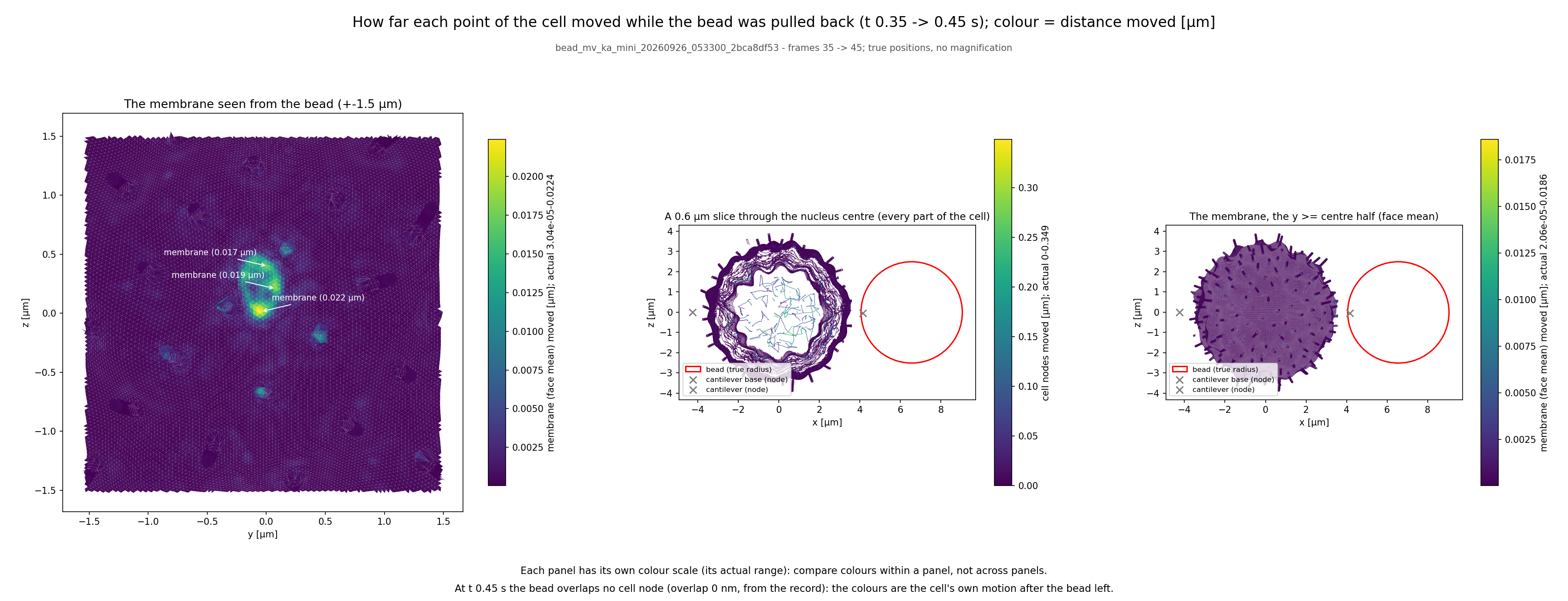
How far each point of the cell moved while the bead pushed in (t 0.05 -> 0.15 s); colour = distance moved [µm]. Every saved frame, steps 5 to 45, one colour scale for the whole movie.Open displacement still · steps 5–15How far each point of the cell moved while the bead pushed in (t 0.05 -> 0.15 s); colour = distance moved [µm] (steps 5 to 15).Open displacement still · steps 35–45How far each point of the cell moved while the bead was pulled back (t 0.35 -> 0.45 s); colour = distance moved [µm] (steps 35 to 45).
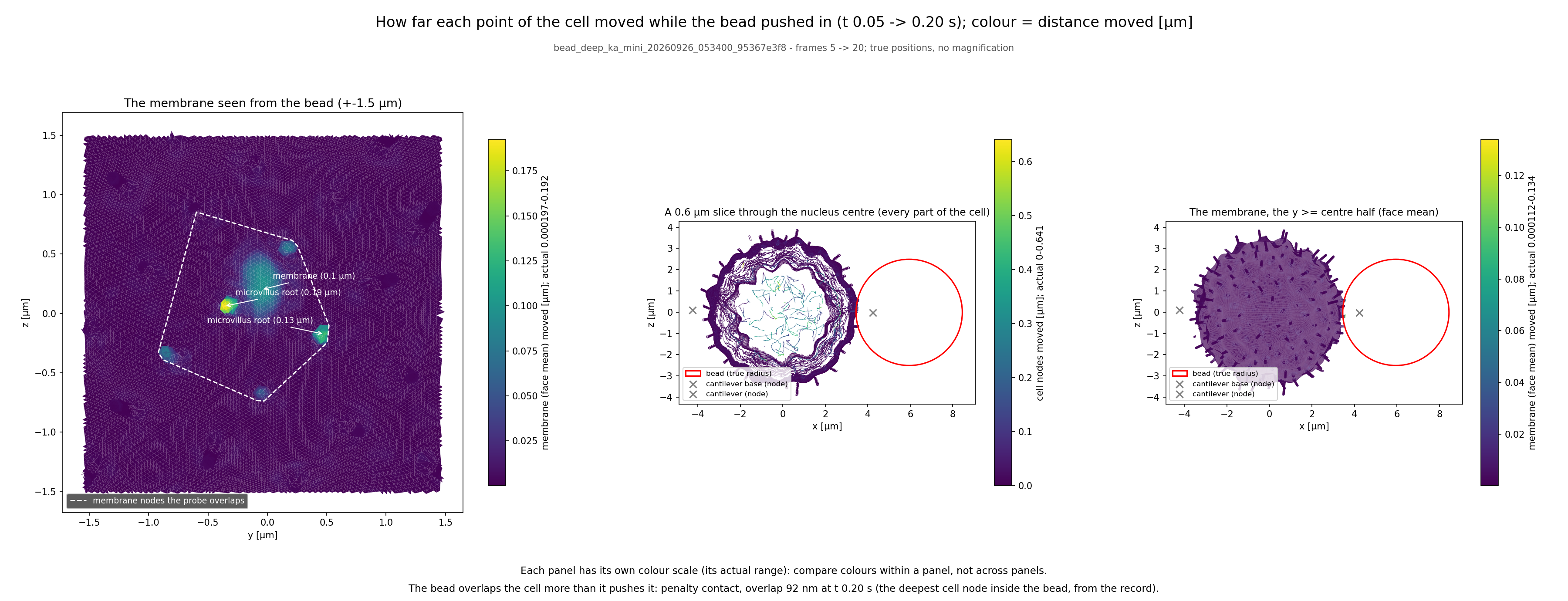
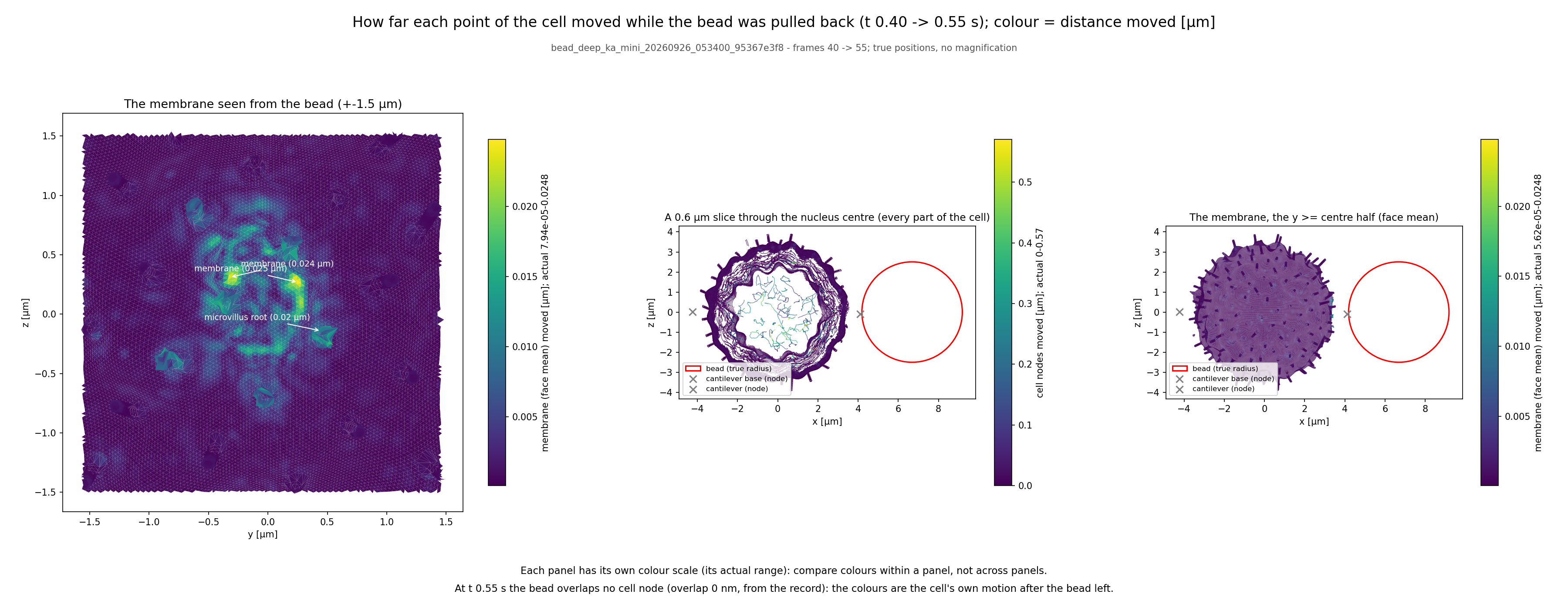
How far each point of the cell moved while the bead pushed in (t 0.05 -> 0.20 s); colour = distance moved [µm]. Every saved frame, steps 5 to 55, one colour scale for the whole movie.Open displacement still · steps 5–20How far each point of the cell moved while the bead pushed in (t 0.05 -> 0.20 s); colour = distance moved [µm] (steps 5 to 20).Open displacement still · steps 40–55How far each point of the cell moved while the bead was pulled back (t 0.40 -> 0.55 s); colour = distance moved [µm] (steps 40 to 55).
Different builds, thermal settings and solver budgets. These records are retained for comparison; they are not the current runs above.
Cortical tension, measured the ways labs do
Plate compression, indentation, micropipette aspiration, membrane flicker and tether pulling, each run as a virtual instrument on the same smaller test cell. Each card puts the number the instrument's own formula reports beside the tension the cortex carries, read from its own forces: method against model on one cell, not yet a result. The runs that gave a reading come first; the others are folded below, each with its reason.
Preview run · not yet a resultFORCE-ACCEPTED, 10 Newton/step: 10 solver iterations a step, not a forceSmaller test cell (1.5 M nodes); every input a placeholder value
How these runs were declared and checked
Each run's pass/fail rule was written before it ran; a run shows numbers only when every saved frame passes the containment audit (no node on the wrong side of a surface) and its data pack reads. From C2's showcase showcase_20260926 at d5994580c 2026-09-28 11:20 (rows declared 2026-09-26 04:2x KST).
Readings
Plate compression deep v2 (1.0 µm at 10 µm/s, hold, release; 100 steps)
Reading. The plate was driven 1.0 µm in at 10 µm/s, held and released over 100 steps; the force reached 3.53 nN. Its formula reads 1,640 pN/µm while the cortex's own forces read 53.8 pN/µm under load, a 31–33× gap.
Preview run · not yet a resultFORCE-ACCEPTED, 10 Newton/step: 10 solver iterations a step, not a forceSmaller test cell
The plate again, over 100 steps (1 s): pressed 1.0 µm in at 10 µm/s, held, released. The plate's formula turns force and contact size into a tension.
the cantilever well's recorded reaction per frame (observe.probe_report sensor), s = the probe's position along the axissensor force against the top plate's position along the axisThree estimators over the full cortex shell, each an estimator, not a verified true tension. Band: cortical tension measured on suspended, rounded MCF-7 cells by AFM parallel-plate confinement, median 270 pN/µm, IQR 180–400 (n = 27; Hosseini et al. 2020, Adv Sci 7:2001276, figure-read ±30 pN/µm). That is the whole surface's effective Laplace tension, membrane included; the lines are the model cortex's own tension. They are not yet the same quantity: comparing like with like is part of what is being built.
Source, label and caveats
FORCE-ACCEPTED RUN, 10 Newton/step (median) · residual median 3.43e+03 pN (step-end net force, 20 steps) · contact share 1.00 (Sdf+Barrier / all, at the argmax node; median of 20 steps)
Label, quoted: FORCE-ACCEPTED (10 Newton/step), K_A ON, (a′) OFF, 4090_1, 100 steps (settle 5 / approach 10 at 10 µm/s / hold 65 / release 10 / rest 10) — frame audit PASS: envelope containment 0/0 on 21 frames, membrane parity 0 wrong-side / 0 overlap on 20/20 frames (worst margin −4.3 nm, k70, inside the barrier band); residual median 3.43e3 pN; contact share 1.00; γ_CMC apparent 1640 pN/µm at k15 (F 3.53 nN, a 1.14 µm) against core tension 53.8 pN/µm (k50, under load) → 50.0 (k100, after release): 31–33× gap; the plate overlaps the cell by 72 nm at k15 (penalty contact); the retract is the probe's own unconverged balance (+10 pN at k100), not force
Source: C4 11:12 KST 09-28, verbatim (readout bf98227b1; parity tool c53a1d1f7 = a1bab8fcf + C1 11eb90ac1); the record's commit taken from its archived job script (the workstation record stamps none), labelled so in the pack; ratified by Lead Fable 11:14 KST 09-28 as written
Note on the row: row added after landing (Lead Fable 10:29 KST 09-28); the run itself was pre-registered before it ran: PREREG-lite-2026-09-28-plate-deep-v2 + amendment 1 (a1bab8fcf: frames every 5, raw k50 + k100)
Record
plate_mv_ka_deep_v2_20260928_001_a1bab8fcf
Commit
a1bab8fcf
Class
FORCE-ACCEPTED RUN, 10 Newton/step (median)
Run by
C4
Loop
20 saved steps at 3.333 a second, nothing in between
Reading. Over the 100-step run the sphere went 0.61 µm deep at 6,625 pN; the cortex under it moved 0.12 µm, the membrane 0.28 µm.
Preview run · not yet a resultFORCE-ACCEPTED, 10 Newton/step: 10 solver iterations a step, not a forceSmaller test cell
The AFM sphere again, now over 100 steps (1 s) at 5 µm/s: pushed about 0.6 µm in, held, pulled back. Hertz's law turns force against depth into an apparent modulus.
The instrument's reading
Apparent modulus E* = 4992 ± 8.6e+02 Pa (hertz formula)
Young's modulus E (ν = 0.5 assumed) = 3744 ± 6.4e+02 Pa (hertz formula)
Tension from the cortex's own forces
79.6 → 57.9 pN/µm (steps 50 → 100) — an estimator, not a verified true tension
Added to this list after its record landed; its pass/fail rule was written before it ran.
sensor force k_c (s - anchor) against the probe depth s_contact - s, every recorded step (observe.bead_signal; contact = the first approach frame with F > 2 % of the approach max); err = |the probe node's own residual along the axis| (FORCE-ACCEPTED)p99 axial membrane position in the 0.25 um patch about the probe axis, k10 minus k (includes the microvilli under the probe)Three estimators over the full cortex shell, each an estimator, not a verified true tension. Band: cortical tension measured on suspended, rounded MCF-7 cells by AFM parallel-plate confinement, median 270 pN/µm, IQR 180–400 (n = 27; Hosseini et al. 2020, Adv Sci 7:2001276, figure-read ±30 pN/µm). That is the whole surface's effective Laplace tension, membrane included; the lines are the model cortex's own tension. They are not yet the same quantity: comparing like with like is part of what is being built.
Source, label and caveats
FORCE-ACCEPTED RUN · residual median 3.91e+03 pN (step-end net force, 20 steps) · contact share 1.00 (Sdf+Barrier / all, at the argmax node; median of 20 steps)
Caveat, quoted: 10-Newton FORCE-ACCEPTED steps: the hold's τ and the retract may read the solver's balance, not force (flicker τ_int reading, Lead 08:55); the approach and Hertz E* are read as declared (C3's pack CAVEAT at 84ef94be7, as Lead Fable sent C3 (08:55); the final wording is pending Fable)
Label, quoted: afm_deep v2 (4fc2981d4 · RTX 3090 · MINI · K_A ON · (a′) free bodies ON · 100 steps, 5 µm/s): FORCE-ACCEPTED RUN (10 Newton/step; worst step 19, 9,428 pN, F_ROSE) · frame audit VALID (containment + C1 exact membrane parity at every saved frame, 20/20) · force max 6,625 pN at probe depth 0.611 µm (end of approach) · cortex patch indentation 0.123 µm ≈ 0.6 h, membrane patch 0.284 µm · ORACLE Hertz E* 4,992 ± 859 Pa (E 3,744 ± 644 Pa at ν = 0.5 assumed; n_fit 6): an apparent modulus of a layered body, which errs soft (the probe's penalty face sits up to 257 nm into cell nodes in the hold); afm_deep v1 at 10 µm/s read 3,591 ± 472 Pa, a different rate, not a check · core_tension (full shell; estimator, not verified true tension) 79.6 → 57.9 pN/µm, loaded hold → end · 10-Newton FORCE-ACCEPTED steps: the hold's τ (0.262 s) and the retract may read the solver's balance, not force (flicker τ_int reading, Lead 08:55); the approach and Hertz E* are read as declared · EXAMPLE parameters · fluid OFF, node drag only · no filament–filament excluded volume · not a physics conclusion
Source: C3 11:06 KST 09-28, verbatim (pack b5509eba7, scorer 7985ab20b; a first pack pass that took the spec's 10 µm/s instead of the calls' 5 µm/s is kept as datapack_spec_speed_DEFECT.json and superseded); card RTX 3090 (holder 375, queue3090; c7 10:3x), job log shared with the plate run; ratified by Lead Fable 11:14 KST 09-28 as written
Note on the row: row added after landing (Lead Fable 10:29 KST 09-28); the run itself was pre-registered before it ran: PREREG-lite-2026-09-27-afm-deep-v2 + amendment 1 (4fc2981d4: frames every 5, raw k50 + k100)
Record
bead_deep_ka_v2_mini_20260928_001_4fc2981d4
Commit
4fc2981d4
Class
FORCE-ACCEPTED RUN
Run by
C3
Loop
20 saved steps at 3.333 a second, nothing in between
The contact up close: membrane (faces), microvilli and the formin cortex within 1.5 µm, every saved step, positions interpolated between them for display; the plate drawn as its declared plane face at its node's recorded position. Where cell nodes sit inside the probe (the penalty contact lets them, up to about 90 nm), they are drawn as they are.
Plate compression (microvilli ON, K_A)
Reading. The plate moved 0.66 µm into the cell and the force on it rose to 3,550 pN.
Preview run · not yet a resultFORCE-ACCEPTED, 10 Newton/step: 10 solver iterations a step, not a forceSmaller test cell
A flat plate presses the whole cell. From the force on the plate and the contact geometry, the cortical tension is inferred (the apparent CMC inversion).
the cantilever well's recorded reaction per frame (observe.probe_report sensor), s = the probe's position along the axissensor force against the top plate's position along the axisThree estimators over the full cortex shell, each an estimator, not a verified true tension. Band: cortical tension measured on suspended, rounded MCF-7 cells by AFM parallel-plate confinement, median 270 pN/µm, IQR 180–400 (n = 27; Hosseini et al. 2020, Adv Sci 7:2001276, figure-read ±30 pN/µm). That is the whole surface's effective Laplace tension, membrane included; the lines are the model cortex's own tension. They are not yet the same quantity: comparing like with like is part of what is being built.
Source, label and caveats
FORCE-ACCEPTED RUN, 10 Newton/step (median) · residual median 3.57e+03 pN (step-end net force, 45 steps) · contact share 1.00 (Sdf+Barrier / all, at the argmax node; median of 45 steps)
Label, quoted: FORCE-ACCEPTED (10 Newton/step), K_A ON, A100 — frame audit PASS (0 wrong-side / 0 overlap, k15/30/45); argmax BarrierTerm in 44/45 steps (mvdemos' HingeTerm runaway gone); A/A0 min 0.964 (bead) / 0.976 (plate), envelope 0.997; residual median 10× lower than mvdemos (plate 3.54e4 → 3.57e3, bead 4.71e4 → 3.78e3 pN); contact share 1.00; the retract segment is the probe's own unconverged balance (+1.5 / +1.4 nN at k45), not force — approach and hold are interpretable
Source: Lead Fable 07:40 KST 09-26 (message to C2); C1's 3-frame audit
The contact up close: membrane (faces), microvilli and the formin cortex within 1.5 µm, every saved step, positions interpolated between them for display; the bead drawn as its declared surface, r 2.5 µm, at its node's recorded position. Where cell nodes sit inside the probe (the penalty contact lets them, up to about 90 nm), they are drawn as they are.
Bead indentation (microvilli ON, K_A)
Reading. The bead, a 2.5 µm sphere, moved 0.68 µm toward the cell and the force rose to 3,440 pN.
Preview run · not yet a resultFORCE-ACCEPTED, 10 Newton/step: 10 solver iterations a step, not a forceSmaller test cell
A small bead is pushed into the cell's side. Hertz's contact law turns force against depth into an apparent modulus.
The instrument's reading
Apparent modulus E* = 2892 Pa (hertz formula)
Tension from the cortex's own forces
93.4 → 61.3 pN/µm (steps 15 → 45) — an estimator, not a verified true tension
the cantilever well's recorded reaction per frame (observe.probe_report sensor), s = the probe's position along the axisapproach frames with F > 2 % of the approach maximum; depth = s_contact - sThree estimators over the full cortex shell, each an estimator, not a verified true tension. Band: cortical tension measured on suspended, rounded MCF-7 cells by AFM parallel-plate confinement, median 270 pN/µm, IQR 180–400 (n = 27; Hosseini et al. 2020, Adv Sci 7:2001276, figure-read ±30 pN/µm). That is the whole surface's effective Laplace tension, membrane included; the lines are the model cortex's own tension. They are not yet the same quantity: comparing like with like is part of what is being built.
Source, label and caveats
FORCE-ACCEPTED RUN, 10 Newton/step (median) · residual median 3.78e+03 pN (step-end net force, 45 steps) · contact share 1.00 (Sdf+Barrier / all, at the argmax node; median of 45 steps)
Label, quoted: FORCE-ACCEPTED (10 Newton/step), K_A ON, A100 — frame audit PASS (0 wrong-side / 0 overlap, k15/30/45); argmax BarrierTerm in 44/45 steps (mvdemos' HingeTerm runaway gone); A/A0 min 0.964 (bead) / 0.976 (plate), envelope 0.997; residual median 10× lower than mvdemos (plate 3.54e4 → 3.57e3, bead 4.71e4 → 3.78e3 pN); contact share 1.00; the retract segment is the probe's own unconverged balance (+1.5 / +1.4 nN at k45), not force — approach and hold are interpretable
Source: Lead Fable 07:40 KST 09-26 (message to C2); C1's 3-frame audit
Record
bead_mv_ka_mini_20260926_053300_2bca8df53
Commit
2bca8df53
Class
FORCE-ACCEPTED RUN, 10 Newton/step (median)
Run by
C1
Loop
45 saved steps at 6 a second, nothing in between
bead_deep_ka_mini_20260926_053400_95367e3f8 commit 95367e3f8 FORCE-ACCEPTED RUN
The contact up close: membrane (faces), microvilli and the formin cortex within 1.5 µm, every saved step, positions interpolated between them for display; the sphere drawn as its declared surface, r 2.5 µm, at its node's recorded position. Where cell nodes sit inside the probe (the penalty contact lets them, up to about 90 nm), they are drawn as they are.
AFM deep indentation (sphere)
Reading. The sphere went 0.71 µm deep at 7,280 pN; the cortex under it moved 0.19 µm, the membrane 0.24 µm.
Preview run · not yet a resultFORCE-ACCEPTED, 10 Newton/step: 10 solver iterations a step, not a forceSmaller test cell
An AFM sphere is pushed about 0.7 µm into the cell, held and pulled back. Hertz's law again gives an apparent modulus, here of a layered body.
The instrument's reading
Apparent modulus E* = 3591 ± 4.7e+02 Pa (hertz formula)
Young's modulus E (ν = 0.5 assumed) = 2693 ± 3.5e+02 Pa (hertz formula)
Tension from the cortex's own forces
88.2 → 68.3 pN/µm (steps 10 → 55) — an estimator, not a verified true tension
sensor force k_c (s - anchor) against the probe depth s_contact - s, every recorded step (observe.bead_signal; contact = the first approach frame with F > 2 % of the approach max); err = |the probe node's own residual along the axis| (FORCE-ACCEPTED)p99 axial membrane position in the 0.25 um patch about the probe axis, k5 minus k (includes the microvilli under the probe)Three estimators over the full cortex shell, each an estimator, not a verified true tension. Band: cortical tension measured on suspended, rounded MCF-7 cells by AFM parallel-plate confinement, median 270 pN/µm, IQR 180–400 (n = 27; Hosseini et al. 2020, Adv Sci 7:2001276, figure-read ±30 pN/µm). That is the whole surface's effective Laplace tension, membrane included; the lines are the model cortex's own tension. They are not yet the same quantity: comparing like with like is part of what is being built.
Source, label and caveats
FORCE-ACCEPTED RUN · residual median 4.77e+03 pN (step-end net force, 55 steps) · contact share 1.00 (Sdf+Barrier / all, at the argmax node; median of 55 steps)
Caveat, quoted: 10-Newton FORCE-ACCEPTED steps: the hold's τ and the retract may read the solver's balance, not force (flicker τ_int reading, Lead 08:55); the approach and Hertz E* are read as declared (C3's pack CAVEAT at 84ef94be7, as Lead Fable sent C3 (08:55); the final wording is pending Fable)
Label, quoted: afm_deep (95367e3f8 · VESSL A100 · MINI · K_A ON · (a′) free bodies ON): FORCE-ACCEPTED RUN (10 Newton/step; worst step 40, 14,797 pN, F_ROSE) · frame audit VALID (k20/40/55: containment + C1 exact membrane parity, 0 wrong side / 0 overlap) · force max 7,280 pN at probe depth 0.708 µm (k20, end of approach) · cortex patch indentation 0.191 µm ≈ 0.95 h (h = 0.200 µm), membrane patch 0.244 µm · ORACLE Hertz E* 3,591 ± 472 Pa (E 2,693 ± 354 Pa at ν = 0.5 assumed): an apparent modulus of a layered body, which errs soft (the probe's penalty face sits 92 nm into cell nodes at k20, 217 nm at k40) · core_tension (full shell; estimator, not verified true tension) 88.2 → 68.3 pN/µm global, k10 → k55 · 10-Newton FORCE-ACCEPTED steps: the hold's τ (0.185 s) and the retract may read the solver's balance, not force (flicker τ_int reading, Lead 08:55); the approach and Hertz E* are read as declared · EXAMPLE parameters · fluid OFF, node drag only · no filament–filament excluded volume · not a physics conclusion
Source: C3 04:03 KST 09-27 (message to C2), the row owner's label, verbatim; pack a7e286fff + 92f3b9775 (9a64d1818)
Record
bead_deep_ka_mini_20260926_053400_95367e3f8
Commit
95367e3f8
Class
FORCE-ACCEPTED RUN
Run by
C3
Loop
55 saved steps at 6 a second, nothing in between
Runs that did not give a reading, and engine checks (9)
Kept on the page, each with the reason it gave no reading: a run that failed is part of the record.
Partial, or no reading
Membrane tether pull B (bead as a rigid coarse body), PARTIAL
Reading pending audit. The bead now follows the trap (0.118 µm over 0.75 µm of travel), but the membrane-parity audit of this record is not finished, so no number is shown yet. It stopped at step 80 of 100; the full run lands later today and will take this row's place.
Preview run · not yet a resultFORCE-ACCEPTED, 10 Newton/step: 10 solver iterations a step, not a forceSmaller test cell
The tether pull again, with the glass bead solved as one rigid body so it can follow the trap. Stopped at step 80 of 100.
Added to this list after its record landed; its pass/fail rule was written before it ran.
Source, label and caveats
FORCE-ACCEPTED RUN, 10 Newton/step (median) · residual median 3.14e+03 pN (step-end net force, 20 steps) · contact share 1.00 (Sdf+Barrier / all, at the argmax node; median of 20 steps)
Caveat, quoted: 10-Newton steps: relaxation segments may read the solver's balance, not force (flicker τ_int reading) (Lead Fable 08:55 KST 09-26 (via c7), verbatim)
Label, quoted: tether B (RigidCoarse on the glass bead): PARTIAL, k 0→80 of 100. The list declared steps_ahead 100 while saving every 4th frame, and RecordSpaceFloor stopped it before frame 84 by that declaration (C1's error). The probe now FOLLOWS: bead COM 0.118 µm over 0.75 µm of anchor travel (ratio 0.157 ≥ 0.1, C4's scored bound; tether A: 5e-10); RigidCoarse bad_pivots 0. The trap force rises linearly (slope −83 pN/µm, no plateau; −60 pN at k76), so this reads the tip-bound microvillus extension, not a tether plateau. σ_tether 489 pN/µm is the oracle's number on that force (R_t 9 nm), not a tether tension. FORCE-ACCEPTED, 10 Newton/step. 10-Newton steps: relaxation segments may read the solver's balance, not force (flicker τ_int reading)
Source: C1 10:50 KST 09-28, numbers read from the record (pack writer 12f271355); the follow ratio is read over the first and last SAVED frames as declared (k4 → k80: a partial-window read); ratified by Lead Fable 11:14 KST 09-28 as written
Note on the row: row added after landing (Lead Fable 10:29 KST 09-28); the run itself was pre-registered before it ran: PREREG-lite-2026-09-27-tether-rigid-coarse (5f94bc83f) + PROJECTION.md amendment 3 (87f7e799c: frames every 4, raw k50 + k100)
20 saved steps at 3.333 a second, nothing in between
Micropipette aspiration: glass cap + fluid
No reading. Nothing was drawn into the pipette at any step: the suction that reached the mouth (27.7 Pa) stayed below the critical 56.4 Pa.
Preview run · not yet a resultFORCE-ACCEPTED, 10 Newton/step: 10 solver iterations a step, not a forceSmaller test cell
A glass pipette with water inside is sealed onto the cell and suction is applied. Laplace's law turns the suction at which the membrane enters the bore into a tension.
The instrument's reading
Tension: no reading — L < R_p at every recorded step: the Laplace inversion has no threshold
Tension from the cortex's own forces
76.2 pN/µm (step 10) — an estimator, not a verified true tension
Measurements for this record
the ledger's suction.set_pa Reading (the data pack): suction set: the set ramp, 10 -> 100 Pa drop that acted at the mouth: the drop the fluid held across the mouth, 1.3 -> 27.7 Pa (13 % -> 28 % of the set drop)largest axial distance past the mouth plane of the membrane nodes within the bore radius Reading (the data pack): 0 at every step: no aspiration. Consistent, since the acting drop 27.7 Pa < dP_c 56.4 Pa (Laplace with the model's own full-shell tension); a consistency check, not a measurement
Source, label and caveats
FORCE-ACCEPTED (10 Newton/step); pipeline demo, not a measurement (capfluid3: v1 fluid check) · residual median 4.46e+03 pN (step-end net force, 10 steps) · contact share 1.00 (Sdf+Barrier / all, at the argmax node; median of 10 steps)
Label, quoted: FORCE-ACCEPTED (10 Newton/step); pipeline demo, not a measurement — sealed bore delivers 57 → 68 % of the set ΔP at the bore end (k1 → k10); fluid solve unconverged at 200 iterations (continuity share 0.73 → 0.15 vs the 0.002 bar, 10/10 steps above); L_p = 0 at every step; Laplace threshold with the cell-side radius, dP_c = 2T(1/R_p − 1/R_c) = 56.4 Pa (T 76.2 pN/µm, R_p 1.50, R_c 3.37 µm): the ACTING bore-end drop reached 27.7 Pa < dP_c, so no aspiration is consistent on the acting drop (the set drop, 100 Pa, is above it) — a consistency check, not a measurement; T_MPA null (L < R_p); patch flux 0.8 → 6.0e3 µm³/s (v1 permeation)
Source: Lead Fable 06:26 KST 09-26 (message to C2): the correction, spliced into the 06:25 label where it wrote '…'; C5's re-score 65462ec28
Record
qs_mini_mpa_capfluid3_20260926_040000_44a2920d3
Commit
44a2920d3
Class
FORCE-ACCEPTED (10 Newton/step); pipeline demo, not a measurement (capfluid3: v1 fluid check)
Run by
C5
Loop
10 saved steps at 1.667 a second, nothing in between
No reading. A limit of the model: the drop at the mouth (73.8 Pa) passed the critical 48.5 Pa, yet nothing was drawn in, because the v1 membrane lets the water through (about 2.3e7 times too permeable). The pipette cannot measure tension until that is fixed.
Preview run · not yet a resultFORCE-ACCEPTED, 10 Newton/step: 10 solver iterations a step, not a forceSmaller test cell
The same pipette with a stronger suction for 30 steps, declared before the run to test whether the membrane enters the bore once the acting drop passes the critical one.
The instrument's reading
Tension: no reading — L < R_p at every recorded step: the Laplace inversion has no threshold
Tension from the cortex's own forces
65.4 pN/µm (step 30) — an estimator, not a verified true tension
Added to this list after its record landed; its pass/fail rule was written before it ran.
Measurements for this record
the ledger's suction.set_pa Reading (the data pack): suction set: the set ramp, 20 -> 300 Pa drop that acted at the mouth: the drop the fluid held across the mouth, 3.5 -> 73.8 Pa (17 % -> 25 % of the set drop)largest axial distance past the mouth plane of the membrane nodes within the bore radius Reading (the data pack): 0 at every step although the acting drop 73.8 Pa >= dP_c 48.5 Pa: the v1 membrane does not answer a supercritical drop (its leak, a declared limit)
Source, label and caveats
FORCE-ACCEPTED (10 Newton/step); pipeline demo, not a measurement (MPA2: v1 pipeline demo) · residual median 5.33e+03 pN (step-end net force, 30 steps) · contact share 1.00 (Sdf+Barrier / all, at the argmax node; median of 30 steps)
Label, quoted: FORCE-ACCEPTED (10 Newton/step); P1 held: bore-end / p_disc passed capfluid3's 0.682 and stayed below 1. It went 0.614 (k2) → 0.694 (k22), then held at 0.688–0.691 to k30; P2 held: the acting (3b) drop passed this run's own dP_c. dP_c = 2T(1/R_p − 1/R_c) = 48.5 Pa, from T 65.4 pN/µm (core_tension global, full shell, k30) and R_c 3.37 µm. The acting drop crossed it at k22 (52.9 Pa) and reached 73.8 Pa at k30 (set 300 Pa; the acting drop is 25 % of set); P3 held: L_p = 0 at every recorded step; P4 held: nonfinite 0 on all 30 steps, and no stop. With P2 and P3 both held, as declared: the v1 membrane does not answer a supercritical acting drop. It is the leak (the membrane's normal coupling ~2.3e7× too permeable), a limit, not a tension result.
Source: C5's PREREG-lite-2026-09-26-c5-mpa2, Result section (eafd40270, 09-27 00:30), its sentences quoted in order; scored with mpa_score 6ed9cd73c
Note on the row: row declared 00:3x 09-27, AFTER its record landed (C5's request) — the experiment itself was pre-registered before its run (PREREG-lite 49e7eac90, 06:2x 09-26, VESSL 65), so the pre-registration is the PREREG, not this table row; added regardless of outcome (P1–P4 held; L_p 0 with drop 73.8 Pa ≥ dP_c 48.5 Pa = the v1 membrane leak, a declared limit, not a tension result) (Lead Fable 00:31 KST 09-27)
Record
qs_mini_mpa2_20260926_062500_44a2920d3
Commit
44a2920d3
Class
FORCE-ACCEPTED (10 Newton/step); pipeline demo, not a measurement (MPA2: v1 pipeline demo)
Run by
C5
Loop
15 saved steps at 2.5 a second, nothing in between
Membrane flicker spectrum
No reading. The flicker loses its memory over about 10 frames at every mode, which is the solver's relaxation under 10-Newton steps rather than thermal equilibrium, so no mode passes the rule declared before the run. It needs steps that reach their force tolerance.
Preview run · not yet a resultFORCE-ACCEPTED, 10 Newton/step: 10 solver iterations a step, not a forceSmaller test cell
No instrument touches the cell: the membrane's own thermal flicker is recorded and its spectrum is fitted for tension and bending stiffness.
The instrument's reading
Tension σ: no reading — not resolvable (rule declared before the run): 0 of 76 modes pass the inclusion rule
Bending stiffness κ: no reading — not resolvable (rule declared before the run): 0 of 76 modes pass the inclusion rule
Tension from the cortex's own forces
62.4 → 61.2 pN/µm (steps 50 → 100) — an estimator, not a verified true tension
Measurements for this record
sheet faces x 3 equatorial planes through the sheet centroid -> r(phi) at 1024 -> c_n; <|dc_n|^2> over the window minus its mean; block-bootstrap error. Window k ∈ [26, 100] shaded. Both axes log.Three estimators over the full cortex shell, each an estimator, not a verified true tension. Band: cortical tension measured on suspended, rounded MCF-7 cells by AFM parallel-plate confinement, median 270 pN/µm, IQR 180–400 (n = 27; Hosseini et al. 2020, Adv Sci 7:2001276, figure-read ±30 pN/µm). That is the whole surface's effective Laplace tension, membrane included; the lines are the model cortex's own tension. They are not yet the same quantity: comparing like with like is part of what is being built.
Source, label and caveats
FORCE-ACCEPTED RUN, 10 Newton/step (median) · residual median 3.25e+03 pN (step-end net force, 100 steps) · contact share 1.00 (Sdf+Barrier / all, at the argmax node; median of 100 steps)
Label, quoted: FORCE-ACCEPTED (10 Newton/step), (a′) ON, A100, 100 steps — σ and κ NOT RESOLVABLE by the declared inclusion rule (0 of 76 modes, n 5–80; τ_int 6.9–10.9 frames, median 10.3, vs the 3.75-frame limit of a 75-frame window); the spectrum sits 1.2 decades below the ORACLE band (κ_input 0.0828, σ = core_tension 61–75 pN/µm); core_tension 62.4 / 75.1 / 61.2 pN/µm at k50/75/100 (full shell); residual median 3.25e3 pN; contact share 1.00; free bodies 121 free / 40 reflected / 0 unresolved. Lead reading, not scored: τ_int ≈ 10 frames at every n is the solver's relaxation under 10-Newton steps, not thermal equilibrium — the follow-up is converged steps, not a longer window ‖ ADDED (Lead Fable 16:45 KST 09-27 from the PI's Codex review; wording C3 16:49): A converged Π does not restore the spectrum's stiff end: backward Euler holds a mode of stiffness k at (kT/k)·2D/(2D + k) (fastmodes.py), an integrator bias apart from the solver's non-convergence; the two are measured separately (tighter tolerance at fixed dt vs fastmodes' exact law).
Source: Lead Fable 08:55 KST 09-26 (message to C2)
Record
flicker_mv_ka_mini_20260926_053300_f1ecaee15
Commit
f1ecaee15
Class
FORCE-ACCEPTED RUN, 10 Newton/step (median)
Run by
C1
Loop
100 saved steps at 6 a second, nothing in between
PRESS demo: glass rim pressing the membrane
No reading. A seal demonstration, not a measurement. The rim reached the membrane but did not seal (0.02 of the 0.9 target); the run stopped at 34 of 60 steps at the cloud time limit.
Preview run · not yet a resultFORCE-ACCEPTED, 10 Newton/step: 10 solver iterations a step, not a forceSmaller test cell
A glass rim is pressed onto the membrane and suction is then applied, a demonstration of the seal the pipette needs.
The instrument's reading
Tension: no reading — L < R_p at every recorded step: the Laplace inversion has no threshold
Tension from the cortex's own forces
199 pN/µm (step 30) — an estimator, not a verified true tension
Measurements for this record
the holder's axial reaction against the anchor travel, over the PRESS phase Reading (the data pack): the reaction rises with the travel at 7.06e+06 pN/um = 0.994 of the holder's own stiffness: the glass stalled and the holder took the whole travellargest axial distance past the mouth plane of the membrane nodes within the bore radius Reading (the data pack): 0.383 um at the seal start (the cap's apex inside the bore by its sagitta, not aspiration) -> 0.469 um at the last frame, against R_p 1.50 um
Source, label and caveats
FORCE-ACCEPTED (10 Newton/step); pipeline demo, not a measurement (PRESS demo, v1 membrane leaks; stopped by the VESSL wall cap after 34 of 60 steps (suction reached at k 26, ramp cut at 90 Pa); step cost = the stiff contact solve (CG at its 400 cap on 88 % of Newton iterations, 4,000 CG per step against capfluid3's 115), not an SDF refit) · residual median 6.98e+03 pN (step-end net force, 34 steps) · contact share 1.00 (Sdf+Barrier / all, at the argmax node; median of 34 steps)
Label, quoted: FORCE-ACCEPTED (10 Newton/step), (a′) OFF, A100 — PARTIAL (34 of 60 steps, VESSL 3,600 s cap): press ended by depth at k20 (0.300 µm), hold k21–25, suction 10 → 90 Pa over k26–34; P1–P5 all held: P1 min gap 9.96 nm ≥ ξ + d̂; P2 seal 0.011 → 0.021 → 0.112; P3 limit recorded 'sealed placement unreachable, wrinkle ~300 nm'; P4 L_p 0.383 → 0.469 µm at k30 < R_p 1.5, Laplace check k30: T 199 pN/µm (full shell), dP_c 147 Pa vs acting 27.9 Pa (consistent); P5 health OK (nonfinite 0; F 3.4–15 kN, Barrier); protocol finding on this spec, not cell physics: the glass mouth moved 5.1 nm (frames 5–30) for 300 nm of anchor travel; reaction 99 % of k × travel, slope 0.994 k_holder; rim 7.1–10.6 nm off the membrane at the barrier's activation edge; the cell did not yield (K_A membrane 2.0e5 pN/µm EXAMPLE, envelope 4.86e5 SOURCED, closed volume, no area reservoir on MINI_MPA); step cost 88–110 s = the stiff contact solve (CG at the 400 cap on 88 % of Newton iterations, 4,000 CG/step vs capfluid3's 115; ls_bounds 25.9 s), not SDF refit. Limit: at k30 one membrane node lies in the glass annulus — v1's rim annular face carries no contact (one sheet at the bore); a stated limit, not a sheet crossing (PRESS v2, PI #14)
Source: Lead Fable's 09:36 label with the four 09:43 corrections applied (on C5's pack, ceaa2ffb1): CG 88 %, P1–P5 held with P4, the glass mouth 5.1 nm, the annulus limit
Record
qs_mini_press_20260926_040700_d5e57ad6b
Commit
d5e57ad6b
Class
FORCE-ACCEPTED (10 Newton/step); pipeline demo, not a measurement (PRESS demo, v1 membrane leaks; stopped by the VESSL wall cap after 34 of 60 steps (suction reached at k 26, ramp cut at 90 Pa); step cost = the stiff contact solve (CG at its 400 cap on 88 % of Newton iterations, 4,000 CG per step against capfluid3's 115), not an SDF refit)
Run by
C5
Loop
6 saved steps at 1 a second, nothing in between
Membrane tether pull
Did not run as intended. The trap moved 0.95 µm but the bead did not follow (it moved 5e-10 µm): the solver does not resolve the stiff bead's rigid motion. A fix is written and waits for its run.
Preview run · not yet a resultFORCE-ACCEPTED, 10 Newton/step: 10 solver iterations a step, not a forceSmaller test cell
An optically trapped bead attached to the membrane is pulled away to draw out a thin tether; the tether force gives the tension.
The instrument's reading
Tension σ: no reading — the probe did not follow the trap: bead COM moved 4.93e-10 um while the anchor travelled 0.95 um (ratio 5.2e-10 < 0.1); the reaction is k_trap x anchor travel, not a tether force
Tension from the cortex's own forces
69 → 67.6 pN/µm (steps 25 → 100) — an estimator, not a verified true tension
Measurements for this record
the load group tether_bead's recorded reaction per step (x component; |F| in extra); anchor travel = speed * dt * (k - 5)the tether bead's node-mean x per frame (the probe following the trap, or not)Three estimators over the full cortex shell, each an estimator, not a verified true tension. Band: cortical tension measured on suspended, rounded MCF-7 cells by AFM parallel-plate confinement, median 270 pN/µm, IQR 180–400 (n = 27; Hosseini et al. 2020, Adv Sci 7:2001276, figure-read ±30 pN/µm). That is the whole surface's effective Laplace tension, membrane included; the lines are the model cortex's own tension. They are not yet the same quantity: comparing like with like is part of what is being built.
Source, label and caveats
FORCE-ACCEPTED RUN, 10 Newton/step (median) · residual median 2.86e+03 pN (step-end net force, 100 steps) · contact share 1.00 (Sdf+Barrier / all, at the argmax node; median of 100 steps)
Caveat, quoted: 10-Newton steps: relaxation segments may read the solver's balance, not force (flicker τ_int reading) (Lead Fable 08:55 KST 09-26 (via c7), verbatim)
Label, quoted: probe frozen — the glass shell's rigid translation is not resolved by the Jacobi/band preconditioner at this forcing (inferred; trap force = −k_trap × travel exactly)
Source: Lead Fable 01:07 KST 09-27 (via C1); decision (b), deflating the probe's rigid modes (C4 design), is recorded; until then the pressing bead stays a penalty face with its label, and A4 stays on hold
Record
tether_mv_ka_mini_20260926_053300_f1ecaee15
Commit
f1ecaee15
Class
FORCE-ACCEPTED RUN, 10 Newton/step (median)
Run by
C1
Loop
100 saved steps at 6 a second, nothing in between
Engine checks, not measurements
W-elastic arm: face-area as K_A elasticity
Engine check. Not a measurement: containment and no collapse held over all 30 steps.
Preview run · not yet a resultFORCE-ACCEPTED, 10 Newton/step: 10 solver iterations a step, not a forceSmaller test cell
Not a measurement: an engine arm comparing two ways of holding the membrane's area, here as an area elasticity (K_A). Scored for containment and no collapse.
Tension from the cortex's own forces
94 → 79 pN/µm (steps 10 → 30) — an estimator, not a verified true tension
Measurements for this record
min over the step's checks of min_f A_f/A0_f on the membrane (FaceAreaALM.check_scalars)max_i |dPi/dx_i| at the step's end (post-update, the face-area step's measure)Three estimators over the full cortex shell, each an estimator, not a verified true tension. Band: cortical tension measured on suspended, rounded MCF-7 cells by AFM parallel-plate confinement, median 270 pN/µm, IQR 180–400 (n = 27; Hosseini et al. 2020, Adv Sci 7:2001276, figure-read ±30 pN/µm). That is the whole surface's effective Laplace tension, membrane included; the lines are the model cortex's own tension. They are not yet the same quantity: comparing like with like is part of what is being built.
Source, label and caveats
FORCE-ACCEPTED (10 Newton/step); a development A/B on the mini, not a measurement · residual median 1.12e+03 pN (step-end net force, 30 steps) · contact share 0.99 (Sdf+Barrier / all, at the argmax node; median of 30 steps)
Label, quoted: FORCE-ACCEPTED (10 Newton/step), A100, 30 kicked mini steps — arm B (W + K_A + (a′) free bodies) passes (a) containment at all 30 steps (census 0/0/0/0, exact crossing 0, nonfinite 0) and (b) no collapse (envelope A/A0 min ≥ 0.99677, no HingeTerm-led step above 1e3 pN): the run plan is not falsified; reported A → B: step-end F median 416.7 → 1,118 pN (2.68×, the free bodies' deeper entries, as in item 8), α_max 0.117 → 0.655, CG/Newton median 10 both; area: A tightens under ALM 0.9969 → 0.9992, B holds under K_A 0.9968 → 0.9974; K_A adds little beyond (a′)
Source: Lead Fable 13:12 KST 09-26 (C4's score_welastic; message to C2)
Record
qs_mini_welastic_B_20260926_034600_2a503a51c
Commit
2a503a51c
Class
FORCE-ACCEPTED (10 Newton/step); a development A/B on the mini, not a measurement
Run by
C4
Loop
3 saved steps at 1 a second, nothing in between
W-elastic arm: the ALM form
Engine check. Not a measurement: containment and no collapse held over all 30 steps.
Preview run · not yet a resultFORCE-ACCEPTED, 10 Newton/step: 10 solver iterations a step, not a forceSmaller test cell
Not a measurement: the same engine arm with the area held by an augmented-Lagrangian constraint.
Tension from the cortex's own forces
92.1 → 92.3 pN/µm (steps 10 → 30) — an estimator, not a verified true tension
Measurements for this record
min over the step's checks of min_f A_f/A0_f on the membrane (FaceAreaALM.check_scalars)max_i |dPi/dx_i| at the step's end (post-update, the face-area step's measure)Three estimators over the full cortex shell, each an estimator, not a verified true tension. Band: cortical tension measured on suspended, rounded MCF-7 cells by AFM parallel-plate confinement, median 270 pN/µm, IQR 180–400 (n = 27; Hosseini et al. 2020, Adv Sci 7:2001276, figure-read ±30 pN/µm). That is the whole surface's effective Laplace tension, membrane included; the lines are the model cortex's own tension. They are not yet the same quantity: comparing like with like is part of what is being built.
Source, label and caveats
FORCE-ACCEPTED (10 Newton/step); a development A/B on the mini, not a measurement · residual median 417 pN (step-end net force, 30 steps) · contact share 1.00 (Sdf+Barrier / all, at the argmax node; median of 30 steps)
Label, quoted: FORCE-ACCEPTED (10 Newton/step), A100, 30 kicked mini steps — arm B (W + K_A + (a′) free bodies) passes (a) containment at all 30 steps (census 0/0/0/0, exact crossing 0, nonfinite 0) and (b) no collapse (envelope A/A0 min ≥ 0.99677, no HingeTerm-led step above 1e3 pN): the run plan is not falsified; reported A → B: step-end F median 416.7 → 1,118 pN (2.68×, the free bodies' deeper entries, as in item 8), α_max 0.117 → 0.655, CG/Newton median 10 both; area: A tightens under ALM 0.9969 → 0.9992, B holds under K_A 0.9968 → 0.9974; K_A adds little beyond (a′)
Source: Lead Fable 13:12 KST 09-26 (C4's score_welastic; message to C2)
Record
qs_mini_welastic_A_20260926_034600_2a503a51c
Commit
2a503a51c
Class
FORCE-ACCEPTED (10 Newton/step); a development A/B on the mini, not a measurement
Run by
C4
Loop
3 saved steps at 1 a second, nothing in between
No numbers yet
Declared runs that stopped early, or whose data packs and audits are not in yet: no numbers are shown. The status lines are C2's, as written.
PRESS v2: glass rim pressing the membrane (MPA mini, 50 steps)(C5) stopped by Lead Fable 12:33 (PI approval); partial k1–5 Label, quoted: partial k1–6: steps 1–5 ~81 s; step 6 took 4,538 s in the contact line-search bounds, CG at its 400 cap. The pipette's contact never bound a step: the glass did not advance (0.0 nm) and the press did not end (1,200 of 2,000 pN). Ledger + pos frame k4 only; no raw step. force control removed v1's µN load (2.1 µN → ≤ 1.14 nN) (C5's corrected label (packs/press_v2/readout.log; scorer ae9c70d3b), with the force-control line added by Lead Fable 12:44 KST 09-28; not 'rim-contact solve')
Instrument formulas and the earlier preview readings
Pick your assay
What each instrument measures, what its formula assumes about the cell, and what Aleph shows about it so far.
AFM indentation
What you measure
Force against indentation depth, fitted by Hertz's formula into an apparent Young's modulus.
What the formula assumes
A uniform, linear-elastic body and a known Poisson ratio.
What the earlier record showed
A 2.5 µm sphere pressed 0.6–0.7 µm into the cell reads an apparent modulus E* of 5.0 kPa (100-step run) and 3.6 kPa (first run), while the cortex under it moves 0.12–0.19 µm.
Reading. Preview readings on the smaller test cell.
The force needed to hold a thin membrane tube pulled out by a trapped bead, giving the membrane tension.
What the formula assumes
A tube held at a steady force plateau.
What the earlier record showed
In the first run the bead did not follow the trap. In the second it follows, but the force keeps rising with no plateau: it reads a microvillus being stretched, not a tether.
No reading yet. The complete 100-step run is being analysed.
Latrunculin A: actin monomers are held back, so filaments stop growing. Filament growth
Cytochalasin D: filament barbed ends are capped. Filament growth
Y-27632: ROCK is inhibited, so fewer myosin minifilaments are active; Aleph has no ROCK pathway, so this would be set directly as fewer active minifilaments. Minifilament
Cell structure, earlier recordings and fluid checks
Includes static geometry comparisons. A still frame shows structure; it does not show a cell moving.
whole cell, 15 saved framesA recorded full-size model. The run conditions and solver status are named in its source record.Source
Record
qs_long_bt_nogrowth_20260925_040000
Commit
b496c1527
Class
native record
myosin minifilaments in the cortex, declared close-upA recorded full-size model. The run conditions and solver status are named in its source record.Source
Record
qs_long_bt_nogrowth_20260925_040000
Commit
b496c1527
Class
native record
native record
The native cell, 150 steps
The full cell — 7,545,139 nodes — for 150 steps of 0.01 s with growth off. Strands are coloured by their axial force from the raw record, red for tension and blue for compression.
FORCE-ACCEPTED (10 Newton/step). Tension magnitudes from this record are not quoted.
Missing: none declared (the ledger of qs_long_bt_nogrowth_20260925_040000_b496c1527 has no missing_declared key).
Unread (cell/language.py at b496c1527): FRONTIER is empty; BOUNDED_OMISSIONS['cytosol_electrochemistry']: pH-dependent rates, because no rate in the corpus is measured against pH; ABSENT_IN_SPECIMEN['integrin', 'clutch', 'substrate']: the suspended cell has no ligand surface or substrate.
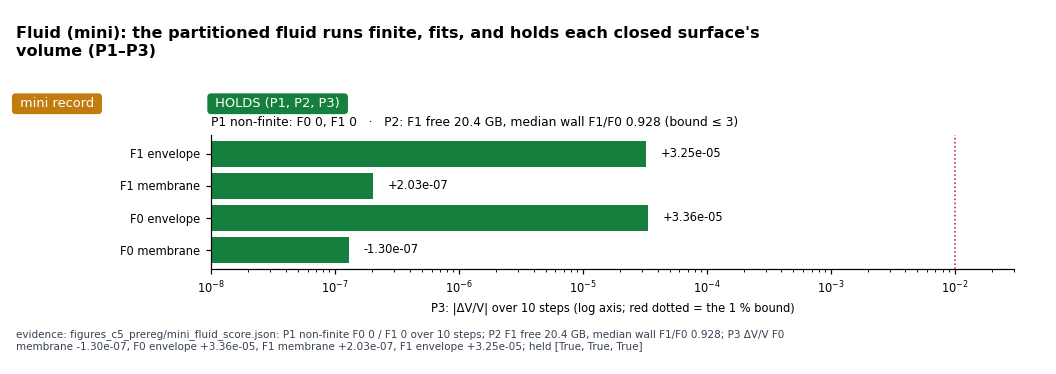
the three pre-declared checksA smaller development cell. This record does not establish full-cell physical behaviour.Source
Record
qs_mini_fluid_F0 / F1
Commit
2c6d6ab1c
Class
mini record
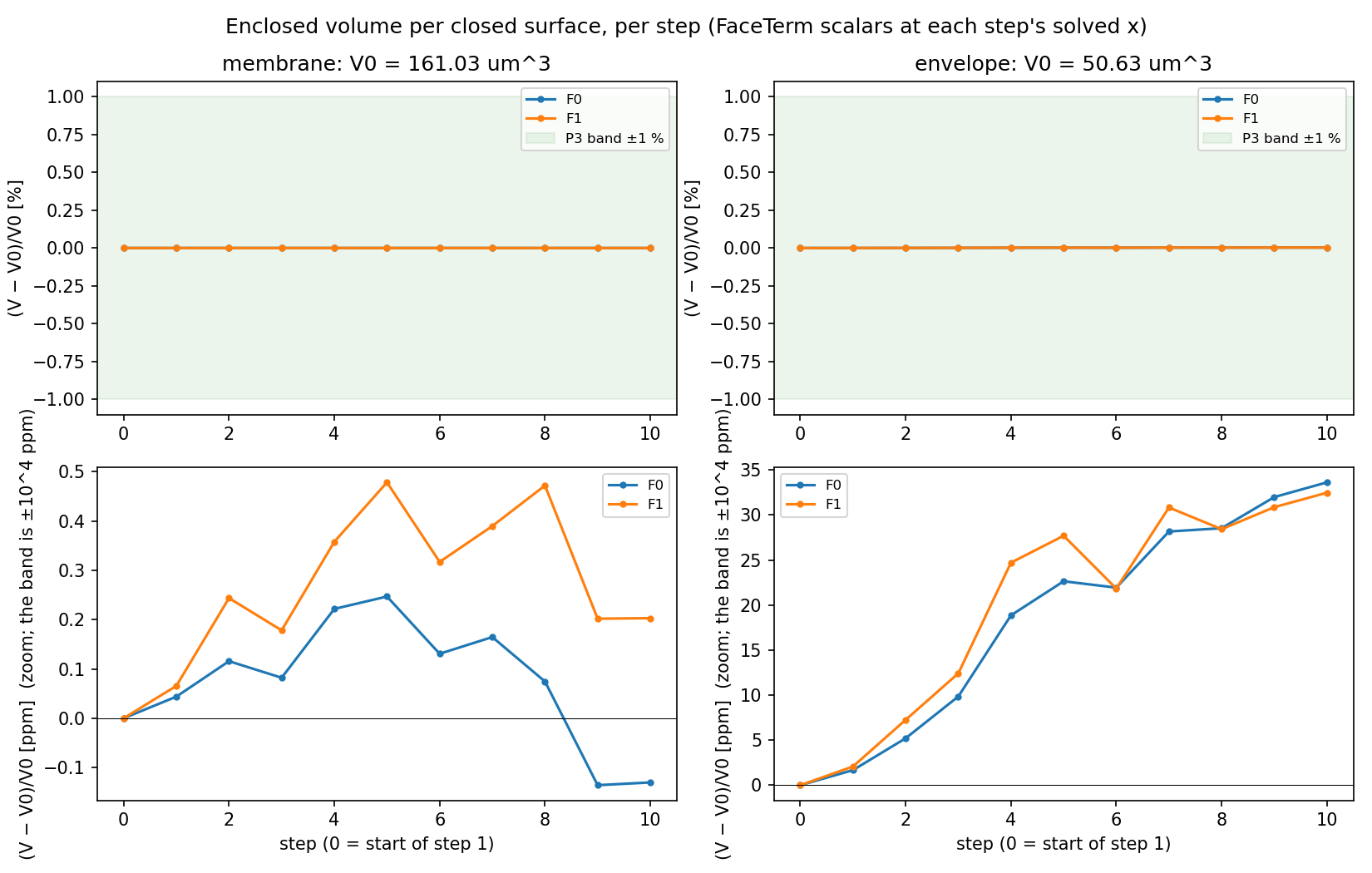
volume per closed surface, per stepA smaller development cell. This record does not establish full-cell physical behaviour.Source
Record
qs_mini_fluid_F0 / F1
Commit
2c6d6ab1c
Class
mini record
mini record
The mini cell with its solvent
The 1.4 M-node mini cell run with and without the partitioned fluid for 10 steps. The run stays finite, fits in memory, and holds each closed surface's volume.
A development check of the fluid path, not a fluid result.
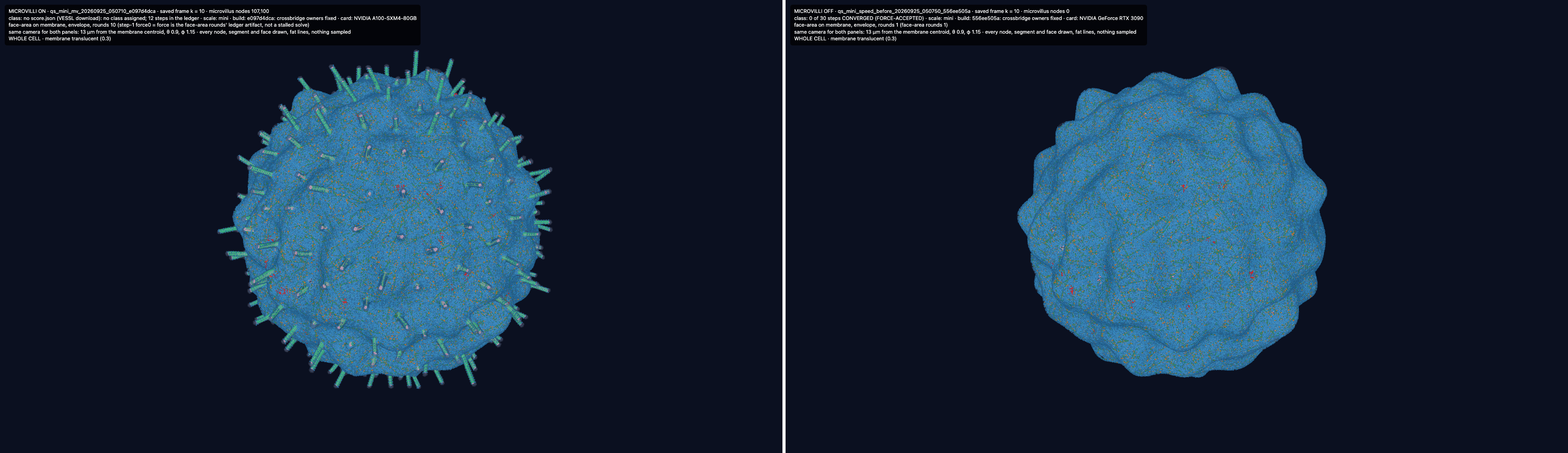
the whole cell, membrane translucent: on left, off rightSource
Record
ON qs_mini_mv_20260925_050710_e097d4dca; OFF qs_mini_speed_before_20260925_050750_556ee505a; renders 25c2fcfd7
Commit
e097d4dca / 556ee505a
Class
mini records: on has no class assigned; off is force-accepted
the membrane and the microvillus cores onlySource
Record
ON qs_mini_mv_20260925_050710_e097d4dca; OFF qs_mini_speed_before_20260925_050750_556ee505a; renders 25c2fcfd7
Commit
e097d4dca / 556ee505a
Class
mini records: on has no class assigned; off is force-accepted
mini record
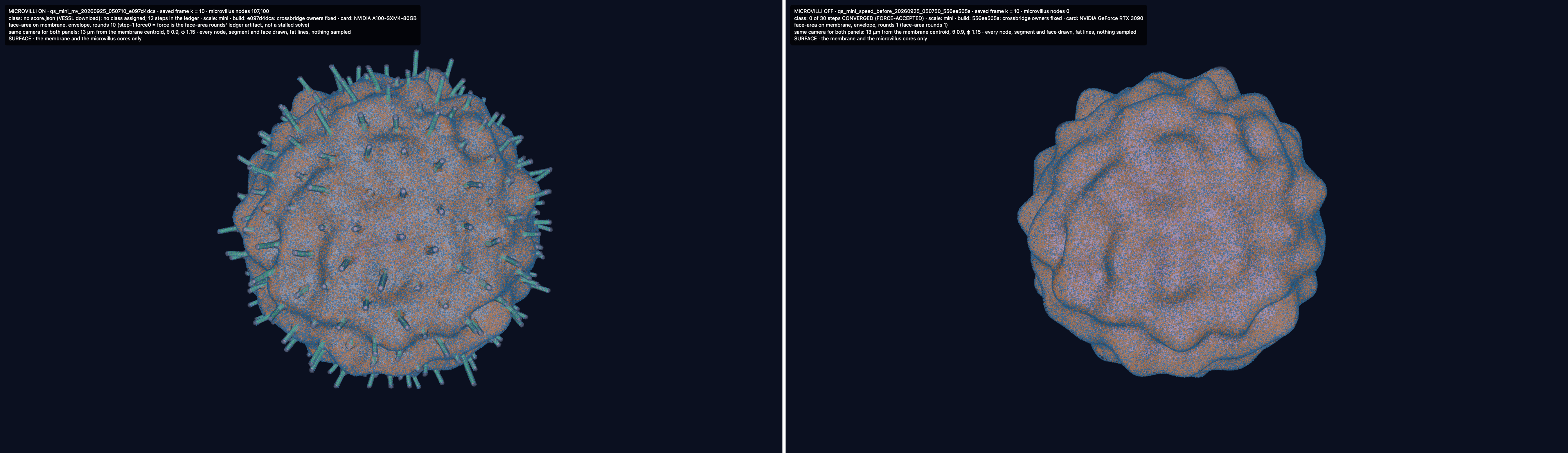
Microvilli on and off
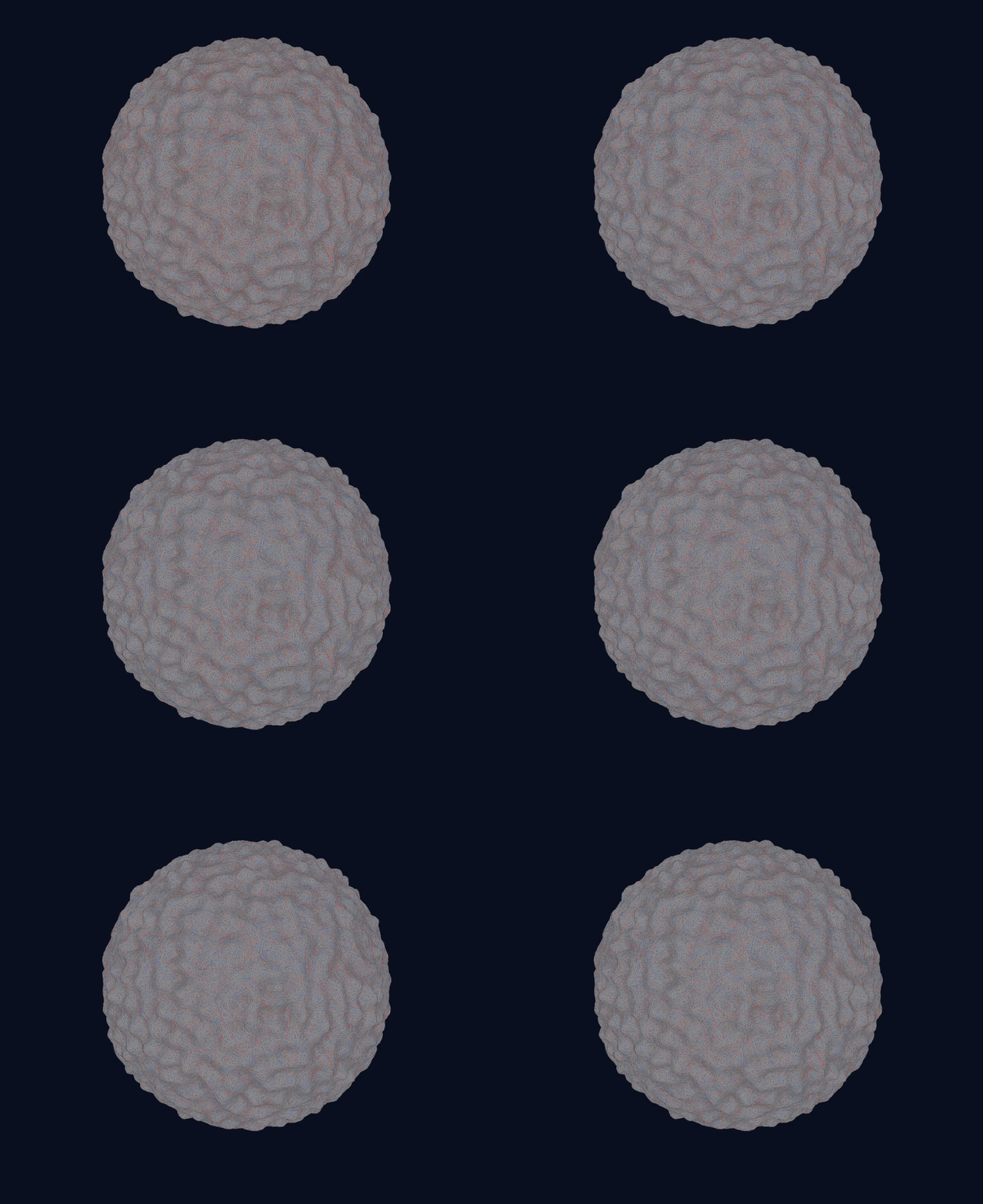
The same mini cell with microvilli (left, 107,100 microvillus nodes) and without (right), at saved frame 10 with the same camera, 13 µm from each membrane's centre.
On: the download has no score file, so no evidence class is assigned (12 steps). Off: FORCE-ACCEPTED (10 Newton/step), 30 steps. A picture of the build, not a mechanical result.
Missing (declared in qs_mini_mv_20260925_050710_e097d4dca/ledger.json missing_declared, and the same in the off record's): no excluded volume between filaments (contact pairs surfaces only): at the cortex's density the build is 3-5x above Onsager's phi_I, so ordering and steric stiffening are absent by construction.
Unread (cell/language.py at e097d4dca): FRONTIER is empty; BOUNDED_OMISSIONS['cytosol_electrochemistry']: pH-dependent rates, because no rate in the corpus is measured against pH; ABSENT_IN_SPECIMEN['integrin', 'clutch', 'substrate']: the suspended cell has no ligand surface or substrate.