Physics engine

See how nodes move, exchange forces and interact with water. The same building blocks form the virtual cell.

As of 16 October 2026 · engine 1ce9612ba

How the engine is built now

A general physics engine is being checked on small test worlds first; the cell is placed on it later, as data.

0laws verified from a full-size device record
1,202signed input rows
603/1,202rows executed on the live path
4unit-world checks against closed formsDEV UNIT WORLD · NOT NATIVE
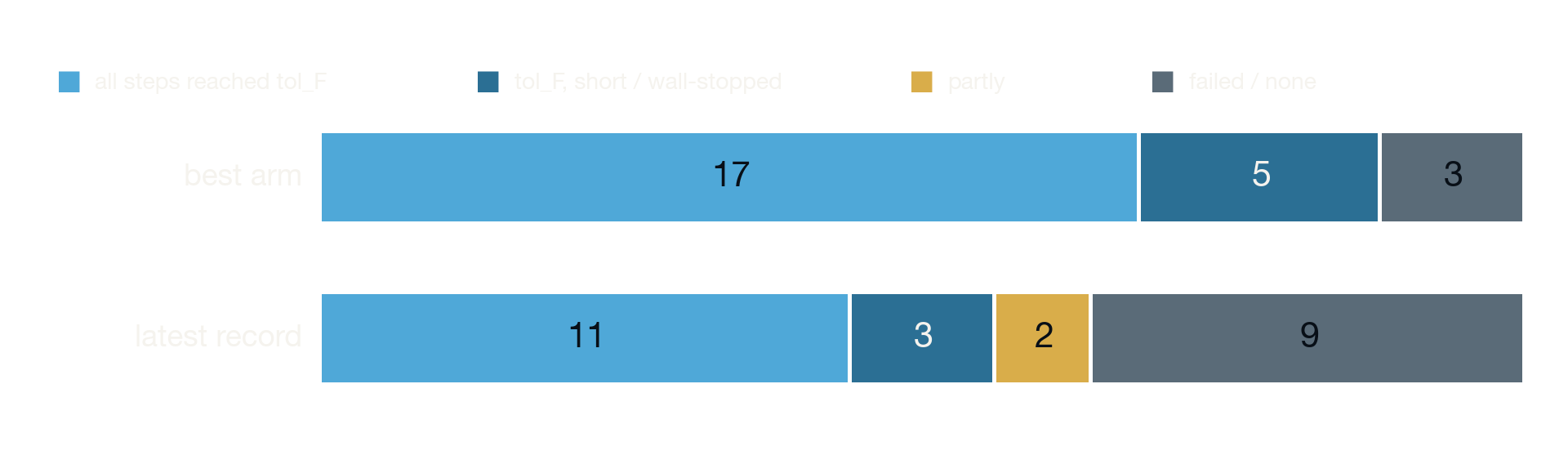
17/25development worlds with every step at tol_F (best arm)DEV UNIT WORLD · NOT NATIVE
11/25… by their latest recordDEV UNIT WORLD · NOT NATIVE

On 7 October the PI set the rules the engine is now built to. In short: get a general physics engine working on simple worlds first, then place the cell on it as data. Nothing below is a result about a cell. What “converged” means, and how Aleph compares with other simulations →

The 9 rules

  1. Engine first, cell secondGeneral engine proven on simple worlds before any cell goes on it.

    The engine is a general physics engine, not a cell engine. It must run correctly on simple worlds (chains, sheets, vesicles) before a cell is placed on it. A problem seen in the cell is fixed in the engine's general behaviour, never with a special case for that cell.

  2. The world is built from dataWorlds are stood up from declared data alone, no cell code.

    A world is built only from what is declared: nodes, relations, surfaces, rigid bodies, fluid regions and their properties. No cell-specific code is needed to stand a world up.

  3. Properties, not namesContact, area and permeation follow data tags, never names.

    Contact, surface area, permeation and fluid walls follow the data tags on each object, never its name. A test stops new name-based branches from being added to the engine.

  4. All laws on, alternatives in parallelEvery law on; alternative models run as parallel declared arms.

    There is one set of laws and all of them are on. Where there is more than one way to model or solve something (for example ideal, osmotic-coefficient or virial osmotic laws, or different solver aids), each is a declared arm. The arms run in parallel on the same world and write the same record format. None is picked as the answer in advance.

  5. Judged by what is left at the endJudged by force left at the end; capped steps stay FORCE-ACCEPTED.FORCE-ACCEPTED

    A step is judged by the force still on the nodes when the solver stops (the tolerance tol_F). The route there is free: coupled solves, preconditioners, continuation or a learned first guess. On 7 October the PI signed a relative stop rule: the remaining force must be at most min(tol_F, 0.1 × the starting force). A step that stops at its iteration budget is still labelled FORCE-ACCEPTED. The physics itself has no mechanism for approving or rejecting a step.

  6. Learned shortcuts are checkedNetworks may speed a step; tol_F still checks every step.surrogate

    Networks may supply the solver's first guess or other aids. That only saves time per step: the final step is still checked against tol_F. A prediction made without the full computation is labelled surrogate and paired with full-resolution comparison steps. No network trained on engine output has yet been shown to make the solve better or faster.

  7. Fluid where it belongsCells need the solvent; without it a run is an approximation.approximation

    For a test of the engine alone, the solvent is optional. For anything run as a cell (from the mini cell up), it is required, and a cell run without it is a labelled approximation that cannot support a conclusion. The fluid region covers only the space nodes can occupy, with no grid inside rigid bodies, on a mesh fitted to the node structure rather than a fixed rectangular box. Since 8 October the engine refuses to build a cell-level world without fluid unless the run declares itself a fluid-free approximation, and that label is written into its record.

  8. Volume by osmosisVolume follows Na⁺, K⁺, Cl⁻ osmosis, not pressure flow alone.

    Cell volume follows explicit solute osmosis, not pressure-driven flow alone. Water crosses the membrane down the osmotic difference set by Na⁺, K⁺, Cl⁻ and large impermeant anions. Discrete (stochastic) and continuous (Goldman–Hodgkin–Katz) ion fluxes run as parallel arms. ATP is held at a fixed concentration, with a finite pool as a parallel arm. Electroneutrality is meant to emerge from the membrane capacitance, not be imposed.

  9. Two parameter files, never mixedEngine and cell numbers live in two separate files.

    Every number is an input. Engine numbers (thermal, solvent, contact, solver tolerances) and cell numbers (nodes, relations, parts) live in two separate files, and the engine code holds no biological constant. Every row has a tag, a unit, a range and a source. An uncertain value is a swept range, not a single number.

Since 2 October

Grouped by what the evidence says. Open a card for the detail and its source.

Matched a prediction on a device 1

  • Vesicle in free-space solventVesicle shape mobility matched Milner–Safran; volume held to 12 digits.Device unit world, cell-free, one seed; an engine check, not a cell result

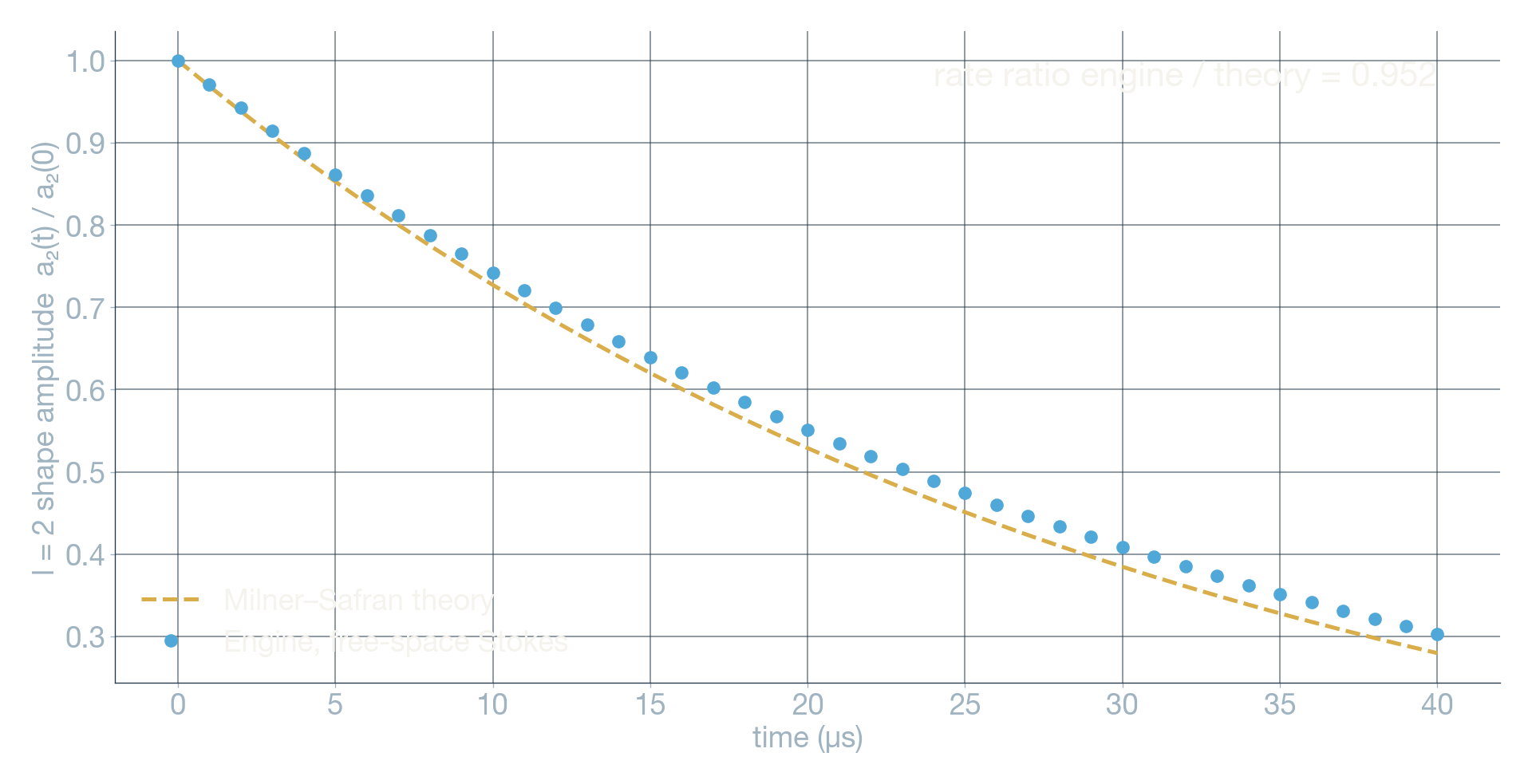
    A cell-free vesicle unit world with 2,562 nodes ran on an RTX 4090 in an unbounded Stokes solvent, at T = 0. The vesicle's shape-mode mobility matched the continuum prediction for a passive surface (22/21 of Milner–Safran at l = 2, 46/45 at l = 3). In the 2,562-node run the enclosed volume held to 12 digits over 40 steps. Shape-relaxation rates with an area modulus are not settled and are not shown.

    Engine design note on Stokes boundary conditions, §10, §12 and §14 (jobs 6–7 October)

Ran on a device, development scale 3

  • Membrane surface viscosityImplemented; device tests pass, but 0 of 10 W3 steps reached tolerance.Device unit tests pass; unit-world steps FORCE-ACCEPTED

    The membrane's in-plane viscosity is implemented as a law. On a device, its term matched its host mirror, and a sheared flat patch dissipated the Boussinesq–Scriven power. In the W3 unit world at dt 1e-3, 0 of 10 steps reached tolerance. The viscosity itself stays a swept range.

    Pending-default-flips registry (PI 8 October)

  • Two solver arms tested on a device (15 Oct)Contact hold and triangle blocks raised steps at tolerance on single parts.Device development runs on single parts, one or two seeds; not full size, not a conclusion

    Holding contact while reducing (reduce_hold_contact): parts C01 and C06 reached the new stop rule on 2 of 2 steps each, at about 0.002 pN; with it off, 0 of 4. Triangle blocks in the preconditioner: part P05 at 310 K went from 0 to 12–13 of 20 steps reaching tolerance; controls P04 20/20, C02 20/20, P06 19/20, at 13 % more cost.

    Project status file, 15 October 10:55 entry

  • Parts and rigs on a device (14–15 Oct)Aster 20/20 steps at the stop rule; motor rig 0.751 vs theory 0.750.Device development runs, one or two seeds; not full size

    A microtubule aster (part P08) reached the stop rule on 20 of 20 steps (4 Newton iterations). A motor rig (M3) read v/v0 = 0.751 against a theory of 0.750. Part C05 reached it on 99 of 100 steps with one fix and 0 of 100 after a later one; the follow-up fix is written but has not run.

    Project status file, 15 October 10:55 entry

Failed, stopped or FORCE-ACCEPTED 5

  • Still not reaching toleranceFull-size 310 K run: 6 steps, none at tol_F; mini cell refused at build.Device runs; FORCE-ACCEPTED or stopped; no conclusion

    A full-size run at 310 K (10 October) stopped after 6 steps; none reached tol_F, and a contact overlap appeared. Unit U1: 0 of 1 steps reached tolerance (reading 0.042 pN); its preconditioned arm costs about 14× more per Newton iteration. P05 preconditioner arms: 0 of 3–4. The mini cell was refused at build because its Arp2/3 pool was overdrawn (132,961 available against 257,944 needed); a pool-first builder fix is queued.

    RESULT 10 October (lead takeover); project status file, 15 October entries

  • Nuclear volume law, one unitA softer nuclear volume modulus failed its preregistered drift limit.Device development unit, below full size; every step FORCE-ACCEPTED (10 Newton iterations)

    The nucleus layer alone (61,277 nodes) ran on a device to test a softer proposed volume modulus (1.5 kPa). It failed its preregistered drift criterion: the volume drifted 0.0117 V0 per second against a limit of 0.01. The old law held (2.6e-5).

    RESULT 7 October, nucleus K_V unit (job 534)

  • Pipette records re-readWater left through the membrane ~9.3 × 10⁴ times faster than membrane entered.Host re-analysis of stored device records; mini cell; every step FORCE-ACCEPTED (3 Newton iterations)

    Earlier mini-cell pipette records were re-read. Water left the cell through the membrane in front of the pipette about 9.3 × 10⁴ times faster (median) than membrane moved into the pipette. This matches the earlier finding that the old membrane let water through far too easily. The reading bands were proposed but not signed.

    RESULT 4 October, MPA v1 leak records

  • Development cell retired from debuggingThe 503,112-node unit reached no step's tolerance; debugging moved to unit worlds.Device development unit, below full size; FORCE-ACCEPTED

    The 503,112-node development unit (U3) ran again on 7 October. No step reached its force tolerance within its 10 Newton iterations. Development cells were then retired from debugging, and debugging moved to cell-free unit worlds. A 16-hour run of those worlds on two cards started that evening. Its results are not yet in the status file, so none are shown here.

    Project status file, 7 October entry

  • Full-size cell build on one 24 GB cardFull-size build: 13.0 M live nodes; out of memory on a 24 GB card, 0 steps.Device build census; 0 physics steps

    The full-size cell was built on a single 24 GB card on 16 October: 15,735,300 nodes allocated, 13,045,402 live, 47.2 million coordinate degrees of freedom. Building the host tables took 4.4 h and host memory peaked at 218.8 GB. The card ran out of memory at 22.95 GB while setting up the contact barrier, so no physics step ran. One 24 GB card is not enough; the hardware choice is open.

    Build-only record, 16 October (engine 53d976dc6)

Written or decided, no device record 6

  • How much of the input is usedNo row unread, 603 executed; 0 laws verified from a full-size device record.Code census on the host; not a physics result

    Of 1,202 signed input rows, none is left unread by the code, and 603 are executed on the live path (wiring ledger computed at engine 1ce9612ba). The number of laws whose observable has been read from a full-size device record is 0. The laws are written, not verified.

    Project status file, wiring ledger (current)

  • Volume law switched to osmosisOsmosis is now the volume law; its unit worlds have not run.PI decision, implemented; no device record

    On 7 October explicit solute osmosis became the volume law. The earlier pressure law (p = p0 + K_V (V0 − V)/V0) is kept as a declared comparison arm. The unit worlds that would verify it on a device have not run yet.

    Pending-default-flips registry, PI 7 October

  • Fluid rule enforcedA cell-level world without fluid is refused unless labelled an approximation.Implemented with host tests; no device record

    A cell-level world without fluid is now refused when the world is built. A run may still go fluid-free only by declaring itself an approximation, and its record then says it supports no conclusion.

    Pending-default-flips registry (8 October)

  • Written since 2 October, not yet verified on a deviceFitted fluid mesh, osmotic arms, solver aids and more: host-tested only.Written: code with host tests; no device record shown

    A fluid mesh fitted to the nodes; the engine parameter file; a scene format that builds a world from data; osmotic-law arms (ideal, osmotic coefficient, virial, Pitzer); ion channels as membrane inclusions; solver-aid arms (warm start, preconditioner, contact prediction); a trust-region Newton arm; a lossless record codec; splitting one world across two GPUs. On 15 October about 45 further lanes were merged, each adding a new mechanism as a declared arm; that batch was checked on the host only. All of these are implemented. Each is now going through testing, and any that shows no advantage will be dropped.

    Engine integration history, 2–15 October; status file, 15 October 21:00 entry

  • Mini-cell instrument showcaseSix instrument call lists prepared; preregistration not signed, nothing has run.Plan only; no run

    Call lists with the solvent are prepared for plate, AFM sphere, tether, micropipette, flicker and ablation on the mini cell. The preregistration was rebuilt on 16 October; it is proposed, not signed, and nothing has run.

    Preregistration 8 October, rebuilt 16 October (PROPOSED, NOT SIGNED)

  • Why the coupled fluid solve has a slow modeSlow mode traced to a nearly redundant flux row; fix in testing.Host algebra, reduced fixtures

    In the coupled fluid solve, the closed-surface flux row is almost a combination of the pressure rows (the discrete divergence theorem), so the constraint is nearly redundant. A basis change that keeps the solution cut iterations from 689 to 489 and from 647 to 524 on two reduced test problems. Host algebra on reduced fixtures; the change is implemented and going through testing.

    Solver note, 16 October

Unit-world checks against closed forms

l=2 shape amplitude of a vesicle against Milner–Safran
DEV UNIT WORLD · NOT NATIVE Vesicle l = 2 mode in a Stokes solvent: engine/theory rate 0.952.
Full caption

Vesicle l=2 shape mode relaxing in a free-space Stokes solvent (job 521, 6 Oct): engine/theory rate ratio 0.952; volume held to 1.8e-13 relative. Records and sha256 in media/verif1016/sources.tsv; numbers in numbers.json.

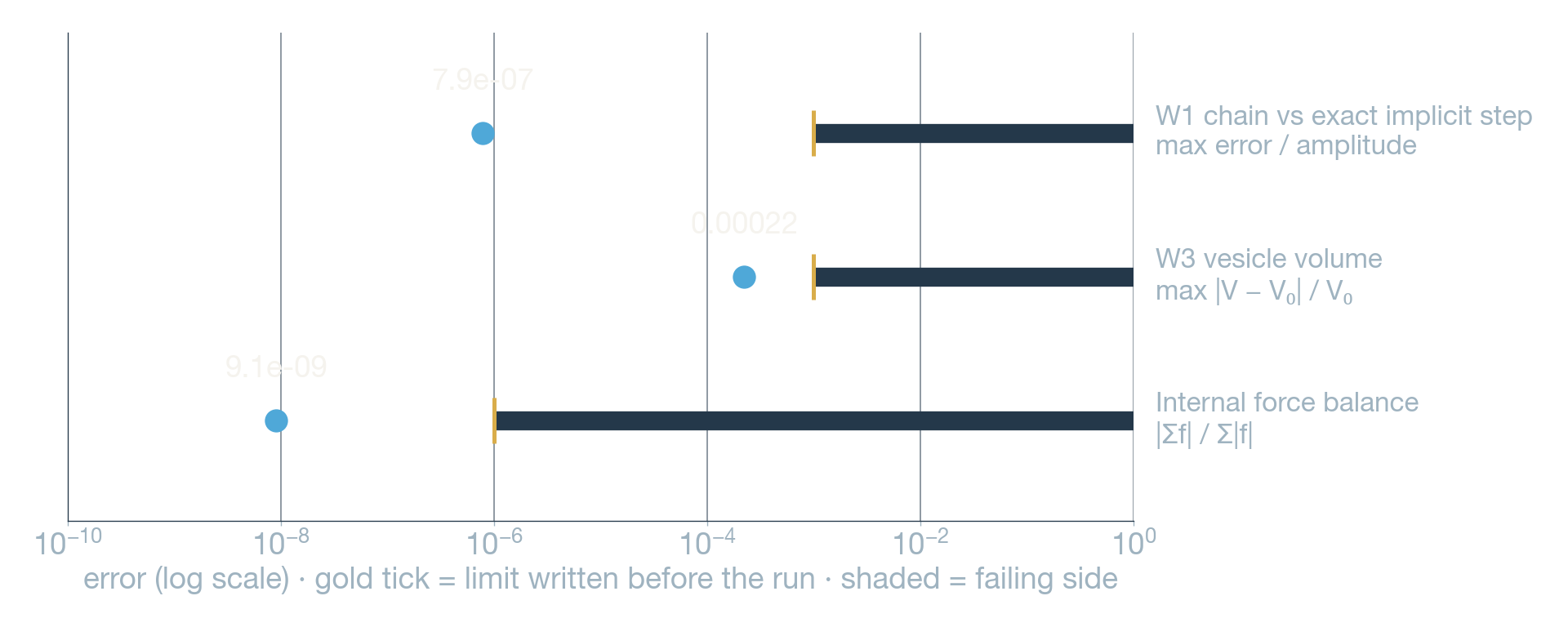
Three error readings against limits written before the run
DEV UNIT WORLD · NOT NATIVEW3 steps FORCE-ACCEPTED Three error readings against limits written before the run.
Full caption

Three readings against limits written before the run: W1 chain vs the exact implicit step 7.9e-7, W3 vesicle volume 2.2e-4, internal force balance 9.1e-9. W3's steps are FORCE-ACCEPTED. Records and sha256 in media/verif1016/sources.tsv; numbers in numbers.json.

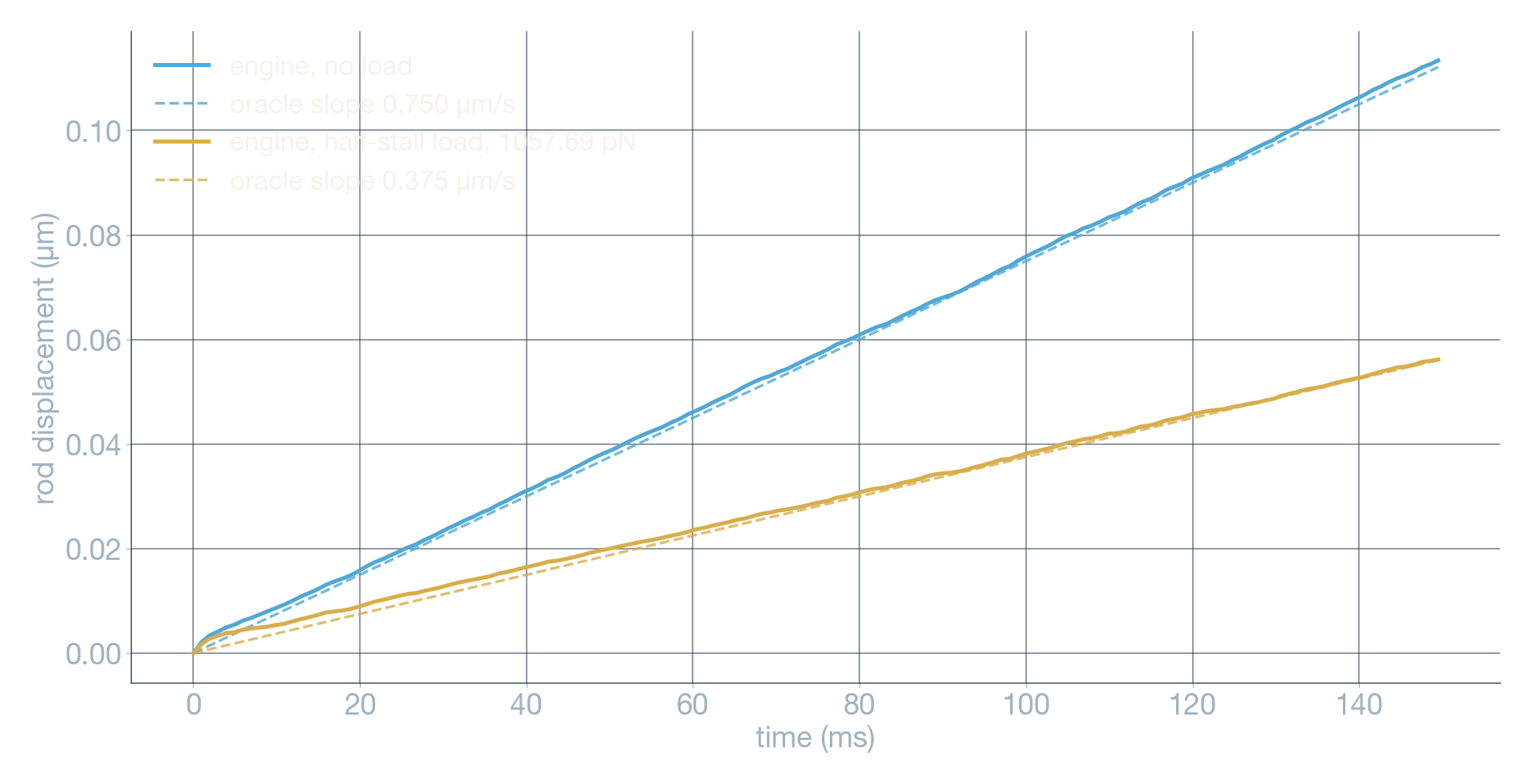
Motor rig rod displacement against oracle slopes
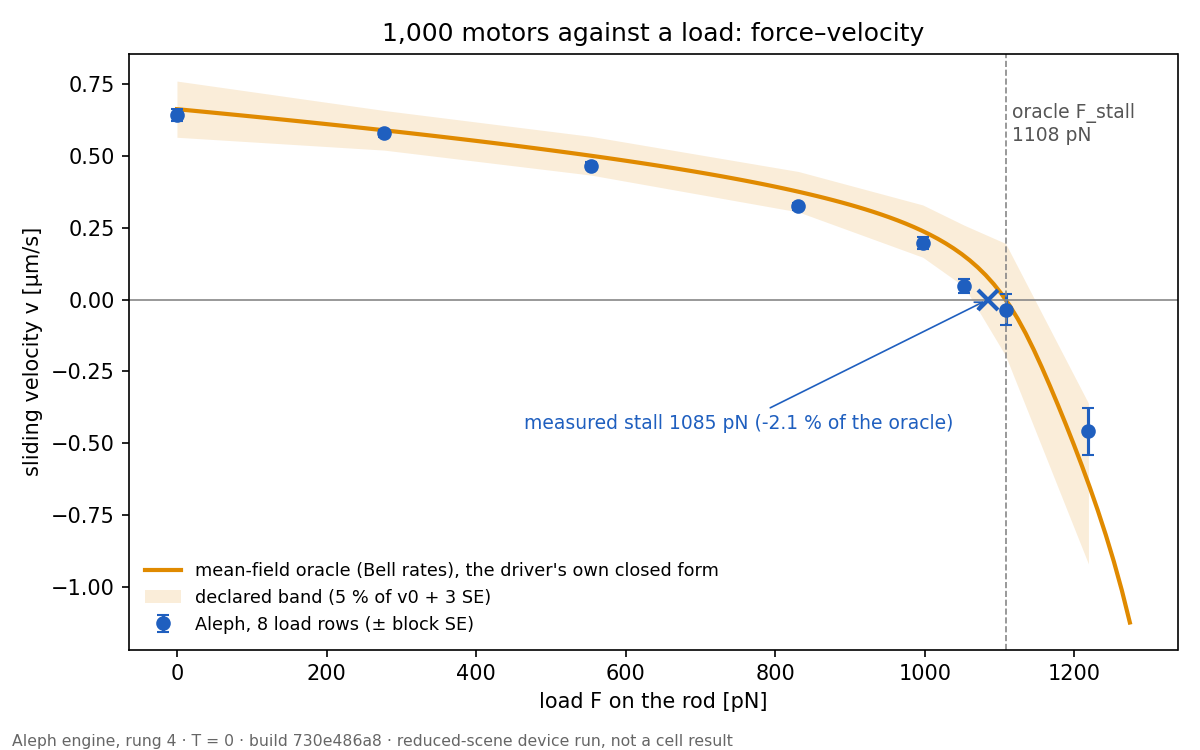
DEV UNIT WORLD · NOT NATIVE Motor rig speed against its mean-field slope, loaded and unloaded.
Full caption

M3 two-rod motor trap: 0.751 ± 0.033 µm/s with no load (oracle 0.750) and 0.366 ± 0.027 µm/s at half-stall, 1057.69 pN (oracle 0.375); ± is 3 SE, one seed. Records and sha256 in media/verif1016/sources.tsv; numbers in numbers.json.

Counts of development worlds by how many steps reached the force tolerance
DEV UNIT WORLD · NOT NATIVE 25 development worlds by how many steps reached tol_F.
Full caption

25 development worlds, latest records read 16 Oct 11:33: best arm 17 with all steps at tol_F, 5 at tol_F but short (≤2 steps) or wall-stopped, 0 partly, 3 failed; latest record 11 / 3 / 2 / 9. M3's best arm is the rig without the full engine core. Records and sha256 in media/verif1016/census_latest/sources.tsv.

Device records, 2–16 October · dev unit worlds, not native

More recent records

Records from the last two weeks, drawn from their stored frames, one video frame per stored frame.

Microtubule aster at 310 K (P08 unit world)

Solved at tol_F · every step

Microtubules radiating from one centrosome, kicked by thermal noise at 310 K for 50 steps (no solvent: engine unit world).

RecordOpen

P08_mt_aster__T310_arm2_straight@phys2 · engine · 2026-10-14 · ALL 50 STEPS SOLVED AT tol_F

Motors carrying cargo along microtubules, with solvent (C05)

Solved at tol_F · every step

Motor heads walk cargo beads along a microtubule aster in Stokes solvent at 310 K; white lines are live motor bonds.

RecordOpen

C05_mt_motors_cargo__T310_fluid@e2s_ctrl · engine · 2026-10-15 · ALL 100 STEPS SOLVED AT tol_F

Pulling a membrane tether from a vesicle (B8)

Partial · stopped at wall cap

Two tethers pulled out of a vesicle at constant tension: 97/167 steps solved at tol_F, then the run hit its wall cap (500 steps were declared).

RecordOpen

B8_tether_pull__remesh_off@rm_off_s0_b8fix_full · engine · 2026-10-16 · 97/167 STEPS SOLVED AT tol_F · 70 FORCE-ACCEPTED · RUN STOPPED BEFORE ITS DECLARED END

Membrane vesicle fluctuating at 310 K (P01)

Solved at tol_F · every step

A triangulated membrane vesicle (radius 1 µm) undulating at 310 K; all 450 steps solved at tol_F, the film shows the first 225 stored frames.

RecordOpen

P01_membrane__smooth_T310_long_dt1e-3@phys2 · engine · 2026-10-14 · ALL 450 STEPS SOLVED AT tol_F

Formin cortex patch at 310 K (P04)

Solved at tol_F · every step

A formin-nucleated actin cortex shell with its crosslinkers, moving thermally at 310 K.

RecordOpen

P04_cortex_formin__T310@e2s_ctrl · engine · 2026-10-16 · ALL 50 STEPS SOLVED AT tol_F

Cortex with NMII minifilaments, with solvent (C02 ratchet arm)

Solved at tol_F · every step

An actin cortex shell with NMII minifilaments pulling on it, in solvent at T = 0 (ratchet arm).

RecordOpen

C02_cortex_nmii__T0_fluid_ratchet · engine · 2026-10-15 · ALL 50 STEPS SOLVED AT tol_F

Free motors binding a filament at 310 K (L3, 600 steps)

Solved at tol_F · every step

Free kinesin motors diffuse at 310 K, bind to a filament and unbind; 600 steps.

RecordOpen

L3_free_motor_binding__T310 · engine · 2026-10-16 · ALL 600 STEPS SOLVED AT tol_F

Arp2/3 branched cortex patch at 310 K (P05)

FORCE-ACCEPTED · not solved at tol_F

An Arp2/3 branched cortex with α-actinin and filamin. No step reached tol_F (all 100 were FORCE-ACCEPTED, residual 10–200 pN), so the motion shows the solver's limit, not physics.

RecordOpen

P05_cortex_arp23__T310_angle_form1@cyc_on · engine · 2026-10-16 · 0/100 STEPS SOLVED AT tol_F · 100 FORCE-ACCEPTED

Explore the implementation

The engine, part by part

Open the whole structure →

Follow a part to its laws, inputs and recorded checks.

Foundations

Strands

Surfaces

Contact

Fluid

Instruments and loads

Thermal motion

Kinetics

Time step

Record and replay

Earlier recordings · 24–29 September 2026

These records retain their original conditions and build identifiers. They are kept for comparison with the current gallery.

The engine at work

Aleph builds a cell out of nodes because of its active parts: motors turn chemical energy into force, and only a model that resolves each motor and each filament can show where that force goes. Every scene below is the engine's own record, played back in 3-D. Nothing is drawn that the record does not hold; between two saved steps the motion is interpolated for display, and each scene says so. The cortical-tension instruments (plate, indentation, micropipette, flicker, tether) run on the whole mini cell are on the Experiments page.

How to read these scenes
Node
the engine's one kind of object: a small bead with mass and a radius. Filaments, membranes and motors are all nodes.
Cortex
the mesh of actin filaments just under the membrane.
Myosin minifilament
a bundle of myosin motors whose heads reach out to actin.
Crossbridge, stroke
a myosin head holding actin; the stroke is the step in which it pulls.
FORCE-ACCEPTED (10 Newton/step)
each time step got a budget of 10 solver iterations (not a force of 10 newtons) and kept what the solver reached, without solving it fully.
Residual
the force left unbalanced when the solver stopped.

site_demo_b3b_20260925_050771_7_1e714e687
commit 1e714e687
C4's PREREG-lite verdict: all three pass

A ball comes to rest on a plate

C4's signed B3b scene: a 0.5 µm ball pushed toward a plate with a steady 1 pN force, through water it feels only as drag.More

It falls, touches and stops without passing into the plate. The gold arrow is the force applied to it; the blue arrow is the push the plate gives back, which grows as the ball arrives until the two balance. The engine has no contact friction: the plate pushes only straight back.

  • At rest the plate pushes back 0.998 of the applied force, within the ±5 % signed before the run; the ball's final speed is 0.18 % of its free-fall speed (≤ 1 % signed).
  • No node on the wrong side of the plate and no overlap at any step. It rests 6.8 nm above the plate.

Five steps of 1 ms, each 1.1 s on screen, positions and forces interpolated between steps for display; the last step is held.

Reduced-scene device run (a small scene on the GPU, compared with a closed form declared in advance); not a cell result. It stopped at the first step whose net force is below tolerance. This figure is not a physics conclusion.

Source
Record
site_demo_b3b_20260925_050771_7_1e714e687
Commit
1e714e687

Missing: no contact friction (the scene says 'no friction'); the drag is each node's own 6πηR from still water, no water grid in this scene: a fluid-free approximation, acceptable for an engine-only test but not for a cell. Inputs are EXAMPLE values (directive 10).

flicker_mv_ka_mini_…_f1ecaee15
commit f1ecaee15
no class assigned; 10 Newton/step, residual median 3.25e+03 pN

Microvilli on the cell surface

Where the microvilli are densest on a mini cell that has them: every membrane, microvillus and cortex node within 1.3 µm, through 100 steps of 10 ms.More

Each microvillus is a bundle of actin (orange) rooted in the cortex (green), inside a tube of membrane (grey) that the build wraps around it. Turned so the cell's outside is up.

  • 3,994 microvillus nodes, 6,080 membrane nodes and 8,106 cortex nodes in this patch; the membrane's 11,873 triangles include the tubes.
  • Over this second the surface barely moves: the microvilli sway by a few nanometres.

Every 2nd of 100 recorded steps is shown; positions in between interpolated for display. Families left out of this view: all but membrane, microvilli and cortex.

Mini record (1.5 M nodes); no evidence class assigned in the download (no score file). Step readings over its 100 steps: residual median 3.25e+03 pN (step-end net force), contact share 1.00, 10 Newton/step (median). A patch of it. This figure is not a physics conclusion.

Source
Record
flicker-0926-f1ecaee15 / flicker_mv_ka_mini_20260926_053300_f1ecaee15
Commit
f1ecaee15

Missing: this record's layout carries no ledger, so it declares none of its own; its build is the one described on the Microvilli part page.

qs_long_bt_nogrowth_20260925_040000_b496c1527
commit b496c1527
FORCE-ACCEPTED (10 Newton/step)

A micron-wide patch of cortex, bond by bond

Every node and bond within 0.55 µm of the myosin minifilament with the most heads bound at the last saved step, through its 15 saved steps.More

Alpha-actinin (blue) ties cortex filaments together; myosin heads (amber) grab actin, stroke and let go; ERM tethers (red) hold the membrane (grey) to the cortex. A bond that forms flashes white; one that lets go fades out.

  • Over the 1.4 s shown: 153 alpha-actinin bonds formed and 136 let go;
  • 25 myosin heads grabbed actin, 14 let go and 9 made their power stroke;
  • 658 ERM tethers formed and 692 let go.

Saved every 10 steps (0.1 s); positions in between are interpolated for display.

FORCE-ACCEPTED (10 Newton/step) native record (residual median 6.38e+03 pN, contact share 1.00; step_readings): each step is what the solver reached in the iterations it had. This figure is not a physics conclusion.

Source
Record
qs_long_bt_nogrowth_20260925_040000_b496c1527
Commit
b496c1527

Missing: none declared (the ledger of this record has no missing_declared key). Unread (cell/language.py at b496c1527): BOUNDED_OMISSIONS['cytosol_electrochemistry'], ABSENT_IN_SPECIMEN['integrin', 'clutch', 'substrate']. In plain terms: no ion chemistry, and nothing for the cell to stick to.

qs_long_bt_nogrowth_20260925_040000_b496c1527
commit b496c1527
FORCE-ACCEPTED (10 Newton/step)

One myosin minifilament at work

A close-up of the same minifilament: every node and bond within 0.3 µm of it.More

A bound head sits a few nanometres from its actin, so each one is marked by a sphere: amber when bound, glowing gold after its stroke (most bound heads in this record are past their stroke). Markers grow as a head binds and shrink as it lets go; everything but the heads is dimmed. This is the motor the engine exists for, inside the full cell rather than in a test rig.

  • Over the 1.4 s shown: 17 myosin heads grabbed actin, 8 let go and 4 made their power stroke;
  • 10 heads are bound at the last saved step.

Saved every 10 steps (0.1 s); positions in between are interpolated for display.

FORCE-ACCEPTED (10 Newton/step) native record (residual median 6.38e+03 pN, contact share 1.00; step_readings): each step is what the solver reached in the iterations it had. This figure is not a physics conclusion.

Source
Record
qs_long_bt_nogrowth_20260925_040000_b496c1527
Commit
b496c1527

Missing: none declared (the ledger of this record has no missing_declared key). Unread (cell/language.py at b496c1527): BOUNDED_OMISSIONS['cytosol_electrochemistry'], ABSENT_IN_SPECIMEN['integrin', 'clutch', 'substrate']. In plain terms: no ion chemistry, and nothing for the cell to stick to.

qs_long_bt_nogrowth_20260925_040000_b496c1527
commit b496c1527
FORCE-ACCEPTED (10 Newton/step)

Cargo, microtubules and the motors between them

Where the most cargo is held by motors in the simulated cell: every microtubule node (cyan) and every cargo node within 1.2 µm, through the 15 saved steps, each with the path it took.More

Kinesin and dynein are relations between a cargo and a microtubule; a cargo held by one right now is bright gold, a free one dim. At any moment most cargo here is free, and its path wanders; other families are left out of this view.

  • Over the 1.4 s shown: 6 kinesin-cargo and 5 dynein-cargo bonds formed; 4 and 3 let go.
  • Across the whole cell, cargo nodes moved a median 0.88 µm over these 1.4 s.

Saved every 10 steps (0.1 s); positions in between are interpolated for display.

FORCE-ACCEPTED (10 Newton/step) native record (residual median 6.38e+03 pN, contact share 1.00; step_readings): each step is what the solver reached in the iterations it had. This figure is not a physics conclusion.

Source
Record
qs_long_bt_nogrowth_20260925_040000_b496c1527
Commit
b496c1527

Missing: none declared (the ledger of this record has no missing_declared key). Unread (cell/language.py at b496c1527): BOUNDED_OMISSIONS['cytosol_electrochemistry'], ABSENT_IN_SPECIMEN['integrin', 'clutch', 'substrate']. In plain terms: no ion chemistry, and nothing for the cell to stick to.

show94_rung4bC_…_c21a26b2e
commit c21a26b2e
frames only, T = 0, dt 1e-4 s

The cell's own myosin minifilament sliding two actin filaments

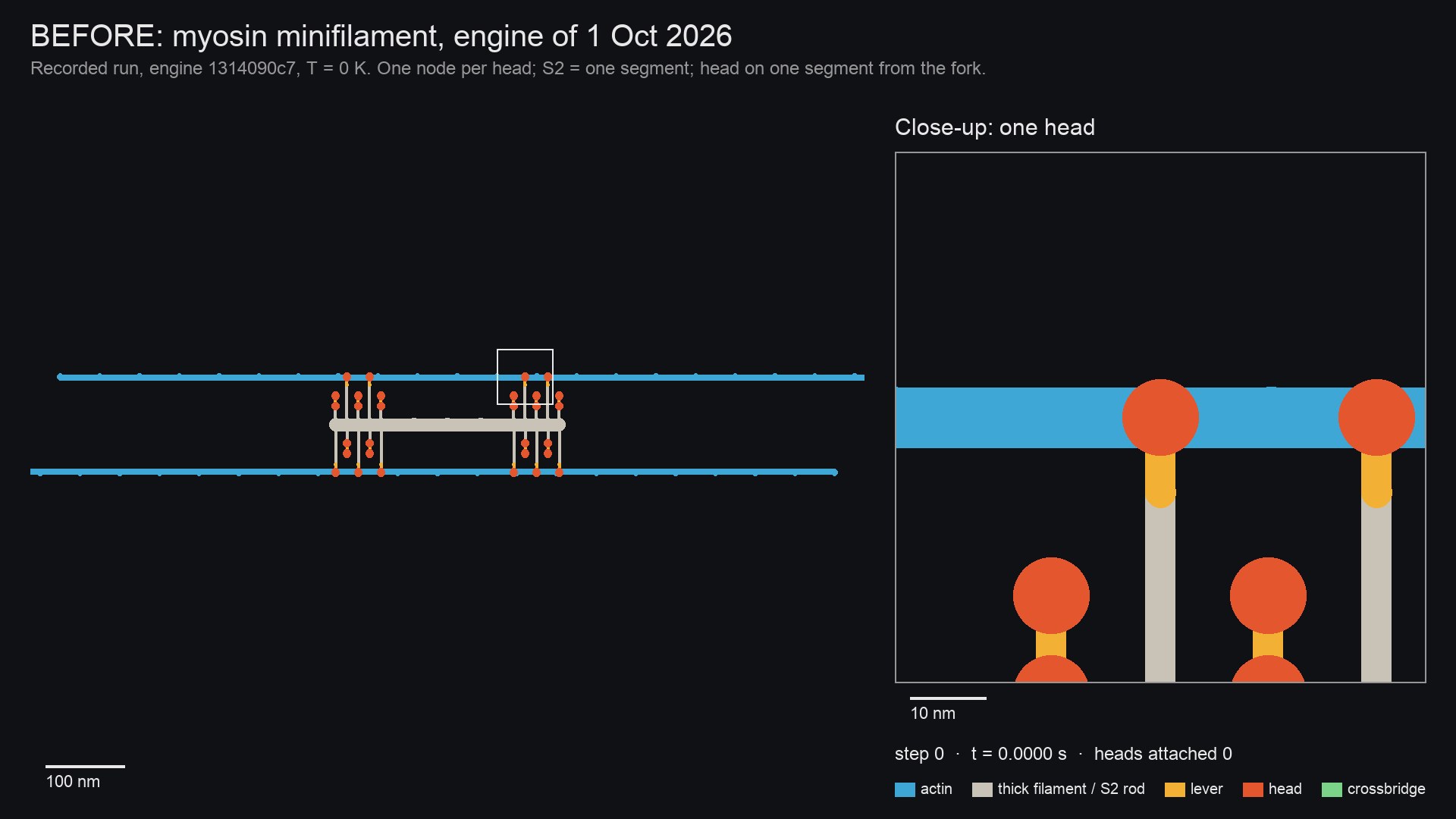
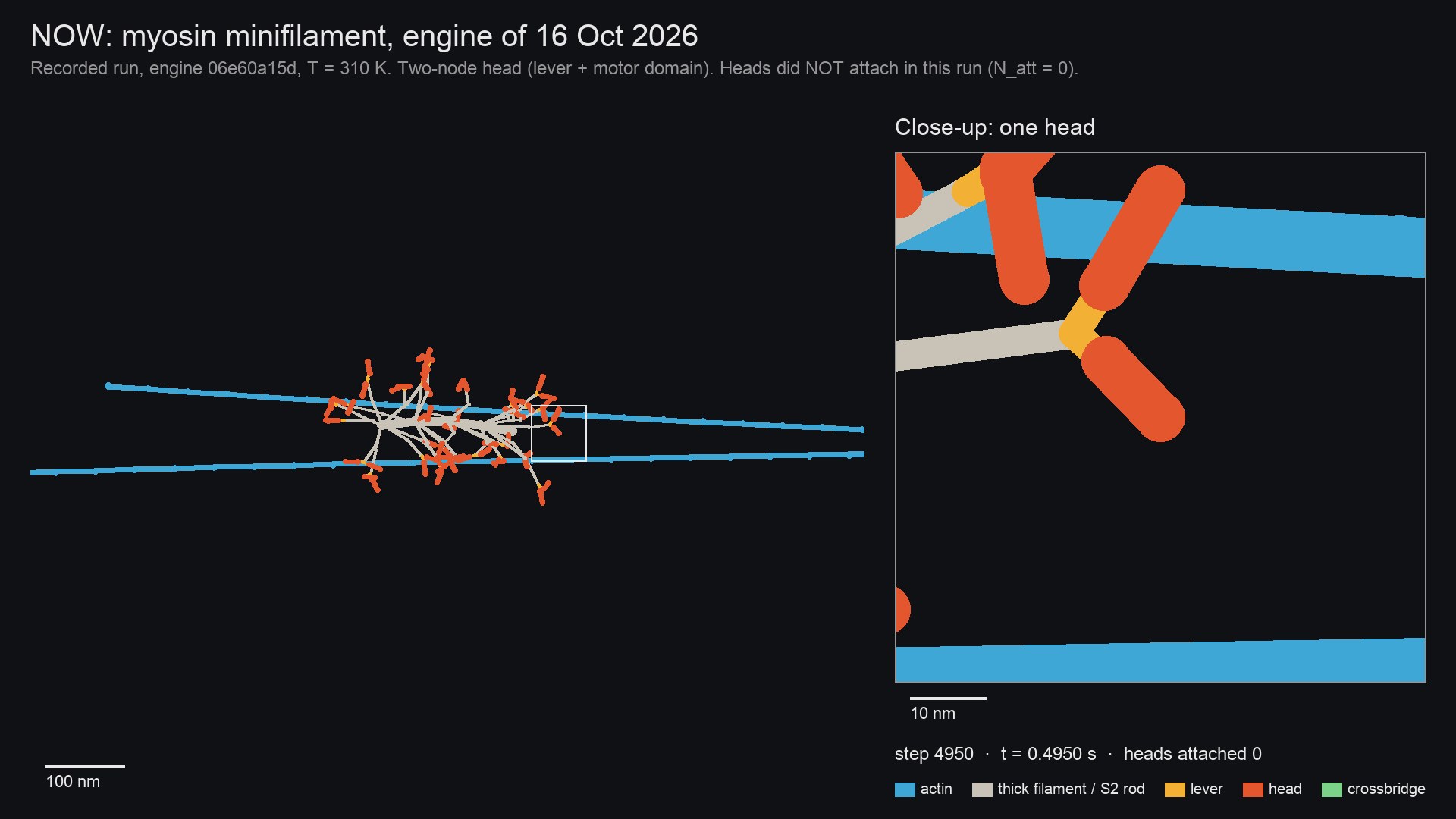
The engine's rung 4b rig: the myosin II minifilament the cell is built with (backbone, arms and 60 heads) placed between two free actin filaments of 40 nodes, at zero temperature, for 3 s.More

Heads within reach grab an actin filament (amber), stroke (glowing gold) and let go, and the two filaments slide apart. Seen from above.

  • Up to 12 heads bound at once, 45 bindings in all; the two filaments slide 0.445 µm apart over the 3 s.
  • At body temperature this rig cannot be stepped with this solver yet (a thermal kick moves a node two segments per step); the zero-temperature row is the one that can.

Recorded every 10 steps of 0.1 ms; every 13th recorded step is shown, positions in between interpolated for display.

Reduced-scene device run, frames only (the rung writes no gate record under --record); not a cell result. This figure is not a physics conclusion.

Source
Record
show94_rung4bC_20260925_050757_81_c21a26b2e / rung4b_T0_sign+1_dt1e-04_pcg_fd_exact
Commit
c21a26b2e

Missing: this frames-only run declares none of its own; the rung's gate record carries its bands. Zero temperature: no thermal motion in this row.

show94_rung4slide_…_c21a26b2e
commit c21a26b2e
frames only, dt 1e-5 s, zero load

A thousand motors sliding one rod past another

The engine's rung 4 rig at zero load: two rods of 200 nodes on one line, and 1,000 motor slots on the upper rod that bind the lower rod, stroke and let go.More

The window shows 1 µm of the 10 µm overlap, every node and motor inside it, side on. In the run both rods lie on one line; here the lower rod is drawn 60 nm below it so the motors between them can be seen. Amber: bound, before its stroke; light blue: after it. A motor that binds flashes white; one that lets go fades.

  • The upper rod slides 0.098 µm in the 0.15 s recorded, about 0.65 µm/s; this rig's gate run measured 0.644 ± 0.023 µm/s against the closed form's 0.6625 ('Motors sliding filaments' below).
  • At any moment about 150 motors are bound before their stroke and about 320 after it, across the whole overlap.

Recorded every 50 steps of 10 µs; every 2nd recorded step is shown, positions in between interpolated for display. The zero-load tie to the holder is not drawn.

Reduced-scene device run, frames only (the rung writes no gate record under --record); not a cell result. This figure is not a physics conclusion.

Source
Record
show94_rung4slide_20260925_050757_75_c21a26b2e / rung4_B_zero_load
Commit
c21a26b2e

Missing: this frames-only run declares none of its own; the rung's gate record carries its bands.

show94_rung4walk_…_c21a26b2e
commit c21a26b2e
frames only, dt 1e-5 s, zero load

The same motors, stroking as a walk

The same rig with the stroke made a walk: each bound motor steps along the lower rod's polarity instead of pulling on a fixed point.More

Zero load. Amber: a motor bound, before its step; light blue: after it. A motor that binds flashes white; one that lets go fades. The window shows 1.4 µm, every node and motor inside it, side on; the lower rod is drawn 120 nm below its true line so the motors can be seen, and the zero-load holder tie is not drawn.

  • The upper rod walks 1.29 µm in the 0.15 s recorded, about 8.6 µm/s at zero load.

Recorded every 50 steps of 10 µs; every 2nd recorded step is shown, positions in between interpolated for display.

Reduced-scene device run, frames only (the rung writes no gate record under --record); not a cell result. This figure is not a physics conclusion.

Source
Record
show94_rung4walk_20260925_050757_76_c21a26b2e / rung4_M_walk_F0.0
Commit
c21a26b2e

Missing: this frames-only run declares none of its own; the rung's gate record carries its bands.

show94_b2_20260925_050757_71_c21a26b2e
commit c21a26b2e
FORCE-ACCEPTED (3 Newton/step)

A bead settling through still water, and the flow it makes

C5's signed B2 scene: one bead smaller than a grid cell, pushed by a steady force through a 32³ box of still water for 40 steps.Recorded before the 7 October engine changesMore

Recorded before the 7 October engine changes (fluid mesh fitted to the nodes, osmotic volume law, relative stop rule); re-recording pending. The lines are streamlines of the water velocity the run kept at every step, traced through that field for display (not simulated); a bright pulse runs along each, faster where the water is faster. Blue is nearly still water, yellow as fast as the bead.

  • The bead's speed over the last 10 steps is 0.988 of Stokes' law, inside the ±3 % signed before the run.
  • The water next to the bead moves with it; in the closed box the water it pushes comes back around the sides.

One step of the run is 0.2 s on screen; the kept velocity is interpolated between steps and the streamlines are retraced as it changes.

Reduced-scene device run (a small scene on the GPU, compared with a closed form declared in advance); not a cell result. FORCE-ACCEPTED (3 Newton/step) / residual median 2.58e-15 pN (step-end net force, 40 steps) / contact share 0.00 (Sdf+Barrier / all, at the argmax node; median of 40 steps). This figure is not a physics conclusion.

Source
Record
show94_b2_20260925_050757_71_c21a26b2e
Commit
c21a26b2e

Missing (declared in show94_b2_20260925_050757_71_c21a26b2e/showcase.json missing_declared): fluid v1: no thermal stress in the solvent and no noise on the face friction; sub-grid beads only: a resolved sphere slips in v1 (its coupling is the grid-scale face friction). This is a re-run of the signed scene with the water velocity kept; its numbers are identical to the gate run site_demo_b2_20260925_050770_7_b305a5ffc.

show94_b4_20260925_050757_79_c21a26b2e
commit c21a26b2e
FORCE-ACCEPTED (3 Newton/step)

Two beads settling side by side

C5's signed B4 scene: two beads, 8 grid radii apart, pushed across the line between them through a 128³ box of still water for 40 steps.Recorded before the 7 October engine changesMore

Recorded before the 7 October engine changes (fluid mesh fitted to the nodes, osmotic volume law, relative stop rule); re-recording pending. Shown: the window of water around them (44³ cells, every cell at full resolution). The lines are streamlines of the water velocity the run kept, traced through it for display (not simulated).

  • Each bead of the pair falls 3.1 % faster than a lone bead in the same box; Rotne–Prager predicts 4.7 %.
  • That is 0.66 of the prediction, outside the ±25 % signed before the run: this check does not match (see the checks below).

One step of the run is 0.2 s on screen; the water velocity is kept every 4th step and interpolated between for display.

Reduced-scene device run (a small scene on the GPU, compared with a closed form declared in advance); not a cell result. FORCE-ACCEPTED (3 Newton/step) / residual median 9.53e-15 pN (step-end net force, 80 steps) / contact share 0.00 (Sdf+Barrier / all, at the argmax node; median of 80 steps). This figure is not a physics conclusion.

Source
Record
show94_b4_20260925_050757_79_c21a26b2e
Commit
c21a26b2e

Missing (declared in show94_b4_20260925_050757_79_c21a26b2e/showcase.json missing_declared): fluid v1: no thermal stress in the solvent and no noise on the face friction; sub-grid beads only: a resolved sphere slips in v1 (its coupling is the grid-scale face friction); box walls not corrected (d/L = 0.08): the increment carries their image effect. A re-run of the signed scene with the water kept; its numbers equal the gate run site_demo_b4_20260925_050770_7_b305a5ffc.

show94_b6_20260925_050757_72_c21a26b2e
commit c21a26b2e
fluid-only solve (300 Uzawa iterations; no Newton)

Suction into a capped pipette

C5's signed B6 scene: a glass pipette in a 16 × 8 × 8 µm box of water, its far end capped, suction held inside the bore.More

Two colours of ink are released from 25 points in front of the mouth, alternating by row, and carried by the water velocity the solve returned, so you can watch the suction draw them in. The ink is drawn into the recorded flow for display, not simulated by the engine; the faint lines are streamlines of the same field.

  • The flow through the bore is 0.945 of Poiseuille flow at the bore's own pressure gradient, inside the ±10 % signed before the run.
  • 0.64 of the set pressure drop reaches the bore.

One steady solve, no time steps: the ink moves at the recorded velocity on a display clock (1 s on screen ≈ 2.3 ms of flow) and fades with a 10 s half-life on screen.

Reduced-scene device run (a small scene on the GPU, compared with a closed form declared in advance); not a cell result. fluid-only solve (300 Uzawa iterations; no Newton) / masked r_div 0.000262 /s, r_mom 1.19e-07 pN/um^3 at the end / contact share n/a (no contact terms: fluid only). This figure is not a physics conclusion.

Source
Record
show94_b6_20260925_050757_72_c21a26b2e
Commit
c21a26b2e

Missing (declared in show94_b6_20260925_050757_72_c21a26b2e/showcase.json missing_declared): fluid v1: no thermal stress in the solvent and no noise on the face friction; no membrane in this scene; in a cell scene v1's membrane normal coupling is the grid face friction, ~2.3e7 x more permeable than the membrane's Lp (DESIGN-2026-09-24-c5-pipette-suction s4); the glass is held MAC faces (the ANY coarse rule), the far end capped (the syringe line); an open far end delivered ~1/3 of the set dP to the bore (DESIGN 52c213bc3). This is a re-run of the signed scene with the water velocity kept; its numbers are identical to the gate run site_demo_b6_20260925_050770_7_b305a5ffc.

show94_rung7_…_c21a26b2e
commit c21a26b2e
frames only, one steady solve

A rod pulled sideways through water, and its flow

The engine's rung 7 scene: a 5 µm rod of 101 nodes held in a 12.8 µm box of water while the water is solved for a sideways pull.More

Two colours of ink are released from 21 points 1 µm behind the rod and carried by the solved velocity: the water next to the rod is dragged along and the rest comes back around its ends. The ink is drawn into the recorded flow for display, not simulated; the faint lines are streamlines of the same field.

  • A rod is harder to pull sideways than along its length; the gate run puts the drag ratio at 1.527, inside the slender-body band 1.482 to 2.005 ('Water dragged by a moving rod' below).
  • This frames run's own tensor check printed a failure (K∥/K⊥ = 0.46); frames runs use a reduced configuration and write no gate record.

One steady solve, no time steps: the ink moves at the recorded velocity on a display clock (1 s on screen ≈ 5.2 s of flow) and fades with a 10 s half-life on screen; the pulses' pace shows relative speed.

Reduced-scene device run, frames only (the rung writes no gate record under --record); not a cell result. This figure is not a physics conclusion.

Source
Record
show94_rung7_20260925_050757_77_c21a26b2e / rung7_rod_perpendicular
Commit
c21a26b2e

Missing: this frames-only run declares none of its own; the rung's gate record carries its bands.

site_demo_b5_20260925_050770_7_b305a5ffc
commit b305a5ffc
FORCE-ACCEPTED (3 Newton/step)

Sixty-four beads kicked by heat

C5's signed B5 scene: 64 free beads in still water, each kicked by heat at every step, for 400 steps.More

Every bead is drawn at its own radius with the path it took, nothing scaled up. Their spread is what the diffusion check below measures.

  • The beads spread 1.89 ± 0.07 (2 SE) times faster than Stokes–Einstein, inside the bracket [1, 2] written before the run.
  • Why above 1: in this version the water has no thermal agitation of its own, so the kick acts on the bead's own drag and the water carries it.

Every 2nd of 401 recorded steps is shown; positions in between are interpolated for display.

Reduced-scene device run (a small scene on the GPU, compared with a closed form declared in advance); not a cell result. FORCE-ACCEPTED (3 Newton/step). This figure is not a physics conclusion.

Source
Record
site_demo_b5_20260925_050770_7_b305a5ffc
Commit
b305a5ffc

Missing (declared in site_demo_b5_20260925_050770_7_b305a5ffc/record.json missing_declared): v1 lacks the solvent's thermal stress: the thermal kick acts on the node's own drag only, so the grid carries the kicked node and D exceeds Stokes-Einstein by up to 1/(1 - R/r_eff); sub-grid beads only: a resolved sphere slips in v1.

show94_rung1_…_c21a26b2e
commit c21a26b2e
frames only, implicit dt 1e-5 s

Sixteen actin filaments shaken by heat

The engine's rung 1 scene: 16 independent 5 µm actin filaments, each 101 nodes in water at 310 K, for 8,000 steps of 10 µs (0.08 s).More

Each is kicked by heat and bends and stretches under its own laws; nothing else acts on it. The replicas ran far apart; for display each is moved and turned whole (one rotation for all its frames) into a row, 0.45 µm apart; its motion within itself is the record's.

  • This scene's gate run matches the worm-like chain's long-wavelength bending (see 'A filament shaken by heat' below); the short-scale bending does not, at practical steps.

Recorded every 40 steps (0.4 ms), 200 frames; positions in between are interpolated for display.

Reduced-scene device run, frames only (the rung writes no gate record under --record); not a cell result. This figure is not a physics conclusion.

Source
Record
show94_rung1_20260925_050757_73_c21a26b2e / rung1_implicit_dt1e-05
Commit
c21a26b2e

Missing: this frames-only run declares none of its own; the rung's gate record carries its bands.

show94_rung5_…_c21a26b2e
commit c21a26b2e
frames only, dt 1e-4 s, relaxation

A closed membrane relaxing

The engine's rung 5 scene: a closed surface of 2,562 nodes and 5,120 triangles, built slightly inflated, relaxing under its own tension and pressure for 1,000 steps of 0.1 ms.More

The faint wire is its first saved shape, so the shrink can be seen against it.

  • Its mean radius goes from 1.050 to 1.003 µm (−4.5 %) over the 0.1 s recorded.
  • The gate run follows the textbook exponential to six digits; at 310 K the same surface breaks down at every tested time step ('A membrane shell relaxing' below).

Recorded every 10 steps; positions in between interpolated for display.

Reduced-scene device run, frames only (the rung writes no gate record under --record); not a cell result. This figure is not a physics conclusion.

Source
Record
show94_rung5_20260925_050757_78_c21a26b2e / rung5_relax_dt1e-04
Commit
c21a26b2e

Missing: this frames-only run declares none of its own; the rung's gate record carries its bands.

Checks against textbook answers

Before it can say anything about a cell, a physics engine has to get simple things right. Each demo below is a small scene with a known textbook answer, run on the GPU and compared with that answer. Failures are shown too.

  • Water dragged by a moving rod

    A 5 µm rod is pulled along its axis through still water. The orange ticks show the water it drags along, brighter where it moves faster.

    Compared with. A rod is about twice as hard to pull sideways as lengthwise. Measured ratio 1.53, inside the textbook range 1.48 to 2.01.

    Source
    Record
    rung 7
    Commit
    39ad3025
    MatchesFigure
  • Drag that comes from the flow

    A ball of nodes held in moving water. Its drag is read from the flow it creates, then compared across grid sizes.

    Compared with. The ball's effective size converges to within 0.1 % of the value published for this kind of grid. One of the scene's checks failed and was later retired.

    Source
    Record
    rung 6
    Commit
    8a9b481a
    Partly matchesFigure
  • A filament shaken by heat

    A 5 µm actin filament in water at body temperature, bent by thermal kicks.

    Compared with. How far it bends over long distances matches the worm-like chain (persistence length 17.06 vs 17.06 µm). The short-scale bending does not match at practical time steps.

    Source
    Record
    rung 1
    Commit
    78286875
    Partly matchesFigure
  • A membrane shell relaxing

    A small closed membrane, inflated a little, relaxing back under its own tension and pressure.

    Compared with. The relaxation follows the textbook exponential to six digits. At body temperature the same surface breaks down.

    Source
    Record
    rung 5
    Commit
    not stamped
    Partly matchesFigure
  • Motors sliding filaments

    Two rods and a set of motor heads that bind, stroke and let go.

    Compared with. The sliding speed and the stall force match their formulas: 0.644 vs 0.6625 µm/s, and 1104 vs 1108 pN.

    Source
    Record
    rung 4
    Commit
    e1059308
    MatchesFigure
  • Filaments that do not stretch

    A chain of nodes held at exact length while it moves.

    Compared with. The length error stays at 2 × 10⁻¹¹ µm. The same test's bending check failed.

    Source
    Record
    rung 8
    Commit
    74894edb
    Partly matchesFigure
  • Flow through a pipette

    Suction through a glass pipette on the water grid, the setup of a micropipette experiment.

    Compared with. With the pipette's far end capped, the flow is 0.945 of Poiseuille flow at the bore's own measured gradient, inside the ±10 % signed before the run; 0.64 of the set pressure drop reaches the bore.

    Missing (declared in site_demo_b6_20260925_050770_7_b305a5ffc/record.json missing_declared): fluid v1: no thermal stress in the solvent and no noise on the face friction; no membrane in this scene; in a cell scene v1's membrane normal coupling is the grid face friction, ~2.3e7 x more permeable than the membrane's Lp (DESIGN-2026-09-24-c5-pipette-suction s4); the glass is held MAC faces (the ANY coarse rule), the far end capped (the syringe line); an open far end delivered ~1/3 of the set dP to the bore (DESIGN 52c213bc3).

    fluid-only solve (300 Uzawa iterations; no Newton) / masked r_div 0.000262 /s, r_mom 1.19e-07 pN/um^3 at the end / contact share n/a (no contact terms: fluid only)

    The archive's automatic stage-1 scorer marks this record INVALID because it looks for a cell run's ledger; the scene is scored by its own band, signed before the run (PREREG-lite 2026-09-25).

    Source
    Record
    site_demo_b6_20260925_050770_7_b305a5ffc
    Commit
    b305a5ffc
    MatchesFigure
  • Nothing passes through a surface

    The full cell, 150 steps: every node checked against every surface at every step.

    Compared with. Zero nodes on the wrong side, zero overlaps, at every step.

    Source
    Record
    qs_long_bt_nogrowth
    Commit
    b496c1527
    MatchesFigure
  • A bead settling

    One bead smaller than a grid cell, pushed by a steady force through still water.

    Compared with. Its speed over the last 10 of 40 steps is 0.988 of Stokes' law, F/(6πηR), inside the ±3 % signed before the run.

    Missing (declared in site_demo_b2_20260925_050770_7_b305a5ffc/record.json missing_declared): fluid v1: no thermal stress in the solvent and no noise on the face friction; sub-grid beads only: a resolved sphere slips in v1 (its coupling is the grid-scale face friction).

    FORCE-ACCEPTED (3 Newton/step) / residual median 2.58e-15 pN (step-end net force, 40 steps) / contact share 0.00 (Sdf+Barrier / all, at the argmax node; median of 40 steps)

    The archive's automatic stage-1 scorer marks this record INVALID because it looks for a cell run's ledger; the scene is scored by its own band, signed before the run (PREREG-lite 2026-09-25).

    Source
    Record
    site_demo_b2_20260925_050770_7_b305a5ffc
    Commit
    b305a5ffc
    MatchesFigure
  • Two beads settling side by side

    Two such beads, 8 grid radii apart, pushed across the line between them; a lone bead in the same box is the control.

    Compared with. The pair falls 3.1 % faster than the lone bead; Rotne–Prager predicts 4.7 %. That is 0.66 of the prediction, outside the ±25 % signed before the run.

    Missing (declared in site_demo_b4_20260925_050770_7_b305a5ffc/record.json missing_declared): fluid v1: no thermal stress in the solvent and no noise on the face friction; sub-grid beads only: a resolved sphere slips in v1 (its coupling is the grid-scale face friction); box walls not corrected (d/L = 0.08): the increment carries their image effect.

    FORCE-ACCEPTED (3 Newton/step) / residual median 9.53e-15 pN (step-end net force, 80 steps) / contact share 0.00 (Sdf+Barrier / all, at the argmax node; median of 80 steps)

    The archive's automatic stage-1 scorer marks this record INVALID because it looks for a cell run's ledger; the scene is scored by its own band, signed before the run (PREREG-lite 2026-09-25).

    Source
    Record
    site_demo_b4_20260925_050770_7_b305a5ffc
    Commit
    b305a5ffc
    Does not matchFigure
  • A bead jiggling in water

    64 free beads kicked by heat for 400 steps.

    Compared with. The beads spread 1.89 ± 0.07 (2 SE) times faster than Stokes–Einstein. Written before the run: a value between 1 and 2, because this version's water has no thermal agitation of its own. It lands inside that bracket; a predicted excess, not a pass.

    Missing (declared in site_demo_b5_20260925_050770_7_b305a5ffc/record.json missing_declared): v1 lacks the solvent's thermal stress: the thermal kick acts on the node's own drag only, so the grid carries the kicked node and D exceeds Stokes-Einstein by up to 1/(1 - R/r_eff); sub-grid beads only: a resolved sphere slips in v1.

    FORCE-ACCEPTED (3 Newton/step) / residual median 0 pN (step-end net force, 400 steps)

    The archive's automatic stage-1 scorer marks this record INVALID because it looks for a cell run's ledger; the scene is scored by its own band, signed before the run (PREREG-lite 2026-09-25).

    Source
    Record
    site_demo_b5_20260925_050770_7_b305a5ffc
    Commit
    b305a5ffc
    Inside the predicted bracketFigure
  • A sphere coming to rest on a plate

    A ball of nodes pushed onto a flat plate, with node drag only and no water (a fluid-free approximation; fine for an engine-only test).

    Compared with. No node crosses the plate at any step (signed: none); the ball's final speed is 0.18 % of its free speed (signed: under 1 %); at rest the plate pushes back 0.998 of the applied force (signed: within ±5 %).

    Missing (to be declared in the run's ledger; until then from PREREG-lite 2026-09-25, signed dda5c1d0a, B3b (C4)): The engine has no contact friction: contact pushes only along the normal.

    Stopped at step 5 of a 3,000-step cap, the first step whose net force was under the 1e-4 pN tolerance (net force 2.4e-06 pN; 1 to 5 Newton iterations a step, 20 allowed)

    The archive's automatic stage-1 scorer marks this record INVALID because it looks for a cell run's ledger; the scene is scored by its own band, signed before the run (PREREG-lite 2026-09-25).

    Source
    Record
    site_demo_b3b_20260925_050771_7_1e714e687
    Commit
    1e714e687
    MatchesFigure
  • A sphere pushed along a wall

    A ball of nodes pushed parallel to a wall in water, at two distances from it.

    Compared with. Its extra drag near the wall against Goldman, Cox and Brenner's solution within ±10 %; the rotation it picks up is reported, not scored.

    Missing (to be declared in the run's ledger; until then from PREREG-lite 2026-09-25, signed dda5c1d0a, B3a (C4, conditional)): The engine has no contact friction. Waits for the water scene with a wall.

    Source
    Plan
    PREREG-lite 2026-09-25, signed dda5c1d0a, B3a (C4, conditional)
    Class
    reduced-scene device run (small scene on the GPU, compared with a closed form declared in advance); not a cell result
    Tolerance signed; run queued
  • Flow past a held sphere

    A sphere held in moving water, with the whole flow field drawn.

    Compared with. Not shown in this version: a resolved sphere lets water slip past its surface. It returns with the coupled surface-and-water solve.

    Source
    Plan
    PREREG-lite 2026-09-25, signed dda5c1d0a, B1
    Class
    reduced-scene device run (small scene on the GPU, compared with a closed form declared in advance); not a cell result
    Not in this version
  • Free monomers drifting in a force field

    Free monomer nodes in still water, all pushed by one uniform force: an integrator check, not a physics result.

    Compared with. Their drift against F/γ, within 0.3 % (97.92 against 98.24 µm/s), and their spread against the diffusion constant kT/γ, within 0.1 % (80.77 against 80.84 µm²/s).

    Missing (to be declared in the run's ledger; until then from C4's run on the RTX 4090_1 (6.1 s)): Still solvent, declared: no hydrodynamic interaction and no walls. No capture and no growth. N and F are EXAMPLE values; Pe = F·L/(γ·D) = 24.3.

    C4's label, quoted: In-vitro monomer field box (C4 7dc0a0c1c, 4090_1): free monomer nodes under a uniform force. Drift = F/γ within 0.3 %, diffusion = kT/γ within 0.1 %. No capture, no growth; a visual of field actuation. N and F EXAMPLE, Pe = F·L/(γ·D) = 24.3. Still solvent (no hydrodynamic interaction, no walls), declared. An integrator check against closed forms, not a physics result. (via c7 12:37 KST 09-28)

    Source
    Record
    monomer_field_box_20260928_005_7dc0a0c1c
    Commit
    7dc0a0c1c
    Matches