Physics engine / Contact
Excluded volume
No node may cross a surface. A signed distance, a barrier and continuous collision detection keep every node on its side.
Checked against theory in a code testLaws
Excluded volume
Checked against theory in a code testno node crosses a surface
\[g=\hat{\mathbf n}\cdot(\mathbf p-\mathbf q_f)\,s-c\ \ge 0,\quad \mu\ge0,\quad \mu\,g=0\]
- Built as
- Signed distance plus a barrier with continuous collision detection.
- Inputs
- no rows
- Evidence
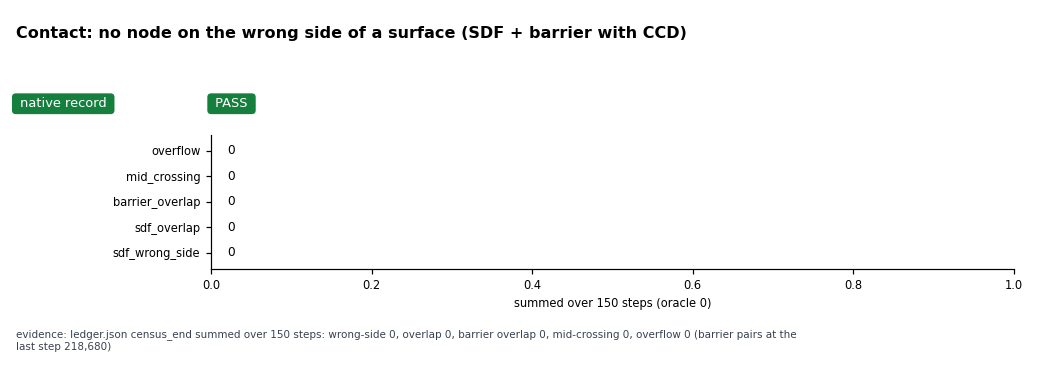
- Native record b496c1527 (150 steps): wrong side 0, overlap 0, mid-crossing 0 at every step.
Force-accepted record; the scope of self-contact and filament–filament exclusion is an open PI decision.
Where it lives in the code
aleph/physics/contact_geometry.pyaleph/physics/joint_constraint.pyaleph/physics/contact_linear.pyaleph/physics/contact_current_rows.pyaleph/physics/contact_recurrence.pyaleph/physics/contact_row_identity.pyaleph/physics/contact_saddle.pyaleph/physics/neighbor_geometry.py
Inputs
| Input | Value | Tag | Source |
|---|---|---|---|
contact.barrier.headroom | 2.0 1 | example | pair capacity as a multiple of the pair count at build (build_barrier headroom >= 1): 2 lets the listed pairs double between rebuilds before the… moredevice overflow flag asks for a rebuild. An allocation margin, not physics |
contact.barrier.safety | 0.9 1 | example | the additive-CCD fraction c of the pairwise barrier (build_barrier safety in (0, 1)): a listed pair keeps (1 - c) of its gap beyond xi per iteration.… moreNUMERICAL CHOICE, not a physical parameter (PI 2026-09-24 09:05, contact Q2): it sets how many iterations a closing pair takes, never the barrier law or where contact holds; 0.9 is the same fraction as contact.sdf.eta. Method source: additive CCD (Li, Kaufman, Jiang 2021, Codimensional Incremental Potential Contact, ACM TOG 40(4)) — NOT in the KB (no row names it, checked 2026-09-24) and the paper's own value is not checked here; registration goes through the KB procedure, not this file |
contact.barrier.parallel_eps | 1e-12 1 | numerical | barrier._PAR_EPS: det <= eps |u|^2|v|^2 treated as parallel edges / sliver (exact at its boundary minimum) |
contact.barrier.coincident | 1e-09 um | numerical | barrier._COINCIDENT_UM: tie band of the start census (1e5 x roundoff of a 10 um coordinate) |
contact.barrier.jacobi_sweeps | 10 1 | numerical | barrier_term._JACOBI_SWEEPS: fixed Jacobi rotations of the 5x5 factor (converged in ~6) |
contact.d_hat | 0.005 um | example | start margin delta = d_hat, PI 2026-09-23 21:24; EXAMPLE. Numerical, not biological: the barrier activation distance of the energy core's contact… moreterms (aleph/physics/energy/sdf.py, barrier.py) and the margin every builder places beyond contact, so the built cell carries zero barrier energy. Present = the builders place against the BUILT surface meshes (aleph/cell/build/clearance.py) and assemble refuses a node short of exclusion radius + half-thickness + d_hat. |
contact.kappa | 16760.0 pN/um | example | barrier stiffness of b(d) = -kappa (d - d_hat)^2 ln(d/d_hat) (energy/sdf.py, energy/barrier.py). It pushes back with |b'(d_hat/2)| = kappa d_hat (ln… more2 + 1/2), so kappa = F_hold / (d_hat (ln 2 + 1/2)) holds F_hold at half the activation distance: F_hold = 100 pN is a number stated here, not a row (the order of the largest bond force of the lane build, as the Lead gave it 2026-09-24 00:2x; not re-measured), and d_hat = contact.d_hat 0.005 um give 1.676e4. A VALUE computed at authoring time (PI 2026-09-29 decision 12: kept valued). Re-compute when contact.d_hat or F_hold changes. Numerical, not in KB source_audit |
contact.sdf.eta | 0.9 1 | example | the SDF line-search fraction (SdfParams.eta in (0, 1)): in one line search a node-face pair may close at most eta of its gap at the line search's… moreSTART (the swept-CCD floor is (1 - eta) gap(0), so 0.9 leaves 10 %), however many advances the bound takes (C3 39c6161b8). NUMERICAL CHOICE, not a physical parameter (PI 2026-09-24 09:05, contact Q2): it sets how far one line search may advance toward a face — how many iterations contact takes, never the contact law or where contact holds. The same fraction as contact.barrier.safety, so both contact terms leave the same share of a gap per line search. Method source: additive CCD (Li, Kaufman, Jiang 2021, Codimensional Incremental Potential Contact, ACM TOG 40(4)) — NOT in the KB (no row names it, checked 2026-09-24); registration goes through the KB procedure, not this file |
contact.sdf.refit_every | 1 1 | example | solver iterations between SDF refreshes (SdfParams.refit_every >= 1). 1 = the budgets and the closest faces are rebuilt every Newton iteration: the… moretightest and costliest choice; a larger value trades face hand-over latency for fewer BVH refits. Numerical |
contact.sdf.ccd_iters | 8 1 | numerical | SdfTerm ccd_iters default: additive-CCD bound evaluations per pair |
contact.sdf.history | 256 1 | numerical | SdfTerm history default: records kept |
contact.sdf.lazy_repair_rounds | 8 1 | numerical | sdf.LAZY_REPAIR_ROUNDS: lazy limit-repair rounds per limit call (cap counted when reached) |
contact.sdf.trial_cap | 4096 1 | numerical | sdf.TRIAL_CAP: most candidate faces one trial query visits; beyond it the trial is INVALID (+inf) |
contact.freebody.local_pad_rel | 9.5367431640625e-07 1 | numerical | freebody._surface_exact (LOCAL-1013): relative slack 2^-20 of the float32 query box that bounds which faces the exact float64 check visits, on the… moresum (max |coordinate| + |p| + reach). The float32 roundings it must cover (each surface vertex, the query point, the half-width, the two box corners) total <= 2^-23 of that sum (IEEE-754 binary32 half-ulp 2^-24 each); 2^-20 is 8x that. Lower bound of the range = 2^-22 (2x). Not physics: a larger value only visits more faces, the verdict is unchanged. Comparison arm (the pre-LOCAL-1013 cost): 1.0e9 makes the box cover every face of the wall — the all-faces visit and the all-faces minimum distance; the side stays the pseudonormal rule (the summed-solid-angle rule itself is at the base SHA only) |
contact.freebody.max_reflect | 64 1 | numerical | freebody.MAX_REFLECT: reflections before a point is counted unresolved |
contact.strand_clearance.enabled | 0 1 | numerical | strand-contact-1009 (Lead/PI AUTO-1009-ALL 2026-10-10, decision 2): 1 = the build's strand-strand clearance pass… more(cell/build/clearance.clear_strand_pairs) moves every non-exempt pair of strand capsules out of xi before the world is made, and the crosslinker centres clear of strands and each other before their arms are drawn. A declared build arm, default 0 = the build as before; once on, ContactScope.start_guard returns for the universal launches. F9-1013: the pass now ends with 0 strand pairs inside xi and the surface check passing on C02, P05 AND U1 (host), but the row stays 0: on a whole-cell build it pushes the DECLARED bundles apart too (their filament spacing lies inside the xi + d_hat it clears to: the coarse cell's filopodium then occupies no bundle relation), and two placements after it put pairs back inside xi (bound NMII heads; crosslinker centres drawn near the filaments) — see ALL_ON.toml |
contact.strand_clearance.max_rounds | 40 1 | numerical | clearance.clear_strand_pairs: Jacobi push rounds before the pass stops and REPORTS the pairs still short (never a density change); the surface pass's… moreown cap (clear_segments max_rounds 40) |
contact.strand_clearance.combine_sweeps | 3 1 | numerical | clearance._combine (F9-1013): Kaczmarz sweeps over a node's asks (its short pairs' shares, its near pairs' slack shares) in one push round. Not… morephysics: more sweeps only bring a node's displacement closer to the point that meets all its asks. Measured on the U1 host build (119,932 short pairs, 56,787 inside xi at the start, 40 rounds): 2 sweeps leave 2 pairs inside xi, 3 leave 0; the mean it replaces left 1,062 |
contact.strand_clearance.release_gap_rel | 0.5 1 | numerical | assemble.build_tables / clearance.clear_strand_pairs (F9-1013): a strand pair closer than xi + this x contact.d_hat after a cycle is CLOSE — the… morebuild runs another cycle, and that cycle's release pass pushes exactly the close pairs out to xi + d_hat. 0 = only the pairs inside xi (the start guard's count). Above 0 because a pair a hair outside xi is no start either: the log barrier's force is kappa (2 x ln(e/d_hat) + x^2/e), x = e - d_hat, i.e. 1.19 kappa d_hat at e = d_hat/2 and growing as 1/e below (12 kappa d_hat at d_hat/10; the first U1 build that reached 0 inside xi left one pair at e < 5e-4 nm). 0.5 = the lower half of the band, a convention, not fitted to a count; SWEPT-able: 1.0 releases every in-band pair (and gives up keeping their chords) |
contact.strand_clearance.max_cycles | 4 1 | numerical | assemble.build_tables (F9-1013; was the literal 2): cycles of (strand pass, whole surface pass, census) before the build goes on with what is left;… morecycle 0 keeps every chord and junction distance, later cycles release the close pairs (release_gap_rel); a cycle is the last once no pair is close after the surface pass. C02, P05 host builds end in cycle 0, U1 in cycle 1; what is left after the cap is REPORTED (STRAND_REPORT overlap_after_surfaces) and the universal launches' start census then records it or refuses (CoreOptions.start_overlaps) |
contact.universal.bond_exempt_band | 0 1 | numerical | MOTOR2-1014 (2026-10-14): the universal contact's BOND exemption rule (energy/barrier.py _exempt, universal_pairs_np), a declared arm. 0 = today: a… morenode pair joined by a live relation is exempt only when the relation's rest is below the pair's xi. 1 = below xi + contact.d_hat, the bound the contour rule already uses: a relation resting inside the barrier's activation band can never sit at its rest while the pair is listed (the barrier is active there and +inf at xi), so contact holds it in tension at every step. Found by the MOTOR-1014 stroke twin: the crossbridge rests at r_md + r_actin = xi by derivation and the barrier pushes it to ~11.7 nm (d - xi ~ 0.9 d_hat). Excluding bonded 1-2 pairs from the non-bonded excluded volume is the molecular-dynamics convention. With 1, a bound tip's distance from its own actin segment is the relation's and the head's angle laws' (law 6, nmii.md_actin_radial_k_theta, holds it radial; without law 6 the tip pivots about its site at zero energy), every OTHER actin segment stays a pair. A rule, not a fitted number |
Experiments
None yet.