Evidence

What has actually been checked

Each check starts with a question, then shows the recorded observation and the conclusion it supports.

30 September recordings

New scenes are available

Solids, water, motors and cell instruments were recorded again with thermal kicks off. Their run conditions and scoring status stay attached.

Physical evidence

Full-cell verification remains open

The pinned ledger marks 0 laws verified from their own full-cell observable. A successful isolated test does not establish the whole cell’s behaviour.

Start here

Read the question before the plot.

A check compares one recorded quantity with one declared expectation. Its result applies to that record and that comparison.

  1. 1 · What was measured?Choose a question. Check whether it used a full cell, a small cell or an isolated device test.
  2. 2 · What was it compared with?Read the axis guide and the expected value or band. A result card without axes is a saved statement.
  3. 3 · What follows from it?Read the conclusion and its limit together. Matching one check does not verify the whole cell.
11 matched this check3 mixed2 did not match2 reported only

18 recorded checks

Surfaces & contact

Do boundaries contain the cell, and what do the remaining forces mean?
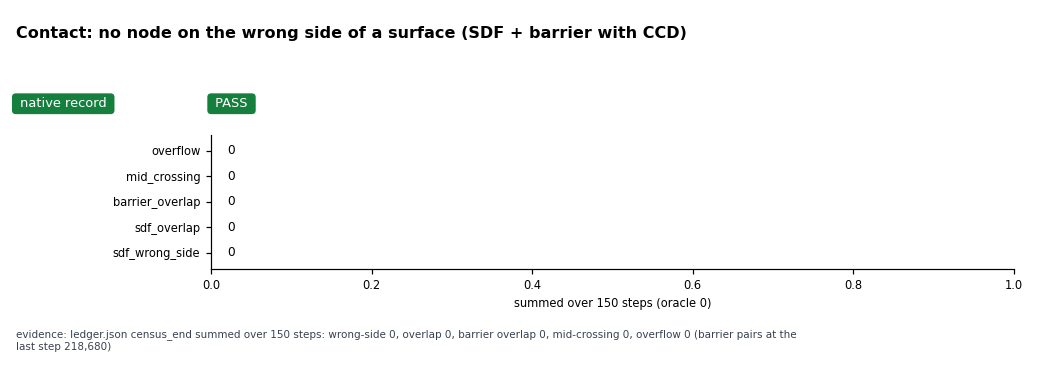
Did the full cell stay on the correct side of its surfaces?The saved containment census reports no wrong-side nodes or overlap. The steps were still force-accepted.Full-cell recordMatched this check
What is checked
Count boundary violations
Read the axes
Horizontal: number of events, summed over 150 saved steps. Vertical: five kinds of containment diagnostic.
What to compare
Every count should be zero. The short horizontal scale is a count axis, not time.
Horizontal: number of events, summed over 150 saved steps. Vertical: five kinds of containment diagnostic.
Original plot · Open full size ↗

What this does not establishZero recorded violations does not establish force convergence. These steps were force-accepted.
Exact comparison, record and original figure
Original verdict
PASS
Recorded question
Contact: no node on the wrong side of a surface (SDF + barrier with CCD)
Observable
per-step census at the step's end: SDF wrong-side / overlap, barrier overlap / mid-crossing / overflow
Declared expectation
0 at every step (the PREREG's R2)
Record
qs_long_bt_nogrowth_20260925_040000_b496c1527 (b496c1527, 4090_1, 150 steps, FORCE-ACCEPTED)
Stored result
ledger.json census_end summed over 150 steps: wrong-side 0, overlap 0, barrier overlap 0, mid-crossing 0, overflow 0 (barrier pairs at the last step 218,680)
Source note
C3's frame audit of the same record (ACTIVE_SESSIONS 10:2x): 17 frames, 0 wrong-side / 0 below need in every frame
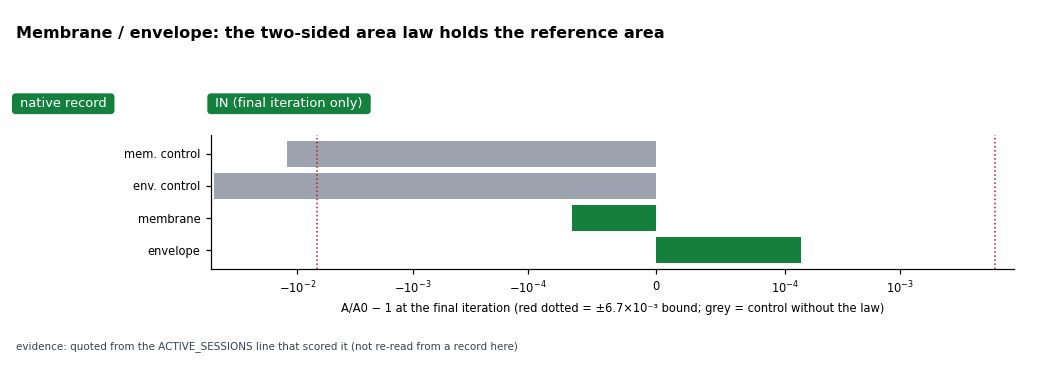
Did the surfaces retain their reference area?The final iteration lay inside the declared area bound. Earlier iterations were not scored.Full-cell recordMatched this check
What is checked
Compare surface area with its reference
Read the axes
Horizontal: relative area change A/A₀ − 1, with signed logarithmic ticks. Vertical: membrane and envelope, with and without the area law.
What to compare
The red dotted lines mark ±6.7 × 10⁻³. Grey bars are the control without the law.
Horizontal: relative area change A/A₀ − 1, with signed logarithmic ticks. Vertical: membrane and envelope, with and without the area law.
Original plot · Open full size ↗

What this does not establishOnly the final Newton iteration was scored. This page retains the reported result, not a new reading of its raw record.
Exact comparison, record and original figure
Original verdict
IN (final iteration only)
Recorded question
Membrane / envelope: the two-sided area law holds the reference area
Observable
A/A0 − 1 at the final Newton iteration (membrane, envelope)
Declared expectation
|A/A0 − 1| ≤ 6.7×10⁻³ (the PREREG's bound); control run without the law for contrast
Record
qs_passive_300_arealaw (75dfe969c) vs its control (native passive)
Stored result
quoted from the ACTIVE_SESSIONS line that scored it (not re-read from a record here)
Source note
ACTIVE_SESSIONS (PREREG 4b7be72c0 scored): P2 IN at final iteration only (envelope +1.38e-4 vs control −5.27e-2; membrane −6.6e-5 vs −1.23e-2; every-iteration unscored)
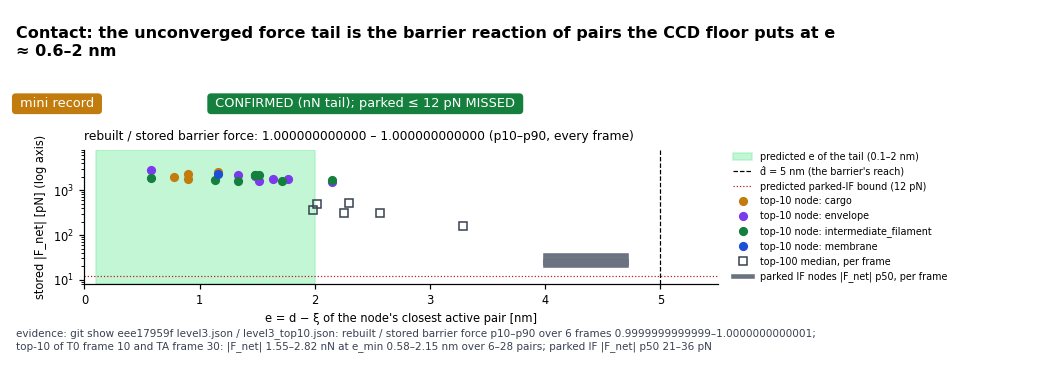
What caused the large remaining contact forces?Reconstructed pair forces explained the large force tail. A second bound for the parked nodes was missed.Small-cell recordMixed result
What is checked
Explain the remaining contact force
Read the axes
Horizontal: closest active-pair gap in nm. Vertical: stored net force in pN, on a logarithmic scale.
What to compare
The green region is the predicted gap range. The red line is the separate 12 pN bound for parked nodes.
Horizontal: closest active-pair gap in nm. Vertical: stored net force in pN, on a logarithmic scale.
Original plot · Open full size ↗

What this does not establishThe large force tail was explained, but parked-node forces missed their bound. Explanation of a residual is not convergence.

Exact comparison, record and original figure
Original verdict
CONFIRMED (nN tail); parked ≤ 12 pN MISSED
Recorded question
Contact: the unconverged force tail is the barrier reaction of pairs the CCD floor puts at e ≈ 0.6–2 nm
Observable
per top-|F| node: the barrier force rebuilt from its active pairs vs the stored BarrierTerm force; its closest pair's e = d − ξ; |F_net| of the IF nodes parked at e ≈ 4.0–4.7 nm
Declared expectation
the Lead's 17:3x PREREG (from the mentor): tail at e 0.1–2 nm with |F| = Σ of its pair forces; parked IF nodes ≤ 12 pN
Record
qs_thermal_{T0,TA}_20260925_041555_abda8c441 (mini, FORCE-ACCEPTED), frames 10 / 30 / 60 — host analysis of the stored device fields (C3 eee17959f, force_tail_decomposition_20260925 level 3)
Stored result
git show eee17959f level3.json / level3_top10.json: rebuilt / stored barrier force p10–p90 over 6 frames 0.9999999999999–1.0000000000001; top-10 of T0 frame 10 and TA frame 30: |F_net| 1.55–2.82 nN at e_min 0.58–2.15 nm over 6–28 pairs; parked IF |F_net| p50 21–36 pN
Source note
ACTIVE_SESSIONS 17:4x: "the CCD-floor mechanism CONFIRMED for the nN tail"; amendment: the parked nodes carry |F_net| p50 21–36 pN — the queue, an order below the tail, but not ≤ 12 pN. The η = 0.5 arm (VESSL) tests the fix direction.
Was the surface-contact check directly confirmed?A pass was inferred from a quiet log. The archive does not provide a direct scored observation here.Device testReported only
What is checked
Check surface self-contact
Read the saved statement
This original is a written result, with no plotted axes. Read the exact observation in the record below.
What to compare
The comparison was with the host mirror. The reported pass was inferred from the surrounding test log.

What this does not establishThere is no direct scored observation for this check in the exported record.

Exact comparison, record and original figure
Original verdict
PASS (by elimination: the log is quiet)
Recorded question
Contact: surface self-contact (k = 1 derived on a sphere; CCD bounds a closing fold)
Observable
test_surface_contact's two CUDA cases
Declared expectation
the host mirror
Record
mini_surf gate at ca69da34a (4090_1)
Stored result
log 050400 mini_surf gate (ca69da34a): "1 failed, 223 passed, 1 deselected in 312.12s (0:05:12)"
Source note
the gate's only failure was test_barrier's inverted-face test, WAIVED by the PI at 17:0x

Water & volume

Does the recorded flow meet its declared comparison?
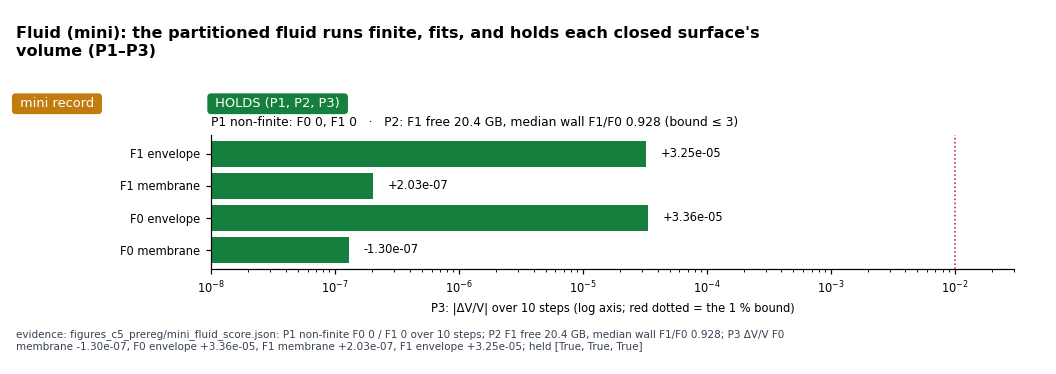
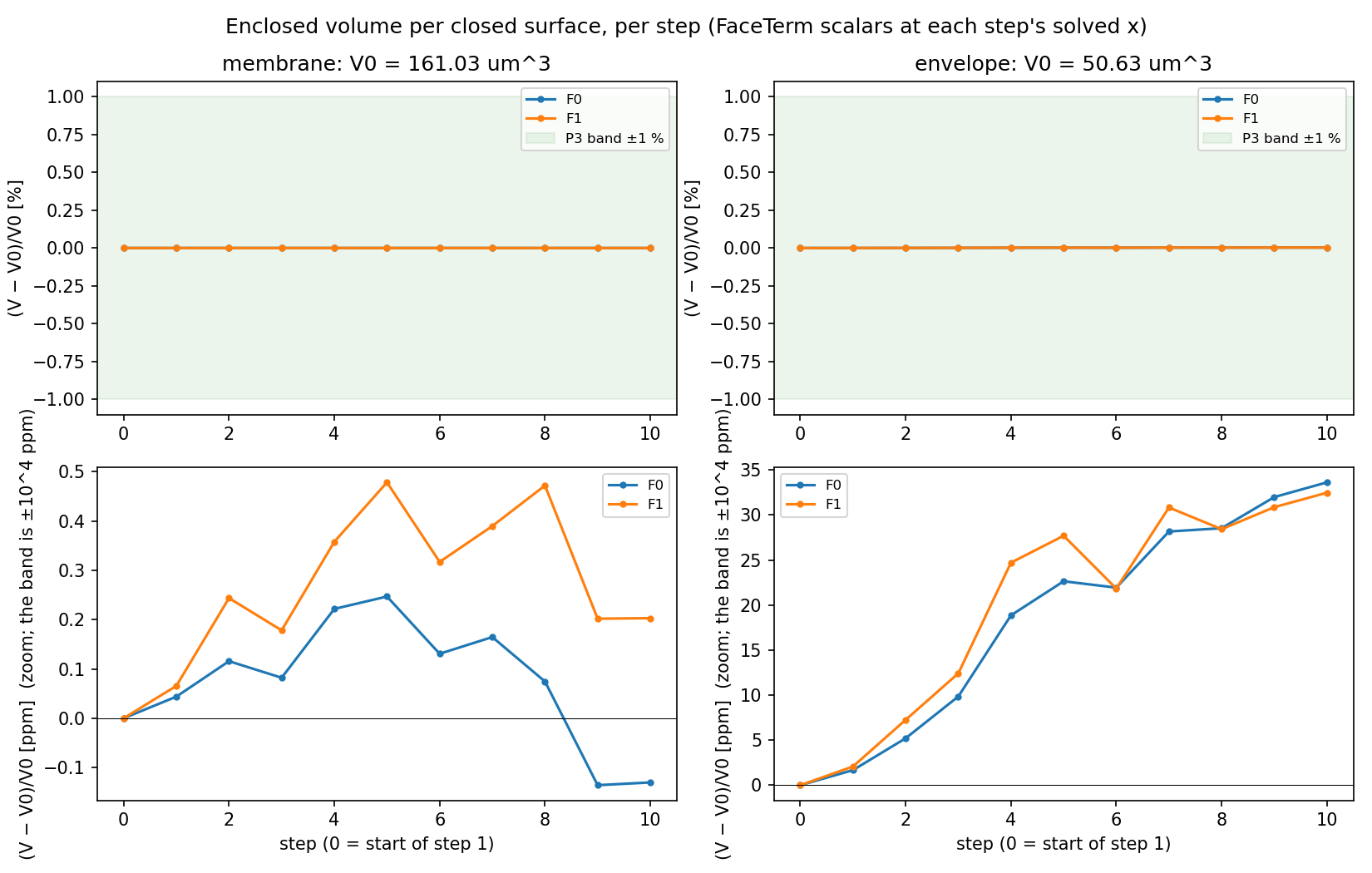
Did the fluid path run and preserve the closed volumes?The three declared development checks held in the small-cell record. This is not a full-cell fluid-law result.Small-cell recordMatched this check
What is checked
Check fluid execution and volume drift
Read the axes
Horizontal: absolute relative volume change |ΔV/V|, logarithmic. Vertical: membrane or envelope with fluid off (F0) or on (F1).
What to compare
The red dotted line is the 1% bound. The text above the bars separately reports finite values, memory and runtime.
Horizontal: absolute relative volume change |ΔV/V|, logarithmic. Vertical: membrane or envelope with fluid off (F0) or on (F1).
Original plot · Open full size ↗

What this does not establishTen force-accepted steps in a small cell check implementation behaviour, not the full cell's fluid law.

Exact comparison, record and original figure
Original verdict
HOLDS (P1, P2, P3)
Recorded question
Fluid (mini): the partitioned fluid runs finite, fits, and holds each closed surface's volume (P1–P3)
Observable
P1 non-finite values per step; P2 free device memory and median step wall, fluid ON vs OFF; P3 relative volume change of each closed surface over 10 steps
Declared expectation
P1 0; P2 free ≥ 0.2 GB and median wall F1 ≤ 3 × F0; P3 |ΔV/V| ≤ 1 % (C5's PREREG, amendment 1)
Record
qs_mini_fluid_F0 (fluid off) and _F1 (partitioned, float64) _20260925_050300_2c6d6ab1c (mini, 3090, 10 steps × 10 Newton, every step FORCE-ACCEPTED: step-end force 2.6–10.4 kN)
Stored result
figures_c5_prereg/mini_fluid_score.json: P1 non-finite F0 0 / F1 0 over 10 steps; P2 F1 free 20.4 GB, median wall F1/F0 0.928; P3 ΔV/V F0 membrane -1.30e-07, F0 envelope +3.36e-05, F1 membrane +2.03e-07, F1 envelope +3.25e-05; held [True, True, True]
Source note
C5's scorer (figures_c5_prereg/mini_fluid_score.py, archived beside the record): held true for P1, P2 and P3; a development check of the fluid path on the mini, not a fluid law's number
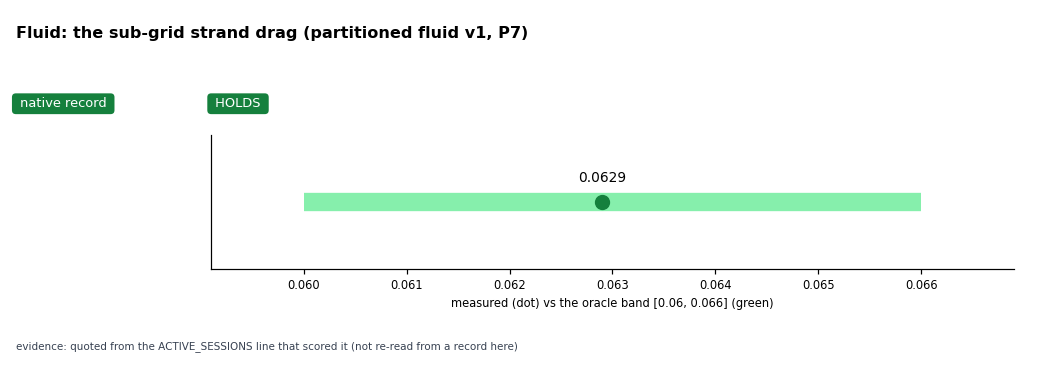
Did unresolved strands add the expected fluid drag?The stored comparison was reported to hold for this fluid implementation.Full-cell recordMatched this check
What is checked
Compare strand drag with the declared band
Read the axes
Horizontal: the reported strand-drag coefficient. This archived figure does not state its unit. There is no second measured axis.
What to compare
The dot is 0.0629; the green interval is [0.060, 0.066].
Horizontal: the reported strand-drag coefficient. This archived figure does not state its unit. There is no second measured axis.
Original plot · Open full size ↗

What this does not establishThe score is quoted from a saved session statement. Its raw observation was not re-read for this page.
Exact comparison, record and original figure
Original verdict
HOLDS
Recorded question
Fluid: the sub-grid strand drag (partitioned fluid v1, P7)
Observable
the strand drag coefficient read from the native fluid arm
Declared expectation
∈ [0.060, 0.066] (Q-F1 PREREG)
Record
qs_fluid_A1 (native, fluid ON, 4732ede50)
Stored result
quoted from the ACTIVE_SESSIONS line that scored it (not re-read from a record here)
Source note
ACTIVE_SESSIONS 07:3x: "strand 0.0629 ∈ [0.060, 0.066]" (P7 HOLDS)
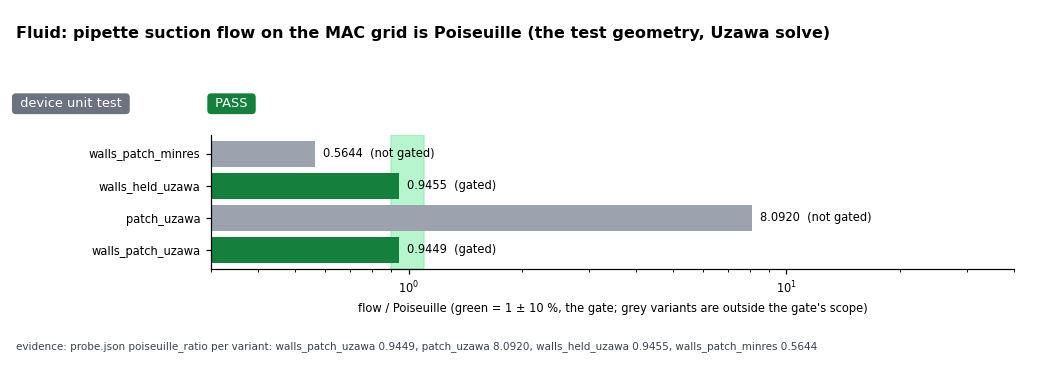
Did flow through the test pipette match its reference profile?The device unit test passed for the declared test geometry.Device testMatched this check
What is checked
Compare pipette flow with Poiseuille flow
Read the axes
Horizontal: recorded flow divided by reference flow, on a logarithmic scale. Vertical: four solver and boundary variants.
What to compare
The green band is 1 ± 10%. Only the two green variants belong to the declared gate; grey variants were outside its scope.
Horizontal: recorded flow divided by reference flow, on a logarithmic scale. Vertical: four solver and boundary variants.
Original plot · Open full size ↗

What this does not establishThis is an isolated device geometry, not a cell aspiration result. A separate residual prediction was missed.

Exact comparison, record and original figure
Original verdict
PASS
Recorded question
Fluid: pipette suction flow on the MAC grid is Poiseuille (the test geometry, Uzawa solve)
Observable
flow through the pipette / the Poiseuille flow at the same pressure drop
Declared expectation
1 ± 10 % for the gated variants (walls + patch, walls held)
Record
qs_pipette_probe_fix_20260925_042000_bdb14d334 (device probe; 39 passed / 0 failed in its gate)
Stored result
probe.json poiseuille_ratio per variant: walls_patch_uzawa 0.9449, patch_uzawa 8.0920, walls_held_uzawa 0.9455, walls_patch_minres 0.5644
Source note
ACTIVE_SESSIONS 09:5x / 10:2x: the Poiseuille ±10 % gate PASSED; the logged masked-residual prediction MISSED (2.331e-9, 23× over); NOT the cell's default fluid path
Did the fluid fix restore motion and the expected volume?The solver freeze was fixed; the volume check still failed.Device testMixed result
What is checked
Separate a solver fix from a volume result
Read the saved statement
This original is a written result, with no plotted axes. Read the exact observation in the record below.
What to compare
The solver movement criterion was β₁² > 0. Volume was compared separately with its expected equilibrium change.

What this does not establishRemoving the freeze did not make the volume check pass. Both outcomes remain attached to this record.

Exact comparison, record and original figure
Original verdict
freeze FIXED; volume hold FAILED
Recorded question
Fluid (monolithic): the net-flux row (Fix B) — the saddle's MINRES no longer freezes
Observable
β₁² per Newton (>0 = the solve moves); t5 volume change vs its equilibrium
Declared expectation
β₁² > 0 every solve; volume at equilibrium
Record
qs_mono_flux_20260925_050051_3fd9365bc (device probe); test_monolithic_flux_row 8/8 at 5e015c08e
Stored result
log 050051 mono_flux_probe: "volume change +8.939e-03, node normal rms 4.994e-02 um, beta1^2 per Newton [104435.09494514052, 65067.56477066678, 65437"; log 042043 mono_flux gate: "==== 1 failed, 32 passed, 1 deselected, 102 warnings in 3124.49s (0:52"
Source note
ACTIVE_SESSIONS 15:5x / 17:1x: "the freeze is fixed (β₁² > 0 in every solve, was −2.74e5)"; "t5_flux +0.89 % vs equilibrium +1.00 %" (FAILED)
Did the wall correction and osmotic response match their predictions?The device tests falsified these two expectations for that implementation.Device testDid not match
What is checked
Compare wall drag and osmotic volume
Read the saved statement
This original is a written result, with no plotted axes. Read the exact observation in the record below.
What to compare
The wall-drag residual was compared with 2%; the impermeable case required zero volume change.

What this does not establishBoth expectations were falsified for that implementation. The crashed T4 probe supplied no result.

Exact comparison, record and original figure
Original verdict
FALSIFIED
Recorded question
Fluid T3 (Haberman–Sayre wall correction) and osmotic T5
Observable
fit residual of the wall-corrected drag; volume change at Lp = 0
Declared expectation
residual ≤ 2 %; ΔV = 0 at Lp = 0
Record
mono_t345 (device probes)
Stored result
quoted from the ACTIVE_SESSIONS line that scored it (not re-read from a record here)
Source note
ACTIVE_SESSIONS: T3 "fit residual 3.5 % > 2 %"; T5 "volume change 1.4 % with Lp = 0" (the freeze); T4 crashed, no record

Binding & release

Are occupancy and release events consistent with the stated rules?
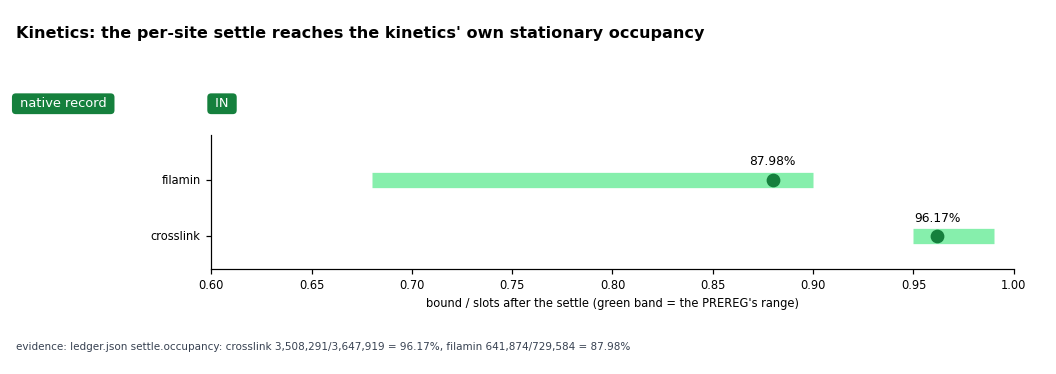
Did the linkers reach the expected occupancy?The recorded crosslink and filamin occupancy fell inside the declared bands.Full-cell recordMatched this check
What is checked
Compare the fraction of occupied sites
Read the axes
Horizontal: bound links divided by available slots. Vertical: filamin and crosslink site kinds.
What to compare
Dots are recorded occupancy; green bands are the declared stationary ranges. The axis starts at 0.60.
Horizontal: bound links divided by available slots. Vertical: filamin and crosslink site kinds.
Original plot · Open full size ↗

What this does not establishThis compares with the kinetics' own stationary occupancy. It is not an independent measurement of living-cell occupancy.

Exact comparison, record and original figure
Original verdict
IN
Recorded question
Kinetics: the per-site settle reaches the kinetics' own stationary occupancy
Observable
bound / slots after the device settle, per site kind
Declared expectation
crosslink ∈ [95, 99] %, filamin ∈ [68, 90] % (C2's settle PREREG, 19:04 09-24)
Record
qs_active_long_20260924_211051_ece70d947 (native; predates the crossbridge fix, which does not touch these kinds)
Stored result
ledger.json settle.occupancy: crosslink 3,508,291/3,647,919 = 96.17%, filamin 641,874/729,584 = 87.98%
Source note
ACTIVE_SESSIONS 01:0x 09-25: "crosslink … 96.17 % ∈ [95, 99] — IN", "filamin 87.98 % ∈ [68, 90] — IN"
Could more than one linker occupy the same site?The small-cell check passed for one-linker-per-site attachment.Small-cell recordMatched this check
What is checked
Count multiply occupied sites
Read the saved statement
This original is a written result, with no plotted axes. Read the exact observation in the record below.
What to compare
The expected count was zero sites with more than one linker of a group, in every saved frame.

What this does not establishThis is a reported small-cell attachment check, not full-cell kinetic calibration.

Exact comparison, record and original figure
Original verdict
PASS
Recorded question
Kinetics: one linker per site (per-site attach, #98)
Observable
sites holding more than one linker of a site group, every saved frame
Declared expectation
0
Record
mini_A (4ca576e91), 20 frames
Stored result
quoted from the ACTIVE_SESSIONS line that scored it (not re-read from a record here)
Source note
ACTIVE_SESSIONS 03:2x: "K3 PASS (0 sites with > 1 linker per group, every frame)"
Did linker release follow the expected rate?A release histogram was reported. See the saved statement for its scope.Small-cell recordReported only
What is checked
Compare release events with the expected rate
Read the saved statement
This original is a written result, with no plotted axes. Read the exact observation in the record below.
What to compare
The statement reports observed / expected release events by kind; it does not include a scored histogram here.

What this does not establishReported only for this noisy run. The crossbridge result came from the defective build and must not be treated as motor validation.

Exact comparison, record and original figure
Original verdict
REPORTED
Recorded question
Kinetics: the off-event histogram against the fire's expected off-rate (K1a)
Observable
observed / expected off events, per kind
Declared expectation
reported only (noise on; scored on T0 only)
Record
mini_A (4ca576e91; crossbridge's 2.0 is the defective build)
Stored result
quoted from the ACTIVE_SESSIONS line that scored it (not re-read from a record here)
Source note
ACTIVE_SESSIONS 03:2x: crosslink 1.035 (35/37 in 3σ), filamin 1.032

Thermal motion

Do stochastic motion and boundary handling behave as expected?

Did a diffusing bead remain inside its reflecting boundary?The device check passed after the recorded fix.Device testMatched this check
What is checked
Check a bead's reflecting boundary
Read the saved statement
This original is a written result, with no plotted axes. Read the exact observation in the record below.
What to compare
The check counts unresolved reflections and boundary violations; both should be zero.

What this does not establishThe recorded fix passed this device check. It does not by itself measure the bead's diffusion coefficient.
Exact comparison, record and original figure
Original verdict
PASS (after the fix abda8c441)
Recorded question
Free bodies (cargo): a free bead's Brownian step with reflection stays contained
Observable
free beads reflected / unresolved; containment census after the step
Declared expectation
unresolved 0, containment 0
Record
thermal_ab gate at abda8c441 (the first run at 2f812380b FAILED: a bead ended on the wrong side, sdf.bad 16)
Stored result
log 20260925_041555 thermal_ab: "[freebody gate] free-bodies ON: {'candidates': 1400, 'free': 1400, 'reflected': 199, 'unresolved': 0, 'not_clear': 0} containment {'bad': [0, 0], 'by_"; "216 passed, 1 deselected in 399.12s (0:0"
Source note
mini record thermal_ab (ACTIVE_SESSIONS 16:3x): S2 PASS, unresolved 0 every step
Did collective diffusion match the thermal prediction?The scored small-cell check failed.Small-cell recordDid not match
What is checked
Compare collective diffusion with thermal theory
Read the axes
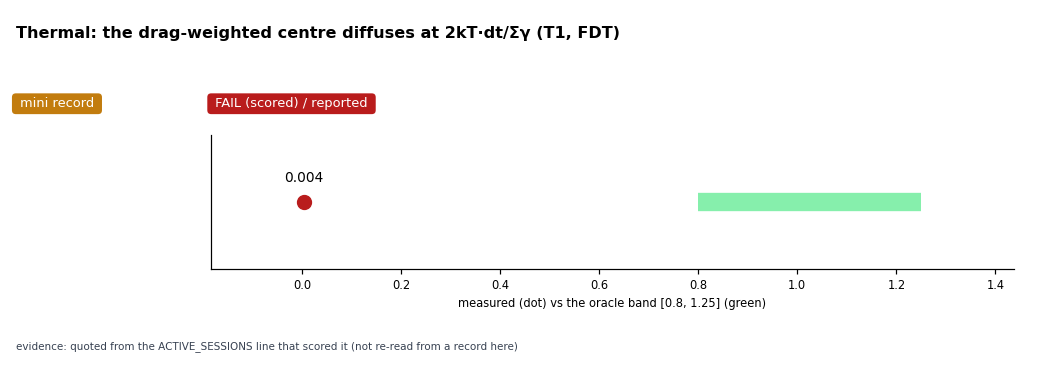
Horizontal: observed centre-displacement variance divided by 2kT·Δt/Σγ. There is no second measured axis.
What to compare
The green interval is [0.8, 1.25]. The scored dot is 0.004, far below the expected range.
Horizontal: observed centre-displacement variance divided by 2kT·Δt/Σγ. There is no second measured axis.
Original plot · Open full size ↗

What this does not establishThe scored small-cell build was defective. Later reported values are not a replacement scored pass.

Exact comparison, record and original figure
Original verdict
FAIL (scored) / reported
Recorded question
Thermal: the drag-weighted centre diffuses at 2kT·dt/Σγ (T1, FDT)
Observable
Var(ΔX_centre) / (2kT·dt/Σγ)
Declared expectation
∈ [0.8, 1.25]
Record
mini_A (4ca576e91, defective build) scored; thermal_ab arms reported only
Stored result
quoted from the ACTIVE_SESSIONS line that scored it (not re-read from a record here)
Source note
ACTIVE_SESSIONS 03:2x: "T1 FAIL 0.004 vs [0.8, 1.25] — the α cap … not the thermal law"; thermal_ab: T1 0.002–0.009, reported not scored
Did the fluid thermal-forcing tests pass?61 tests passed and 3 failed in this recorded batch.Device testMixed result
What is checked
Separate passing thermal tests from failures
Read the saved statement
This original is a written result, with no plotted axes. Read the exact observation in the record below.
What to compare
The test batch uses each test's declared bound; it has no single shared horizontal or vertical axis.

What this does not establish61 tests passed and 3 failed. Passing covariance and drift tests does not establish thermal forcing in a full cell.

Exact comparison, record and original figure
Original verdict
61 passed / 3 failed
Recorded question
Fluid thermal forcing (monolithic stage 3): Landau–Lifshitz stress, RFD drift
Observable
device vs host factor on probes; forcing covariance; drift
Declared expectation
per-test declared bounds
Record
stage3_tests at fa831cedc (4090_1)
Stored result
log 035956 stage3_tests: "============ 3 failed, 61 passed, 97 warnings in 363.48s (0:06:03) ============="
Source note
ACTIVE_SESSIONS 06:0x: the stress-divergence test missed its declared bound by 2.6 % (3.097e-12 vs 3.018e-12); forcing covariance and RFD drift passed; not changed after the data

Implementation checks

Do ownership, memory and solver changes preserve the intended computation?

Did moving the solver decisions onto the GPU change the answer?Seven recorded iteration traces were identical between the two implementations.Full-cell recordMatched this check
What is checked
Compare two implementations of a solve
Read the saved statement
This original is a written result, with no plotted axes. Read the exact observation in the record below.
What to compare
Seven iteration traces were compared entry by entry for 1,001 entries. The original figure is a text result, not a trajectory plot.

What this does not establishBitwise agreement checks implementation parity. It does not establish that either trajectory is physically converged.

Exact comparison, record and original figure
Original verdict
PASS
Recorded question
Solver: the device-decided projected Newton reproduces the host-decided solve (#121)
Observable
seven per-iteration traces (force, α, α_max, Π, gᵀd, CG iterations, argmax node)
Declared expectation
repr-identical (bitwise)
Record
qs_arc_A_20260925_022659_a49c73e09 vs qs_native_N0_20260925_000851_ddd24006e (native, 1,000 Newton each)
Stored result
ledger.json of arc A (a49c73e09, device-decided) vs N0 (ddd24006e, host-decided): 7 of 7 traces repr-identical over the first 1001 entries
Source note
also at mini scale (ACTIVE_SESSIONS 10:2x, #127): 121H and 121D both stop at 1,040 CONVERGED at F = 0.06742026459827428 pN — the same bits
Did the memory allocation change the final positions?The two recorded final-position arrays were identical.Full-cell recordMatched this check
What is checked
Compare final-position arrays
Read the saved statement
This original is a written result, with no plotted axes. Read the exact observation in the record below.
What to compare
The final arrays were checked for bitwise equality; the saved image reports their matching digest.

What this does not establishThis checks reproducibility when the memory rule does not bind, not agreement with an external physical measurement.
Exact comparison, record and original figure
Original verdict
PASS
Recorded question
Reproducibility: the arena fit changes nothing when it does not bind (Q-F1 R5)
Observable
the final positions of arm A1 and arm B1
Declared expectation
bit-identical
Record
qs_fluid_A1_20260925_023201_4732ede50 vs qs_fluid_B1_20260925_023200_4732ede50 (native, fluid)
Stored result
SHA-256 of pos_final.npy: A1 a1d640eb7d83aca3…, B1 a1d640eb7d83aca3… — identical
Source note
ACTIVE_SESSIONS 07:3x: "arena-fit R5 HOLDS: A1 = B1 bit for bit"
Did every motor slot belong to a motor head?All 15,408 slots in the fixed native record had the expected owner.Full-cell recordMatched this check
What is checked
Check who owns each motor slot
Read the axes
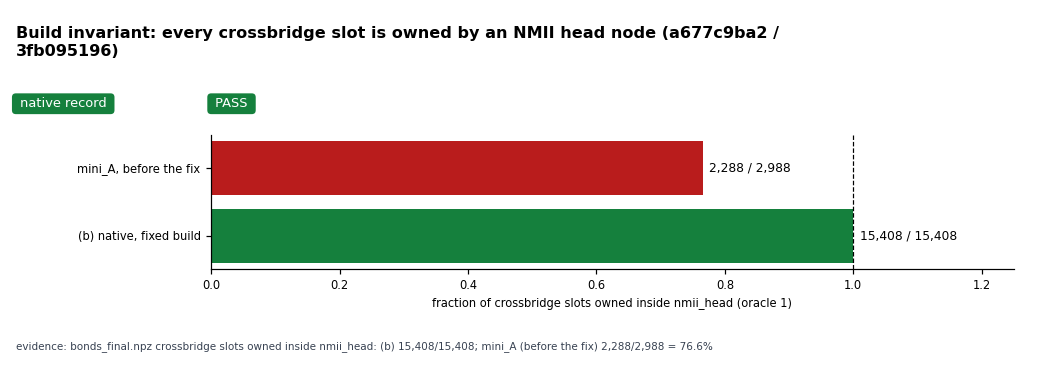
Horizontal: fraction of crossbridge slots owned by an NMII head. Vertical: the defective small build and the fixed native build.
What to compare
The dashed line is 1, meaning every slot has the expected owner. Each bar also gives its numerator and denominator.
Horizontal: fraction of crossbridge slots owned by an NMII head. Vertical: the defective small build and the fixed native build.
Original plot · Open full size ↗

What this does not establishCorrect ownership is a construction invariant. It does not validate motor forces or walking rates.

Exact comparison, record and original figure
Original verdict
PASS
Recorded question
Build invariant: every crossbridge slot is owned by an NMII head node (a677c9ba2 / 3fb095196)
Observable
the owner node of every crossbridge slot in the record's own slot table
Declared expectation
all inside ranges[nmii_head]
Record
qs_long_bt_nogrowth_20260925_040000_b496c1527 (fixed build); mini_A 4ca576e91 shown as the defect
Stored result
bonds_final.npz crossbridge slots owned inside nmii_head: (b) 15,408/15,408; mini_A (before the fix) 2,288/2,988 = 76.6%
Source note
the host test test_kind_owners.py pins it on the coarse and mini builds (host, not a device test)
Source snapshot and evidence levels

Verification ledger: aleph/docs/wiring_verified.toml at 1ce9612ba. Input snapshot: aleph/physics/engine.example.toml 4 cell row files in aleph/cell/ and aleph/inner/cortical_tension/instruments.toml, 2345 rows, 21 tagged SOURCED. This input-file population is distinct from the signed-row ledger and the parameter atlas.

  • Checked against theory on the GPU 10 laws — compared with a textbook formula in a small test scene run on the GPU
  • Checked against theory in a code test 17 laws — compared with a textbook formula in a unit test of the code
  • Built, not yet checked 14 laws — runs in the simulated cell, but nothing has yet compared its result with theory or experiment
  • Written, switched off 17 laws — the code exists but is switched off in the current cell
Earlier open-item list · retained as a historical record

This list predates the 30 September recordings. The motor force–velocity plot and microvilli recordings now exist; neither establishes full-cell observable verification. The original wording below is retained for traceability.

LawOriginal status
Bending (HingeTerm / BendingTerm)nothing scored; the only reading is ΔHinge ≈ control (a P4 MISS)
Hill force–velocity (#46)"not scorable from this run"; K2 qualitative only
Stokes–Einstein S2, wall drift S4 (monolithic)only MINRES-budget runs exist; no D̂ or density number
GUV flicker S3never run (needs a closed-surface builder)
Growth / end insertiondevice tests test_growth_contact / test_growth_driver FAILED in batches 2 and 3; (b) ran growth off
Osmotic permeation (Lp)no passing number
Membrane tensiona reading only (the law at the solved area, −9.9 → −4.8 pN/µm); per-face tension has no field
Arp2/3 branching, turnoverno device number
IF / lamina / LINC, MT aster anchoringno device number
ERM membrane–cortex linkerno device number
Kinesin / dynein v(F)no device number (K2 on mini_A reported: saturated walks)
Monolithic thermal forcing on a live celldevice unit tests only (stage 3); no cell record
Microvilli (tubes + cores)not run on a device yet; host check_tubes REFUSES: 21,475 core nodes short of their clearance (need 11.5 nm; worst margin −17.5 nm, a core node outside its tube); C1's attribution: the ring width and a tube/core shear-reference mismatch (#31); the 642de93e9 run is dropped — tonight's run carries C1's (b) and the PI's ring r/cos(π/m)